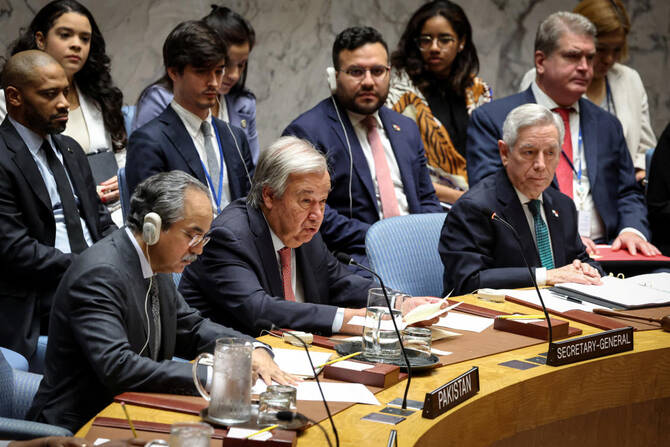

NEW YORK CITY: UN Secretary-General Antonio Guterres on Thursday condemned the worsening crisis in Gaza. He described “an endless catalog of horrors” in the territory and warned of catastrophic humanitarian consequences, as he called for immediate international action to address the situation and ensure accountability.
Guterres said civilians in Gaza were enduring “yet another deadly escalation” as Israel continues to signal plans for a military takeover of Gaza City. He called this a “new and dangerous phase” of the conflict that would have “devastating consequences,” including the displacement of hundreds of thousands of people already traumatized by months of violence.
“This must stop,” Guterres said. “Gaza is piled with rubble, piled with bodies, and piled with examples of what may be serious violations of international law.”
Citing recent airstrikes, he added that Israeli military operations have killed civilians, medical workers and journalists.
A double Israeli strike on Nasser hospital in Khan Younis killed 20 people on Monday, including health workers and journalists. At least one person was killed by the initial strike, and others in a second minutes later as rescuers and journalists rushed to the scene.
The five journalists who died worked for international media outlets, including the Associated Press, Reuters, Al Jazeera and Middle East Eye.
“These attacks are part of an endless catalog of horrors,” Guterres said. “There must be accountability.”
He also condemned Hamas and other armed groups for taking hostages and subjecting them to “atrocious treatment,” and demanded the immediate and unconditional release of all those being held.
He described the deteriorating humanitarian situation in Gaza as beyond critical, warning that famine was no longer a looming threat but “a present-day catastrophe.” He said civilians were dying from hunger, women were giving birth under extreme conditions, and essential services such as water, healthcare and food systems had been “systematically dismantled.”
“These are the facts on the ground,” he added. “And they are the result of deliberate decisions that defy basic humanity.”
As the occupying power, Guterres said, Israel has a legal obligation to ensure the population has access to food, water and medical aid. He called for the implementation of binding provisional measures issued by the International Court of Justice, including the facilitation of full and immediate humanitarian access throughout Gaza, in cooperation with the UN.
He noted that 366 UN workers have been killed since the conflict escalated, and that humanitarian efforts were being “blocked, delayed and denied” on a daily basis. “This is unacceptable,” he added.
The secretary-general also addressed the deteriorating situation in the West Bank, citing increased military operations, settler violence and discriminatory policies. He warned that a recently approved plan to expand settlements there could effectively sever the northern West
Bank from the south of the territory, posing what he described as an “existential threat” to a two-state solution.
“I repeat: the Israeli settlements in the occupied West Bank and East Jerusalem have been established, and are being maintained, in violation of international law,” Guterres said. “Israel must cease such actions and comply with its obligations.
“There is no military solution to this conflict. I appeal once again for an immediate and permanent ceasefire, unfettered humanitarian access across Gaza, and the immediate and unconditional release of all hostages.
“Starvation of the civilian population must never be used as a method of warfare. Civilians must be protected. Humanitarian access must be unimpeded. No more excuses. No more obstacles. No more lies.”