CAIRO: Israeli forces killed at least 16 Palestinians across Gaza on Thursday and wounded dozens in the south of the enclave, local health officials said, as residents reported intensified military bombardment in the suburbs of Gaza City.
The military is preparing to take Gaza City, the enclave’s largest urban center, despite international calls on Israel to reconsider this over fears that the operation would cause significant casualties and displace the roughly one million Palestinians sheltering there.
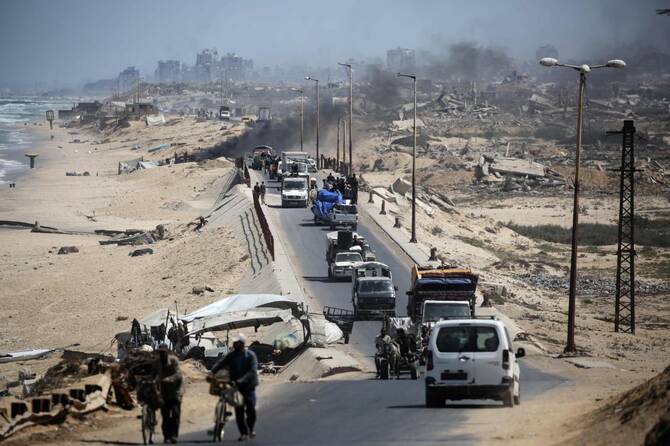
In Gaza City, residents said families were fleeing their homes, with most heading toward the coast, as Israel forces bombarded the eastern suburbs of Shejaia, Zeitoun, and Sabra. Thursday’s deaths took to 71 the number of Palestinians killed by Israeli fire in the past 24 hours, the health ministry said.
Israel officials describe Gaza City as the last stronghold of Hamas, which ignited the war with its deadly October 2023 attack on Israel. The Islamist militant group has since been decimated by Israel’s assault on Gaza.
The Israeli military said in a statement that it was continuing to operate throughout Gaza targeting what it described as “terrorist organizations” and infrastructure.
The military had killed three militants in the past day, it said, without saying how they had identified the individuals.
A spokesperson for the International Committee of the Red Cross told Reuters that 31 “weapon-wounded” patients, most with gunshot wounds, were admitted to the Red Cross Field Hospital in the southern Gaza town of Rafah. Four of them were declared dead on arrival.
“Patients said they were injured while trying to reach food distribution sites,” the spokesperson said, adding that since the food distribution sites began operations on May 27, the hospital had treated over 5,000 “weapon-wounded patients.”
Dozens of Palestinians were admitted to Nasser Hospital in nearby Khan Younis with gunshot wounds, according to a doctor there who said the military had opened fire on a crowd of Palestinians that had gathered near an aid distribution site.
Mohammad Saqer, the head of nursing, told Reuters most of the patients had been admitted with gunshot wounds to the upper parts of the body and that many were in critical condition.
The patients had reported they were shot as they sought to collect food from a distribution site in Rafah, he said.
The Israeli military had no immediate comment.
The war broke out when Hamas-led militants launched a surprise, cross-border attack on Israel on October 7, 2023, killing around 1,200 people and taking another 251 hostage. Most of the hostages have since been released through diplomatic negotiations, though 50 remain, of whom 20 are said to be alive.
Israel has not responded publicly to Hamas’ acceptance of a proposal for a ceasefire that would allow for the return of some of the hostages. Israeli officials have, however, insisted that it would only accept a deal that sees all of the hostages released and Hamas’ surrender.
Israel’s military campaign, which it says is directed toward Gaza’s rulers Hamas, has devastated the territory and displaced most of the roughly two million Palestinians there.
More than 62,000 Palestinians, most of them women and children, have been killed by the Israeli military, according to local health officials, who have not said how many combatants have been killed in the fighting.
With the enclave in the grips of a humanitarian crisis, the Gaza health ministry said on Thursday that four more people, including two children, had died of malnutrition and starvation in the enclave, raising deaths from such causes to 317 people, including 121 children, since the war started.
Israel disputes the health ministry’s fatality figures and on Wednesday asked a global hunger monitor to retract an assessment that found that Gaza City and surrounding areas are suffering from famine.


![]()

Israel steps up bombardment of Gaza City killing 16 people
Short Url
https://arab.news/2k9vm
Israel steps up bombardment of Gaza City killing 16 people
- Gunfire kills four and wounds dozens at aid distribution point in the south
- Families flee their homes in Gaza City, heading to the coast as Israeli bombardment intensifies


Latest updates


© 2026 SAUDI RESEARCH & PUBLISHING COMPANY, All Rights Reserved And subject to Terms of Use Agreement.