

Pakistan, Belarus agree to enhance counterterrorism, border security cooperation

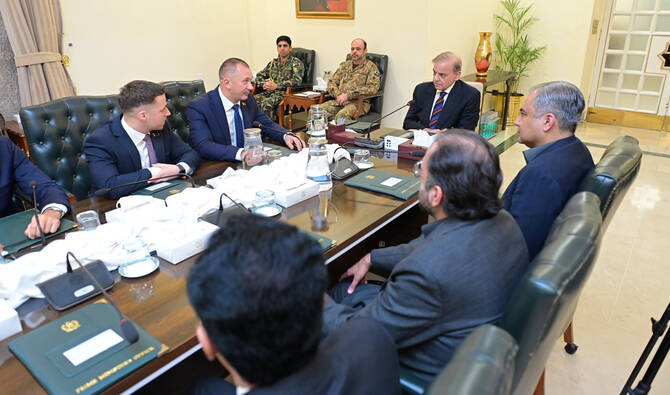
Belarus Internal Affairs Minister Ivan Kubrakov speaks during a meeting with Pakistan Prime Minister Shehbaz Sharif in Islamabad on August 27, 2025. (Handout/PMO)
Short Url
Updated 27 August 2025
Follow

Pakistan, Belarus agree to enhance counterterrorism, border security cooperation

  • Belarus Minister for Internal Affairs Ivan Kubrakov meets Pakistan PM, interior minister in Islamabad
  • Both sides finalize extradition treaty, sign MoU enabling Pakistanis to seeks jobs in Belarus, says state media

ISLAMABAD: Pakistan and Belarus agreed to enhance bilateral cooperation in counterterrorism, border security, police training and finalized an extradition treaty on Wednesday, state-run media reported as both countries eye stronger ties.

Pakistan and the Eastern European country have moved closer in recent months, with Prime Minister Shehbaz Sharif visiting Belarus in April. During his visit, Sharif held talks with Belarusian President Aleksandr Lukashenko to review progress on bilateral cooperation in various sectors.

The latest agreements between the two sides were reached during Belarusian Minister of Internal Affairs Ivan Kubrakov’s ongoing visit to Islamabad, where he met Interior Minister Mohsin Naqvi and Prime Minister Shehbaz Sharif.

“Pakistan and Belarus have agreed to enhance bilateral cooperation in counterterrorism, counter-narcotics, border security and police training,” state broadcaster Radio Pakistan reported.

This understanding was reached during Kubrakov’s meeting with Naqvi, during which both sides also finalized an extradition agreement and signed the protocol for its implementation, state media said.

Pakistan and Belarus also agreed to form a joint working group to further strengthen their bilateral ties, it added. Naqvi said Pakistan values its relations with Belarus and is keen to advance them in all fields.

“He welcomed the signing of the MoU between Belarus and Pakistan’s Ministry of Overseas Pakistanis, saying it will enable several thousand Pakistanis to go to Belarus for employment,” Radio Pakistan said.

The Belarusian minister later met Sharif, the Prime Minister’s Office (PMO) said, expressing his country’s desire to enhance cooperation with Pakistan in agriculture and industry.

Pakistan’s growing engagement with Belarus comes at a time when Islamabad seeks increasing trade and economic cooperation with landlocked Central Asian republics, Gulf allies, traditional allies and new ones.

Pakistan aims to leverage its strategic position as a key trade and transit hub to connect these nations to the global market, while earning much-needed foreign exchange.


Pakistan government confirms Imran Khan’s brief hospital visit as party renews health concerns

Updated 8 sec ago
Follow

Pakistan government confirms Imran Khan’s brief hospital visit as party renews health concerns

  • Information minister says jailed ex-PM underwent 20-minute eye procedure and returned to prison
  • Khan’s party questions lack of notice to family and seeks independent medical oversight

ISLAMABAD: Pakistan’s government on Thursday confirmed that jailed former prime minister Imran Khan was taken to a public hospital over the weekend for a brief eye procedure, saying his condition was stable and routine, as his opposition party renewed concerns over his health and the lack of information shared with his family and lawyers.

The episode has added to long-running tensions surrounding Khan’s incarceration, which has become a flashpoint in Pakistan’s polarized politics. Khan, who served as prime minister from 2018 to 2022, has been in prison since August 2023 following multiple convictions that he and his Pakistan Tehreek-e-Insaf (PTI) party say are politically motivated, a claim the government denies.

News of Khan’s hospital visit first emerged on Wednesday in Pakistan’s leading English-language daily Dawn, prompting PTI leaders to hold a news conference and question why neither Khan’s family nor his legal team had been informed in advance.

Information Minister Attaullah Tarar confirmed on Thursday that Khan was moved on Jan. 24 from Rawalpindi’s Adiala Jail to the Pakistan Institute of Medical Sciences (PIMS), a major public hospital in Islamabad, on the advice of eye specialists.

“At PIMS, he underwent a further eye examination, and after obtaining his written consent, a 20-minute medical procedure was carried out,” Tarar said while speaking to journalists on camera. 

“He was then returned to Adiala Jail with the necessary instructions ... During the procedure, his vitals and all other parameters were completely stable. He is absolutely healthy.”

Tarar said all prisoners were entitled to medical care under jail rules and that the process followed in Khan’s case complied fully with prison regulations.

“Everything was done completely according to the rules,” he said.

In a statement issued shortly after Tarar’s remarks, PTI cited the minister’s confirmation but said the hospital visit had taken place “without prior notice to his family, legal counsel or political representatives.”

“Authorities have provided no verifiable details regarding Imran Khan’s medical condition, the treatment administered, the specialists involved or the basis for his immediate return to prison,” said Syed Zulfiqar Bukhari, a close aide of Khan and a former federal minister.

“Government claiming that the episode was routine remain unsupported by transparent medical disclosure,” he added.

Bukhari said the party had “credible concerns” that Khan was suffering from a serious medical condition affecting his vision and required independent specialist care.

“Continued denial of access to family members and personal physicians, particularly following hospitalization, raises grave human-rights concerns and appears inconsistent with Pakistan’s obligations under international standards,” he said.

“We, therefore, request close monitoring by foreign missions and urge engagement with Pakistani authorities to ensure transparency, independent medical oversight, and full respect for due process and detainee rights,” Bukhari added.

Concerns over Khan’s health are not new. 

In November last year, his sisters publicly raised alarm over rumors that he had died in custody, claims the government dismissed at the time. Khan’s sisters later met him in December and said he was in good health.

Khan has been held at Adiala Jail since his arrest in August 2023 following a series of convictions, including corruption-related cases, which he and his party deny, saying legal proceedings against him are politically driven. 

Khan, who was ousted from the PM’s office through a parliamentary no-trust vote in April 2022, has since accused Pakistan’s powerful military of colluding with his political rivals to remove him from power and keep him imprisoned. The military denies the allegations and says it does not interfere in politics. 

Khan’s health and access dispute comes against a backdrop of multiple high-profile convictions. 

In December 2025, a special court in Rawalpindi sentenced Khan and his wife Bushra Bibi to 17 years’ imprisonment each in the Toshakhana-2 corruption case, involving alleged fraud over state gifts received from foreign dignitaries, with fines also imposed on both.  

Earlier in January 2025, an accountability court convicted Khan and Bibi in the £190 million Al-Qadir Trust land corruption case, sentencing him to 14 years and her to seven years after finding that the trust was used to acquire land and funds in exchange for alleged favors.  

Khan and his allies deny wrongdoing in all cases, saying they are politically motivated, and legal appeals are ongoing.