

Riyadh Metro surpasses 100m passengers in under 9 months

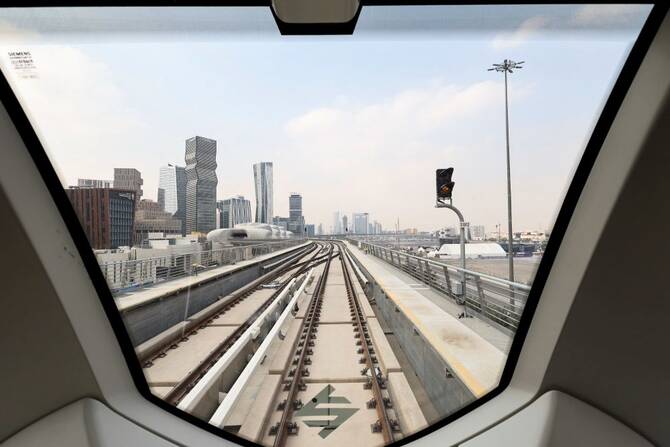
A view from inside a Riyadh Metro green line train as it approaches King Abdullah Financial District Station in Riyadh, Saudi Arabia, Jan. 28, 2025. (Reuters)
Short Url
Updated 26 August 2025
Follow

Riyadh Metro surpasses 100m passengers in under 9 months

  • Service has on-time performance rate of 99.7% and the blue line is the busiest route, with 46.5m riders
  • 100 millionth passenger Masaad Al-Obaid says Metro ‘made my life so much easier. It saves time, no stress, no traffic problem … such a huge time saver’

RIYADH: The Riyadh Metro has reached a major milestone by carrying more than 100 million passengers since its launch in December 2024.

Operated by the Royal Commission for Riyadh City, the metro has maintained an on-time performance rate of 99.7 percent, the Saudi Press Agency reported on Tuesday.

The service’s blue line recorded the highest usage, with 46.5 million riders. The red line ranked second with 17 million, followed by the orange line with 12 million.

Qasr Al-Hokm, KAFDA, stc, and the National Museum were among the busiest stations, together accounting for more than 29 percent of total passenger numbers.

In a message posted by Riyadh Transport on social media platform X, the 100 millionth passenger, Masaad Al-Obaid, said he had no idea his routine journey would turn out to be an extraordinary milestone in the story of the Metro until a member of staff informed him. To mark the momentous occasion he was presented with a travel card providing him with free trips.

Al-Obaid was full of praise for the new Metro and the difference it has made to travel in the city: “It made my life so much easier. It saves time, no stress, no traffic problem, making it a smooth experience and such a huge time saver. It made things easier for me.”

Other regular users also welcomed the Metro’s milestone. Commuter Tausief Ahmed told Arab News: “Glad to know that in just nine months, Riyadh Metro has recorded its 100 millionth passenger.

“The service began last year in December, marking a new era of smart mobility in the Saudi capital. It certainly has made commuting easier and smarter.”

The metro is the world’s longest driverless network, extending 176 km across the capital. The system aims to enhance mobility, expand travel choices and reinforce public transport as a solution for the capital.

The metro aligns with the goals of Saudi Arabia’s Vision 2030 plan for national development and diversification, in particular its aims to modernize the transport sector. There are plans to expand the railway network by more than 50 percent to connect major cities and help boost trade.


Iranian ambassador thanks Saudi for not allowing territory to be used during war

Updated 05 March 2026
Follow

Iranian ambassador thanks Saudi for not allowing territory to be used during war

  • Alireza Enayati tells AFP Iran appreciates Kingdom's pledge not to allow its 'airspace, waters, or territory' to be used in US attacks
  • Envoy also denies that his country hit the US embassy in Riyadh this week with drones

RIYADH: Iran’s ambassador to Saudi Arabia Alireza Enayati said on Thursday his country remained appreciative of Saudi Arabia’s pledge to not allow its airspace or territory to be used during the ongoing war with the US and Israel.
“We appreciate what we have repeatedly heard from Saudi Arabia — that it does not allow its airspace, waters, or territory to be used against the Islamic Republic of Iran,” he told AFP.
Before the outbreak of war, Riyadh had thrown its support behind diplomatic efforts to diffuse tensions between Tehran and Washington and vowed that its airspace would not be allowed to be used for attacks against Iran.
Enayati also categorically denied that his country hit the US embassy in Riyadh this week, after Saudi officials said Iran targeted the compound with drones.
Saudi Arabia has repeatedly accused Tehran of launching missile salvos and drone attacks at its territory and warned that the kingdom reserved the right to defend itself, including by retaliating.
Iran had earlier denied attacking the sprawling Ras Tanura refinery — one of the largest in the Middle East — which Riyadh had also accused Tehran of targeting twice with drones.
Enayati added to the denial, saying Iran also had no hand in the targeting of the US embassy that triggered a fire at the compound.
“We confirmed that Iran has no role in the attack on the US embassy in Riyadh,” the ambassador told AFP.
“If the operations command in Tehran attacks somewhere, it takes responsibility for it.”
The war in the Middle East has engulfed the otherwise stable Gulf region as Iran retaliates over US and Israeli strikes that killed its supreme leader, launching strikes at Israel, the wider region and beyond.
At least 13 people have been killed in the Gulf, including seven civilians, since Iran began its attacks on Saturday.
Enayati, however, denied that Iran was waging a regional war as retaliation for the attacks on his country by the US and Israel.
“This is not a regional war and it is not our war. It was imposed on the region,” he told AFP.