Riyadh Metro on its way to reshaping the city

1 / 8
The integration of nature and architecture at Qasr Al-Hokm Metro Station, making it one of Riyadh’s most visually striking public transit hubs. (AN Photo/Huda Bashatah)
2 / 8
Lush greenery inside Qasr Al-Hokm Metro Station, enhancing the commuter experience with a refreshing, eco-friendly design. (AN Photo/Huda Bashatah)
3 / 8
A view of Qasr Al-Hokm Metro Station’s modern architectural design, blending contemporary elements with traditional Saudi aesthetics. (AN Photo/Huda Bashatah)
4 / 8
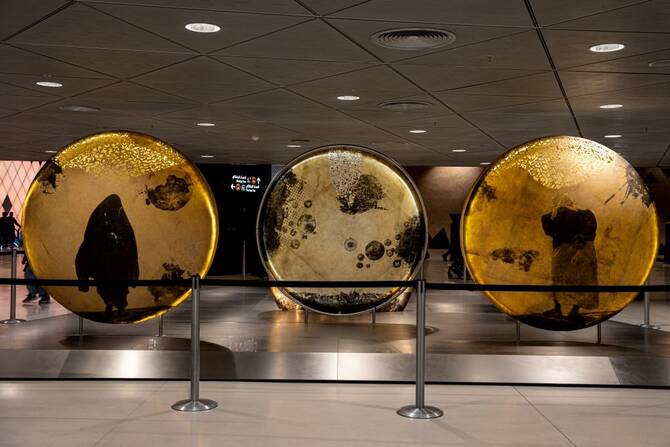
An illuminated artistic installation at Qasr Al-Hokm Metro Station, reflecting Riyadh’s fusion of heritage and modernity. (AN Photo/Huda Bashatah)
5 / 8
An artistic installation inside Qasr Al-Hokm Metro Station, featuring illuminated drum-like structures inspired by Saudi heritage. (AN Photo/Huda Bashatah)
6 / 8
Passengers enter and exit Qasr Al-Hokm Metro Station, highlighting the growing reliance on Riyadh’s modern public transport system. (AN Photo/Huda Bashatah)
7 / 8
The striking entrance of Qasr Al-Hokm Metro Station, featuring a futuristic mirrored canopy reflecting Riyadh’s blend of tradition and modernity. (AN Photo/Huda Bashatah)
8 / 8
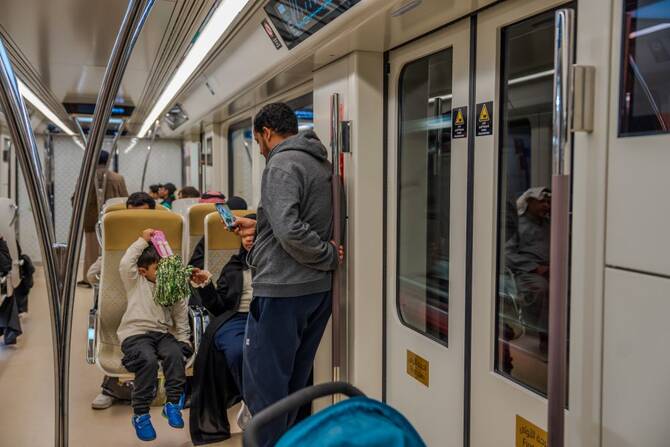
A glimpse inside a Riyadh Metro train, showcasing the diverse commuters embracing the city’s new transportation era. (AN Photo/Huda Bashatah)
Short Url
Updated 03 April 2025
Follow

Riyadh Metro on its way to reshaping the city

  • Some passengers praise affordability, design, while others believe it needs more speed, transfer routes, and reduced transfer times
  • Newly opened Qasr Al-Hokm Station is a key addition to the metro network, strategically located in Riyadh’s historic district

RIYADH: Riyadh Metro is rapidly reshaping the city’s public transportation landscape, providing residents and visitors with an efficient and cost-effective alternative to private cars and ride-hailing services. 

As the metro expands, its social and economic impacts are becoming more evident, from easing traffic congestion to influencing real estate trends. 

The newly opened Qasr Al-Hokm Station is a key addition to the metro network, strategically located in Riyadh’s historic district. It provides easy access to government buildings, cultural landmarks, and bustling markets, making it a crucial hub for commuters and visitors alike. 

To understand the metro’s impact firsthand, several passengers shared their experiences at Qasr Al-Hokm Station, highlighting both the benefits and challenges of using Riyadh’s latest public transport system.

For many residents, the affordability and ease of use make the metro an attractive alternative to private transportation. Menna Ali, a frequent rider, praised its cost-effectiveness: “It’s much easier to use, much cheaper than other transportation options. And you don’t have to stick in the traffic, and I’m happy with it.”

The metro is also helping to cut travel times for many commuters. Abdullah Al-Ghamdi, who regularly visits the area, noted how much simpler his commute has become. “I frequently visit this area, and I used to struggle to get here. Now, it takes me about 20 minutes from my residence to reach this place. Honestly, it’s excellent — saving time, reducing stress, and avoiding traffic. It’s truly great.”

However, while the metro is convenient for some, others note that it can be time-consuming, particularly when multiple transfers are required. Haifa Al-Marhum highlighted this challenge: “Honestly, it takes time — I have to go from one station to another and so on. So in terms of time, no, it does take a while.

“In terms of saving money, it definitely helps — whether for transportation, fuel, or for those who have a car or don’t. It’s a real money-saver, and on top of that, it helps avoid traffic,” she added.

While the metro provides financial relief for many commuters, its speed remains a concern. During peak hours, the overall travel time can be comparable to driving in heavy traffic, raising questions about whether it truly offers a faster alternative. Although it eliminates some of the stress of car travel and reduces fuel costs, the metro’s slower pace may not be ideal for those in a hurry.

Passengers at Qasr Al-Hokm Station also praised the metro’s accessibility, well-placed signage, and helpful staff. Fahad Hussain noted how easy it is to navigate the system. “The staff here make everything easy in terms of assistance and explaining locations. Everything is simple, and we haven’t faced any difficulties so far. Plus, the signs are available everywhere.”

The metro’s modern design and efficiency have also impressed international visitors. Georgii Korshunov, a traveler from Russia, described the system as futuristic, comparing it to Moscow’s extensive metro network. Meanwhile, Kate Pirogova, highlighted its user-friendly layout. “I like Riyadh Metro, it’s very modern, very simple to navigate.” 

To further encourage public transport adoption, authorities have introduced a free Uber ride initiative, allowing passengers to activate a voucher through the Uber app for complimentary rides within 3 km of any metro station. This initiative aims to address the “last-mile problem” by providing seamless connections between metro stations and final destinations, making public transport a more viable option for daily commutes. 

The metro’s influence extends beyond daily commutes; it is also shaping real estate trends in Riyadh. Landlords and real estate agents are increasingly promoting properties by emphasizing their proximity to metro stations, signaling a growing demand for metro-accessible housing.

This trend is common in global metropolitan areas, where transit-oriented developments often lead to increased property values and higher rental demand. As Riyadh continues to expand its metro network, neighborhoods near stations may see a surge in desirability and investment potential. 

The Riyadh Metro represents a major shift in the city’s transportation culture, gradually reducing reliance on private vehicles and contributing to Saudi Arabia’s Vision 2030 goals for sustainable urban mobility. By offering an affordable, efficient, and environmentally friendly alternative, the metro is paving the way for a more connected and accessible city.

However, the metro still faces challenges in terms of speed and efficiency, particularly for those who are accustomed to faster car travel, even in traffic. While its affordability and reliability are strong advantages, future enhancements — such as faster trains, express routes, or reduced transfer times — may be key to convincing more residents to make the permanent switch to public transport.


How Saudi Arabia’s five Founding Day symbols tell a 299-year story

Updated 22 February 2026
Follow

How Saudi Arabia’s five Founding Day symbols tell a 299-year story

  • The flag, the palm, the Arabian horse, the souq and the falcon are symbols that connect Saudi Arabia to its roots
  • Researcher Ismail Abdullah Hejles explains how the Kingdom’s symbols anchor identity, heritage and continuity

RIYADH: As Saudi Arabia prepares to mark its 299th anniversary this Founding Day — commemorating the establishment of the First Saudi State by Imam Muhammed bin Saud in 1727 CE — the moment invites reflection not only on history, but on the symbols that distill that history into enduring meaning.

Beyond ceremony and celebration, the Kingdom’s official Founding Day emblems tell a deeper story: of survival in a harsh landscape, of state-building against the odds, and of values carried forward across nearly three centuries. Together, they form a visual language that binds past to present and projects confidence into the future.

The five Founding Day symbols — the green flag, the palm tree, the Arabian horse, the souq, and the falcon — do not serve a purely celebratory function, Ismail Abdullah Hejles, a Saudi researcher in traditional architecture, told Arab News. Rather, they carry an intellectual and cultural role that connects society to its roots.

“Nations that understand their symbols and identity understand themselves and are better equipped to continue their journey with confidence and balance,” he said.

The Saudi flag. (SPA)

The Saudi flag, a representation of unity and sovereignty, embodies the values upon which the state was founded and reflects the continuity of the nation, linking its past to its present. The current design was adopted in 1937, refining historical banners from the first and second Saudi states.

The Shahada, the Islamic declaration of faith, symbolizes the Kingdom’s foundation on Islamic values, while justice and safety are echoed through the sword, which represents the unification of the Kingdom during the reign of the late King Abdulaziz Al-Saud.

The flag’s green color is traditionally associated with Islam, reflecting continuity and faith as central pillars of the Saudi state.

Additionally, the palm tree and the crossed swords — now synonymous with Saudi Arabia — officially appeared in the Kingdom’s emblem around 1950 following unification. Together, they express strength, justice, and the protection of unity.

The Saudi emblem

“The choice was not arbitrary,” Hejles said. “It brought together strength (the sword) and life and sustainability (the palm). It reflects a careful balance of firmness and generosity.”

The palm tree’s symbolic presence, however, predates the modern state, stretching back to the ancient civilizations of the Arabian Peninsula.

“In the simple oases, the palm tree was life, and the swords were dignity. The palm offered shade and sustenance, the swords protected the land and the name. Between the shade of the palm and the edge of the sword, the story of a nation takes place.”

The palm tree served numerous functions essential to the sustainability of civilizations. Its dates were a nutritious food; its fronds were used for roofing; its trunk built walls; its fiber made ropes; and it provided fuel and shade for communities.

In places such as Qatif and Al-Ahsa, the palm tree formed a complete life system with almost no waste. (SPA)

In places such as Qatif and Al-Ahsa, the palm formed a complete life system with almost no waste. It was not merely an agricultural symbol, but a genuine model of sustainability long before the term itself was coined, Hejles said.

Mentioned in the Qur’an more than 20 times, always associated with generosity and abundance, the palm formed the backbone of the agricultural economy in eastern Arabia.

“The souq (traditional market) was not merely a place of trade but a space for social interaction, knowledge exchange, and solidarity,” Hejles said. Through it, economic activity flourished and relationships between communities were strengthened.

A civilizational concept that emerged centuries before Islam, the souq arose from a simple human need: exchange. (Supplied)

“Nomads and desert dwellers possessed surplus goods and sought what they lacked through barter.”

A civilizational concept that emerged centuries before Islam, the souq arose from a simple human need: exchange. That exchange generated social mobility and fostered a culture of openness, which later contributed to the rise of cities.

A civilizational concept that emerged centuries before Islam, the souq arose from a simple human need: exchange. (Supplied)

In the pre-Islamic era, seasonal markets such as Souq ‘Ukaz, Souq Majanna, and Souq Dhu Al-Majaz were not only commercial hubs, but also literary forums, political arenas, and spaces for reconciliation and arbitration.

Once Islam was adopted, Souq Al-Madinah was established on principles prohibiting monopoly, forbidding fraud, and ensuring justice.

In the Saudi state, the souq evolved from traditional mud-and-wood covered bazaars into modern shopping centers and large commercial complexes. “Yet, the concept remained the same: a place of encounter before it is a place of sale,” Hejles said.

A civilizational concept that emerged centuries before Islam, the souq arose from a simple human need: exchange. (Supplied)

The Arabian horse, another Founding Day symbol, is associated with authenticity and courage. It accompanied the early stages of state-building, travel, and defense, becoming a symbol of strength and pride in Arab heritage.

The Arabs’ oldest companion, the Arabian horse is one of the oldest and purest breeds in the world. It was bred on the Arabian Peninsula for extreme endurance, speed, and agility.

Thanks to their lung capacity, endurance, and strong feet and bones, these horses could cover long distances in harsh desert conditions and survive on minimal resources, sometimes fed only dates and camel’s milk.

To protect them against theft and harsh weather, they were sometimes brought inside family tents, which led to the development of intense bonds with their owners. Arabian horses are known to be fearless and loyal, capable of protecting their masters in battle.

The Arabs’ companion, the Arabian horse is one of the oldest and purest breeds in the world. It was bred on the Arabian Peninsula for extreme endurance, speed, and agility. (SPA photo)

They also possessed a “war-sense,” allowing them to act intelligently in combat, known as well to have a high spirit in battle.

In Saudi Arabia, Arabian horses were vital in travel, trade, and warfare. Today, they symbolize nobility, pride, courage, and honor — reflecting and continuing the Kingdom’s equestrian legacy.

And finally, vigilance, insight, and high ambition are represented by the falcon. “It is tied to the practice of falconry, which requires patience and skill, and today symbolizes the continuity of heritage and elevated aspirations,” Hejles said.

The falcon was not merely a hobby but a hunting tool in a harsh desert environment, a companion to the Bedouin, and a symbol of strength, precision, and patience. (AN photo/AN Huda Bashatah)

Falconry was not merely a hobby, but a hunting tool in a harsh desert environment — a companion to the Bedouin and a symbol of strength, precision, and patience. The long training required to master falconry fostered discipline and strong leadership in its practitioners.

Over time, the falcon became associated with prestige and courage, linked to Bedouin identity and nobility, and embedded in poetry and storytelling.

A heritage passed through generations, falconry is now inscribed on UNESCO’s Representative List of the Intangible Cultural Heritage of Humanity, with Saudi Arabia and other participating countries, reinforcing its global cultural significance.

The falcon was not merely a hobby but a hunting tool in a harsh desert environment, a companion to the Bedouin, and a symbol of strength, precision, and patience. (SPA)

“These symbols were not chosen for their visual appeal,” Hejles said. “They were chosen because they were tested across centuries of lived experience.”

Representing more than their individual images, they are collectively an expression of the Saudi citizen’s relationship with land, environment, dignity, and continuity.