Cambodia passes law to revoke citizenship of people convicted of treason 

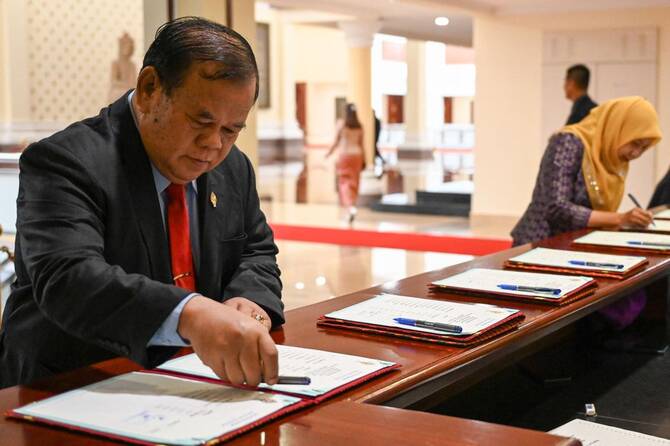
Above, Cambodian lawmakers register as they arrive to attend a meeting at the National Assembly building in Phnom Penh on Aug. 25, 2025. (AFP)
Short Url
Updated 25 August 2025
Follow

Cambodia passes law to revoke citizenship of people convicted of treason 

  • Many prominent political figures have fled Cambodia to avoid arrest amid intensified efforts to stifle dissent
  • Cambodia has held mass trials involving more than 100 opposition figures, with many jailed in absentia on treason and incitement charges

PHNOM PENH: Cambodia’s parliament passed a law on Monday that will allow people convicted of treason to be stripped of their citizenship, a new measure that comes amid a sustained crackdown on opponents of the long-ruling Cambodian People’s Party.
The law, approved by 120 of the 125 members of the CPP-dominated National Assembly, will allow the state to revoke the citizenship of anyone convicted of conspiring with foreign countries or plotting against Cambodian interests.
Many prominent political figures have fled Cambodia to avoid arrest amid intensified efforts to stifle the CPP’s opposition in the wake of the Supreme Court’s 2017 banning of the Cambodian National Rescue Party ahead of an election the following year.
Cambodia has since held mass trials involving more than 100 opposition figures, with many jailed in absentia on treason and incitement charges.
The CPP has been widely condemned by activists and Western countries, including the United States, for a crackdown on remnants of the opposition that has ensured the past two elections were virtually one-horse races.
The government denies targeting opponents and says those sentenced to prison were law-breakers. Notable dissidents in exile include the now defunct CNRP’s co-founders Sam Rainsy, who has lived in France since 2016, and Mu Sochua, now in the United States.
Cambodia’s influential longtime former prime minister and CPP President Hun Sen said in late June that Cambodia needed to take action against nationals who “side with foreign nations.” Rainsy, who has already been banned from entering Cambodia, has long been Hun Sen’s fiercest critic.
He has accused him of mishandling a border dispute with Thailand that spiralled into armed conflict last month, alleging corruption by the military and a government cover-up of civilian deaths, which both have denied.


Pope criticizes prison overcrowding during special Mass for inmates, guards and families

Updated 8 sec ago
Follow

Pope criticizes prison overcrowding during special Mass for inmates, guards and families

  • Leo recalled that visit in Sunday’s homily, as well as Francis’ Holy Year appeal for governments around the world to offer prison amnesties and pardons

ROME: Pope Leo XIV criticized prison overcrowding and insufficient inmate rehabilitation programs on Sunday as he celebrated a special Mass for detainees, guards and their families in the final event of the Vatican’s 2025 Holy Year.
The Vatican said an estimated 6,000 people signed up to participate in the weekend pilgrimage, including representatives from big detention facilities in Italy and prison volunteers, wardens and prison chaplains from 90 countries.
Included were a few groups of inmates who received special permission to participate, according to the Italian penitentiary chaplain’s association.
In his homily, Leo acknowledged the oftentimes poor conditions prisoners face even in wealthier countries. He called for a sense of charity and forgiveness to prevail for prisoners and those responsible for guarding them.
“Here, we can mention overcrowding, insufficient commitment to guarantee stable educational programs for rehabilitation and job opportunities,” he said, adding that patience and forgiveness are needed.
“On a more personal level, let us not forget the weight of the past, the wounds to be healed in body and heart, the disappointments, the infinite patience that is needed with oneself and with others when embarking on paths of conversion, and the temptation to give up or to no longer forgive,” he said.
As the last big event of the 2025 Jubilee, the Mass in many ways closed out the Holy Year that Pope Francis inaugurated Christmas Eve 2024, which had as its main thrust transmitting a message of hope especially for those on society’s margins.
During his 12-year pontificate, Francis had prioritized ministering to prisoners to offer them hope for a better future. On Dec. 26 last year Francis traveled to Rome’s Rebibbia prison to open its Holy Door and include the inmates in the Jubilee celebrations.
Leo recalled that visit in Sunday’s homily, as well as Francis’ Holy Year appeal for governments around the world to offer prison amnesties and pardons, which are a mainstay of the Catholic Church’s Jubilee tradition.
In Italy, prison overcrowding is a longstanding problem that has been denounced by the European Court of Human Rights and humanitarian organizations.
Antigone, an Italian prisoner advocacy group, said Italian prisons are now at 135 percent overcapacity, with more than 63,000 people detained in facilities with fewer than 47,000 beds. Italian prison authorities received 5,837 complaints of inhuman or degrading treatment last year, 23.4 percent more than in the previous year, Antigone said.
The Mass was the final big Jubilee event of the 2025 Holy Year, which Leo will officially close out on Jan. 6 when he shuts the Holy Door of St. Peter’s.