

Pakistan’s deputy PM begins ‘landmark’ Dhaka visit, highest-level trip in years

Pakistan’s Deputy Prime Minister and Foreign Minister Ishaq Dar arrives in Dhaka on August 23, 2025, on a two-day official visit to Bangladesh. (Handout/MoFA)
Short Url
Updated 23 August 2025
Follow

Pakistan’s deputy PM begins ‘landmark’ Dhaka visit, highest-level trip in years

  • The two countries have witnessed more frequent bilateral interactions since Sheikh Hasina’s downfall
  • Ishaq Dar will meet Chief Adviser Muhammad Yunus to discuss political, economic and regional issues

ISLAMABAD: Pakistan’s Deputy Prime Minister and Foreign Minister Ishaq Dar arrived in Bangladesh on Saturday for the most senior visit by a Pakistani official to the country in years, in a sign of warming ties since the ouster of longtime leader Sheikh Hasina.

Dar’s visit follows months of increased contact between the two South Asian nations. Pakistan’s commerce minister Jam Kamal has been in Dhaka this week discussing trade and agricultural collaboration, while Pakistan’s foreign secretary Amna Baloch held the first bilateral consultations in 15 years in April.

Baloch’s visit covered political, economic, trade, agricultural, education and defense ties, as well as regional integration and a revival of the South Asian Association for Regional Cooperation (SAARC).

“Deputy Prime Minister and Foreign Minister of Pakistan, Senator Muhammad Ishaq Dar, arrived in Dhaka today on a landmark official visit from 23–24 August 2025, at the invitation of the Government of the People’s Republic of Bangladesh,” the foreign office said in a statement.
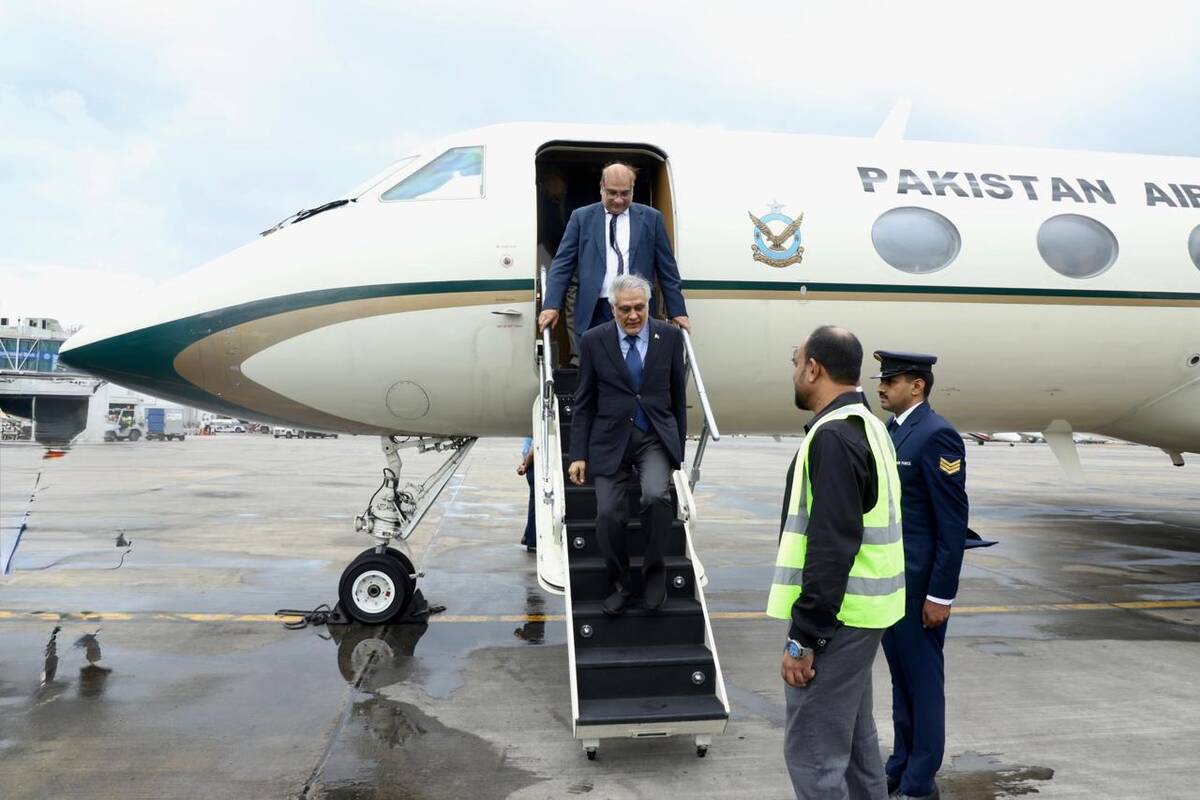


Pakistan’s Deputy Prime Minister and Foreign Minister Ishaq Dar arrives in Dhaka on August 23, 2025, on a two-day official visit to Bangladesh. (Handout/MoFA)

He is scheduled to meet Chief Adviser Muhammad Yunus and senior officials including Adviser for Foreign Affairs Md. Touhid Hossain and Adviser for Commerce SK Bashir Uddin during his two-day stay in Dhaka.

Talks will mainly cover bilateral cooperation as well as regional and international issues.


Pakistan’s Deputy Prime Minister and Foreign Minister Ishaq Dar arrives in Dhaka on August 23, 2025, on a two-day official visit to Bangladesh. (Handout/MoFA)

A day before Dar’s visit, a top Bangladeshi army officer, Lt. Gen. Md. Faizur Rahman, met Pakistan’s Chairman Joint Chiefs of Staff Committee Gen. Sahir Shamshad Mirza to discuss enhanced defense and security cooperation.

According to the military’s media wing, their talks also focused on the regional security environment, with the Bangladeshi official praising the professionalism of Pakistan’s armed forces and their sacrifices against militant violence.

Bangladesh’s ties with Pakistan have begun to ease since Hasina, often seen as close to India, was toppled in a popular uprising last year and fled to New Delhi.

The shift created space for Bangladesh and Pakistan – once one country until the bloody 1971 war of independence – to reset relations.

Dar also met leaders of Bangladesh’s newly formed National Citizen Party (NCP), a student-led movement that spearheaded the protests which unseated Hasina.

The party, formally launched earlier this year, has called for a “second republic” with a new constitution aimed at strengthening democracy and social justice.

Its emergence has reshaped Bangladesh’s political landscape, challenging decades of dominance by traditional parties and giving voice to younger generations.

Pakistan’s deputy prime minister emphasized the need for greater interaction between the youth of the two countries.

The delegation members apprised him of different facets of the nationwide political mobilization in Bangladesh last year.

“The two sides also discussed possibilities to promote cultural exchanges between Pakistan and Bangladesh in the days ahead,” said the foreign office.


IMF Executive Board to review $1.2 billion loan disbursement for Pakistan today

Updated 4 sec ago
Follow

IMF Executive Board to review $1.2 billion loan disbursement for Pakistan today

  • Pakistan, IMF reached a Staff-Level Agreement in October for second review of $7 billion Extended Fund, climate fund program
  • Economists view IMF bailout packages as essential for cash-strapped Pakistan grappling with a prolonged macroeconomic crisis

ISLAMABAD: The Executive Board of the International Monetary Fund (IMF) is set to meet in Washington today to review a $1.2 billion loan disbursement for Pakistan, state media reported on Monday.

Pakistan and the IMF reached a Staff-Level Agreement (SLA) in October for the second review of a $7 billion Extended Fund Facility (EFF) and the first review of its $1.4 billion Resilience and Sustainability Facility (RSF). 

The agreement between the two sides took place after an IMF mission, led by the international lender’s representative Iva Petrova, held discussions with Pakistani authorities during a Sept. 24–Oct. 8 visit to Karachi, Islamabad and Washington D.C.

“The International Monetary Fund’s (IMF) Executive Board is set to meet in Washington today to review and approve $1.2 billion in loan for Pakistan,” state broadcaster Pakistan TV reported. 

Pakistan has been grappling with a prolonged macroeconomic crisis that has drained its financial resources and triggered a balance of payments crisis for the past couple of years. Islamabad, however, has reported some financial gains since 2022, which include recording a surplus in its current account and bringing inflation down considerably.

Economists view the IMF’s bailout packages as crucial for cash-strapped Pakistan, which has relied heavily on financing from bilateral partners such as Saudi Arabia, China and the United Arab Emirates, as well as multilateral lenders including the IMF, World Bank, Asian Development Bank and Islamic Development Bank. 

Speaking to Arab News last month, Pakistan’s former finance adviser Khaqan Najeeb said the $1.2 billion disbursement will further stabilize Pakistan’s near-term external position and unlock additional official inflows.

“Continued engagement also reinforces macro stability, as reflected in recent improvements in inflation, the current account, and reserve buffers,” Najeeb said.

Pakistan came close to sovereign default in mid-2023, when foreign exchange reserves fell below three weeks of import cover, inflation surged to a record 38% in May, and the country struggled to secure external financing after delays in its IMF program. Fuel shortages, import restrictions, and a rapidly depreciating rupee added to the pressure, while ratings agencies downgraded Pakistan’s debt and warned of heightened default risk.

The crisis eased only after Pakistan reached a last-minute Stand-By Arrangement with the IMF in June 2023, unlocking emergency support and preventing an immediate default.