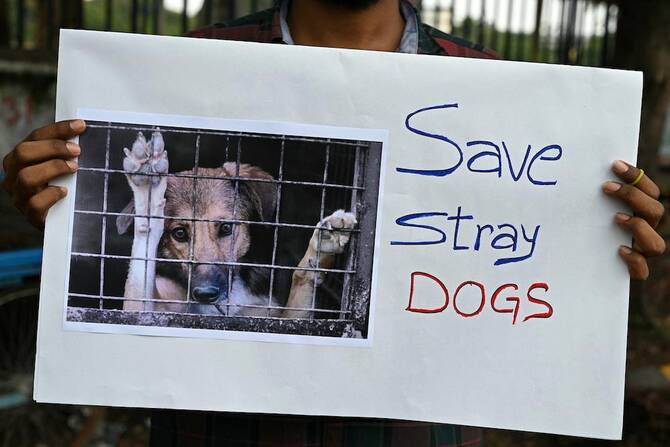
India’s top court modifies earlier order to move stray dogs to shelters

Activists have filed an appeal against India’s Supreme Court earlier order to remove stray dogs from the country’s capital Delhi. (AFP)
Short Url
Updated 22 August 2025
Follow

India’s top court modifies earlier order to move stray dogs to shelters

  • Animal lovers had filed an appeal against the Supreme Court’s earlier order
  • The court’s decision to relocate them had drawn criticism over its implementation

NEW DELHI: India’s top court modified its earlier ruling in a case involving stray dogs on Friday, ordering authorities in capital Delhi and its suburbs to release picked-up dogs in the same area after sterilization and immunization.
Animal lovers had filed an appeal against the Supreme Court’s earlier order to authorities to relocate all stray dogs to shelters after media reports of a rise in cases of rabies, especially among children.
The decision to relocate them had drawn criticism over its implementation, citing lack of infrastructure and medical treatment. Many animal lovers took to the streets to protest against the order.


Closer Russia-Gulf ties deliver an Arabic-speaking tourism boom

Fatma Albalushi, a tourist from Oman, feeds a deer at Husky Land Park in the Moscow region, Russia February 10, 2026. (REUTERS)
Updated 8 sec ago
Follow

Closer Russia-Gulf ties deliver an Arabic-speaking tourism boom

  • Saudi Arabia increases its arrivals in Russia by 15 times compared with pre-pandemic period
  • Visitors from the Gulf stay in high-end hotels in the center of the ‌capital and are a common sight in upmarket Russia-themed restaurants and well-known shopping streets or malls

MOSCOW: In sub-zero temperatures outside ‌Moscow, teams of husky dogs pull tourists from Oman and the UAE across picturesque snow-covered fields in sleds, delighting their passengers who have never experienced a Russian winter before.

Nearby, a couple from Qatar feed a small ​herd of deer and other tourists from the Middle East drive a hovercraft at high speed across a snowy lake.
“It was like drifting in the desert but here on ice,” said Badreya Almarooqi, a tourist from the UAE at the Nazarievo Husky Park — 45 km west of central Moscow — where signs are written in Arabic as well as Russian.
North of the city, another group of Gulf tourists crowd into a hot air balloon to drift over a vast snowy landscape.
“(It was) one of the best activities in my life!” said Ayoub Aziz, a tourist from Saudi ‌Arabia drawn to ‌the experience in the Dmitrov district 65 km from ​the ‌city center, one ​of many such activity destinations dotted around the capital.
Four years into Russia’s war in Ukraine, Moscow’s pivot away from the West and its quest to draw nearer to other parts of the world has produced an Arabic-speaking tourism boom.
There are more direct flights between Moscow and key Gulf capitals, new visa-free regimes and closer diplomatic ties due to the roles of Qatar, the UAE and Saudi Arabia in brokering prisoner exchanges or the handover of children to Ukraine.
With more than 800,000 visits last year, tourists from China, long a close Russian partner, lead official figures by a long way. ‌But Saudi Arabia secured the No. 2 slot for ‌the first time last year with nearly 75,000 tourists, a ​year-on-year increase of nearly 36 percent, while more than ‌59,000 tourists came from the UAE, putting it in sixth place.
“Virtually all Arab countries have at ‌least doubled their numbers, said Alexander Musikhin, general director of the Intourist tour operator.
“But there are also destinations like Saudi Arabia, which has increased its arrivals in Russia — and in Moscow in particular — by almost 15 times compared with the pre-pandemic period,” he said.
Visitors from the Gulf stay in high-end hotels in the center of the ‌capital and are a common sight in upmarket Russia-themed restaurants and well-known shopping streets or malls.
They often spend at least 200,000-300,000 roubles ($6,523) on extra services, tour operators say, and would spend more if the rules did not limit them to bringing in $10,000 in cash without a declaration. 
Western sanctions mean Visa and Mastercard do not work in Russia, “so it has to be in cash,” UAE tourist Rashan Godani said.
Despite its war with Ukraine, Russia welcomed a total of 1.64 million tourists in 2025, according to the country’s association of tour operators, 4.5 percent up on 2024, but sharply down on 2018, the year Russia held the World Cup, when 4.2 million foreign tourists visited.
By contrast, 2.45 million Russians visited the UAE alone last year, up by nearly a quarter year-on-year, and some Russian businessmen have opened up offices in Dubai.
Musikhin, the Intourist head, said fallout from the conflict was limiting growth. He cited the periodic and temporary closure of Russian ​airports due to Ukrainian drone attacks and ​the longer time it takes tourists to cross the border due to heightened security checks.