

Indian top court orders roundup of stray dogs in Delhi

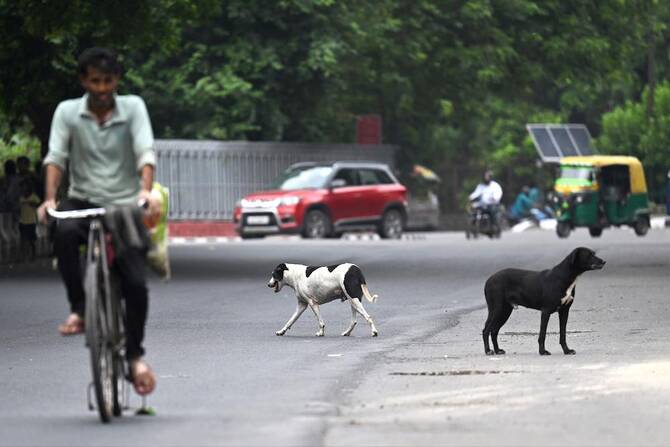
Data tabled in the Indian parliament showed more than 3.7 million cases of dog bites and 54 suspected human deaths from rabies in 2024. (AFP file photo)
Short Url
Updated 11 August 2025
Follow

Indian top court orders roundup of stray dogs in Delhi

  • At least 60,000 stray dogs live on the streets of Delhi, according to India’s Livestock Census of 2012
  • India’s Supreme Court warned of action against animal activists who obstruct the removal of dogs

NEW DELHI: India’s Supreme Court on Monday ordered the removal of tens of thousands of stray dogs from the capital, citing public safety concerns after a surge in dog bites.

India is home to millions of stray dogs and deadly attacks, particularly on children and the elderly, are regularly reported by the city’s media.

At least 60,000 stray dogs live on the streets of Delhi, according to India’s Livestock Census of 2012, the most recent data available.

Some suggest that number to be now far higher, with large rival dog packs patrolling parks and residential neighborhoods across the city.

The country accounts for more than a third of global rabies deaths, according to the World Health Organization, a crisis exacerbated by a lack of sterilization programs and legal restrictions on canine culling.

The court asked city authorities to set up dog shelters within eight weeks, and maintain daily records of the canines captured.

“What is important, and without which the entire exercise would go futile, not a single stray dog should be released,” it said, which applies to Delhi and its satellite suburbs, a megacity home to some 30 million people.

The court warned of action against animal activists who obstruct the removal of dogs.

It also ordered a 24-hour helpline to be set up to report dog bites and officials must publicize locations where anti-rabies vaccines are available.

Data tabled in the Indian parliament showed more than 3.7 million cases of dog bites and 54 suspected human deaths from rabies in 2024.

Other estimates peg the number to be nearly twice as high, with Delhi alone accounting for roughly 2,000 cases of dog bites every day.

In middle class neighborhoods, many of Delhi’s strays are beloved by their residents despite lacking formal owners, with some dogs clothed in special canine jackets to keep warm during the winter.

But they are also a hazard to humans, with Indian media regularly reporting on the mauling of young children by aggressive dog packs.


Volcanic eruptions may have brought Black Death to Europe, say new study

Updated 9 min 46 sec ago
Follow

Volcanic eruptions may have brought Black Death to Europe, say new study

  • Study says volcanic eruptions in 1345 caused temperatures to drop, leading to crop failure and causing famine
  • This led Italy to have ships bring grain from central Asia, where the bubonic plague is thought to have first emerged
  • The plague killed tens of millions of people and wiped out up to 60 percent of the population in parts of Europe 

PARIS: Previously unknown volcanic eruptions may have kicked off an unlikely series of events that brought the Black Death — the most devastating pandemic in human history — to the shores of medieval Europe, new research has revealed.
The outbreak of bubonic plague known as the Black Death killed tens of millions and wiped out up to 60 percent of the population in parts of Europe during the mid-14th century.
How it came to Europe — and why it spread so quickly on such a massive scale — have long been debated by historians and scientists.
Now two researchers studying tree rings have suggested that a volcanic eruption may have been the first domino to fall.
By analyzing the tree rings from the Pyrenees mountain range in Spain, the pair established that southern Europe had unusually cold and wet summers from 1345 to 1347.
Comparing climate data with written accounts from the time, the researchers demonstrated that temperatures likely dropped because there was less sunlight following one or more volcanic eruptions in 1345.
The change in climate ruined harvests, leading to failed crops and the beginnings of famine.
Fortunately — or so it seemed — “powerful Italian city states had established long-distance trade routes across the Mediterranean and the Black Sea, allowing them to activate a highly efficient system to prevent starvation,” said Martin Bauch, a historian at Germany’s Leibniz Institute for the History and Culture of Eastern Europe.
“But ultimately, these would inadvertently lead to a far bigger catastrophe,” he said in a statement.
Deadly stowaways

The city states of Venice, Genoa and Pisa had ships bring grain from the Mongols of the Golden Horde in central Asia, which is where the plague is thought to have first emerged.
Previous research has suggested that these grain ships brought along unwelcome passengers: rats carrying fleas infected with Yersinia pestis, the bacterium that causes plague.
Between 25 and 50 million people are estimated to have died over the next six years.
While the story encompasses natural, demographic, economic and political events in the area, it was ultimately the previously unidentified volcanic eruption that paved the way for one of history’s greatest disasters, the researchers argued.
“Although the coincidence of factors that contributed to the Black Death seems rare, the probability of zoonotic diseases emerging under climate change and translating into pandemics is likely to increase in a globalized world,” study co-author Ulf Buentgen of Cambridge University in the UK said in a statement.
“This is especially relevant given our recent experiences with Covid-19.”
The study was published in the journal Communications Earth & Environment on Thursday.