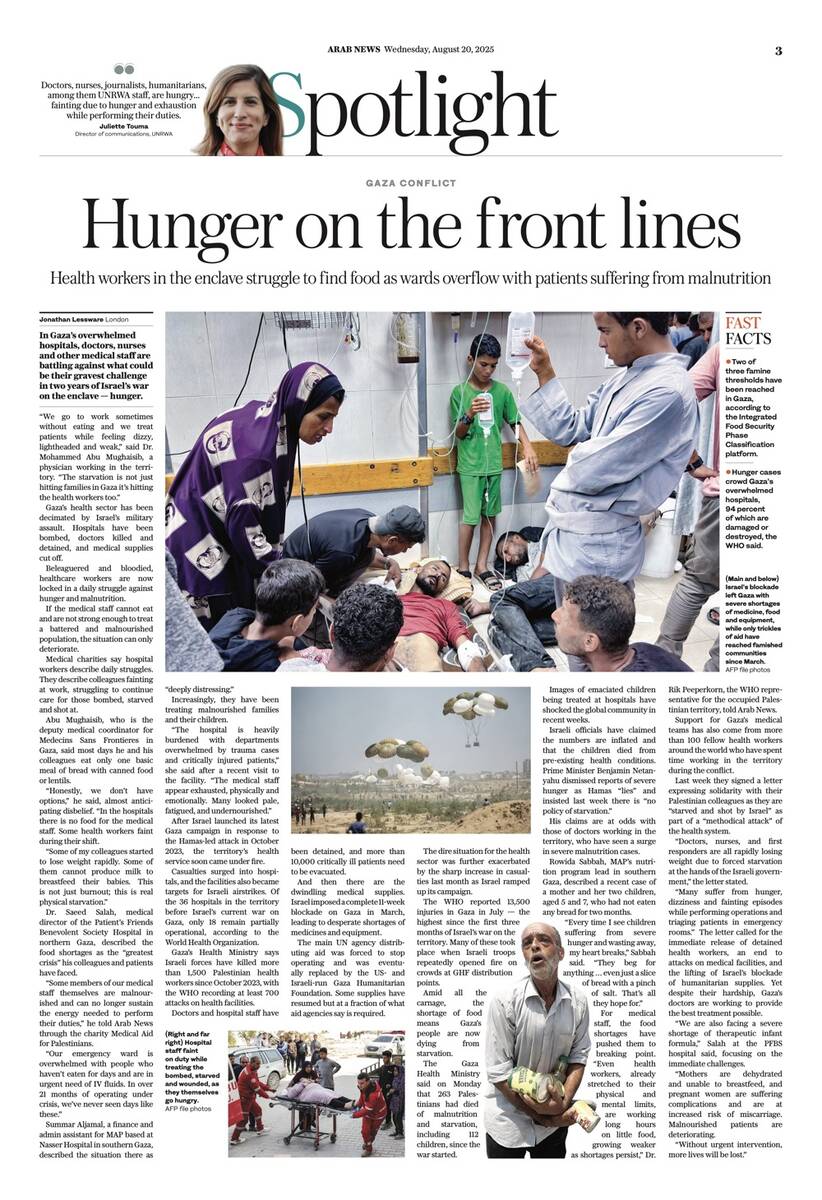
LONDON: In Gaza’s overwhelmed hospitals, doctors, nurses and other medical staff are battling against what many fear could be their most insurmountable challenge in nearly two years of Israel’s war on the territory’s people — hunger.
“We go to work sometimes without eating and we treat patients while actually feeling dizzy, lightheaded and weak,” said Dr. Mohammed Abu Mughaisib, a physician working in the territory. “The starvation is not just hitting families in Gaza it’s hitting the health workers too.”
Gaza’s health sector has been decimated by Israel’s devastating military assault. Hospitals have been bombed, doctors killed and detained, and medical supplies cut off.
Beleaguered and bloodied, health care workers are now locked in a daily struggle against hunger and malnutrition affecting people across the entire territory.

Casualties surged into hospitals, and the facilities also became targets for Israeli airstrikes. (AFP)
If the medical staff cannot eat and are not strong enough to perform the painstaking work needed to treat a battered and malnourished population, the situation can only deteriorate.
In accounts provided to Arab News from medical charities, hospital workers have described their daily struggles to find enough food to sustain them through their long shifts and feed their families.
They describe colleagues fainting at work, struggling to continue their lifesaving care for those bombed, starved and shot at as they try to reach the meagre food supplies making it into the territory.
Abu Mughaisib, who is the deputy medical coordinator for Medecins Sans Frontieres in Gaza, said that despite the decades of conflict affecting the territory, he never imagined such a situation.
He said most days he and his colleagues eat only one basic meal of bread with canned food or lentils.
Some days the market is completely empty, and there are never any vegetables, fruit, or meat.
“Honestly, we don’t have options,” he said, almost anticipating that those outside of Gaza would not believe him.

Beleaguered and bloodied, health care workers are now locked in a daily struggle against hunger and malnutrition affecting people across the entire territory. (AFP)
“In the hospitals there is no food for the medical staff. Some health workers faint during their shift. They clean the wounds, they deliver babies, and perform surgeries on empty stomachs.
“Some of my colleagues started to lose weight rapidly. Some of them cannot produce milk to breastfeed their babies. This is not just burnout this is real physical starvation.”
Dr. Saeed Salah, medical director of the Patient’s Friends Benevolent Society Hospital in northern Gaza, described the food shortages as the “greatest crisis” his colleagues and patients have faced.
“Some members of our medical staff themselves are malnourished and can no longer sustain the energy needed to perform their duties,” he said, in response to Arab News questions passed through the charity Medical Aid for Palestinians.
“Our emergency ward is overwhelmed with people who haven’t eaten for days and are in urgent need of IV fluids. In over 21 months of operating under crisis, we’ve never seen days like these.”
Summer Al-Jamal, a finance and admin assistant for MAP based at Nasser Hospital in southern Gaza, described the situation there as “deeply distressing.”

The hospital has been inundated with victims from shooting attacks on Palestinians gathered at aid distribution hubs nearby, as well as patients injured from Israeli bombings, or who are sick.
Increasingly, they have been treating malnourished families and their children.
“The hospital is heavily burdened with departments overwhelmed by trauma cases and critically injured patients,” she said after a recent visit to the facility. “The scale of suffering and the intensity of the emergency were unlike anything I had witnessed before.
FASTFACTS
• Two of three famine thresholds have been reached in Gaza, according to the Integrated Food Security Phase Classification platform.
• Hunger cases crowd Gaza’s overwhelmed hospitals, 94 percent of which are damaged or destroyed, the WHO said.
“The medical staff appear exhausted, physically and emotionally. Many looked pale, fatigued, and undernourished. The toll of the past weeks had left them drained.”
After Israel launched its latest Gaza campaign in response to the Hamas-led attack in October 2023, the territory’s health service soon came under fire.
Casualties surged into hospitals, and the facilities also became targets for Israeli airstrikes. Nearly two years into the conflict, the health service is broken.

Israel imposed a complete 11-week blockade on Gaza in March, leading to desperate shortages of medicines and equipment for hospitals, along with basic food for the entire population. (AFP)
Of the 36 hospitals in the territory before Israel’s current war on Gaza, only 18 remain partially operational, and less than 40 percent of primary health care facilities are still functional, according to the World Health Organization.
All the facilities have been damaged and are flooded with patients far beyond their maximum operating capacities.
Gaza’s Health Ministry says Israeli forces have killed more than 1,500 Palestinian health workers since October 2023, with the WHO recording at least 700 attacks on health care facilities in the territory.
Doctors and hospital staff have been detained, and more than 10,000 critically ill patients need to be evacuated.
And then there is the dwindling medical supplies. Israel imposed a complete 11-week blockade on Gaza in March, leading to desperate shortages of medicines and equipment for hospitals, along with basic food for the entire population.

If the medical staff cannot eat then they are not strong enough to perform the painstaking work needed to treat a battered and malnourished population. (AFP)
The main UN agency distributing aid was forced to stop operating and was eventually replaced by the US- and Israeli-run Gaza Humanitarian Foundation. Some supplies have resumed but at a fraction of what aid agencies say is required.
The dire situation for the health sector was further exacerbated by the sharp increase in casualties last month as Israel ramped up its campaign in the face of an international outcry and widespread accusations of genocide.
The WHO reported 13,500 injuries in Gaza in July — the highest since the first three months of Israel’s war on the territory. Many of these took place when Israeli troops repeatedly opened fire on crowds of Palestinians as they waited to collect food from GHF distribution points.
Opinion
This section contains relevant reference points, placed in (Opinion field)
Amid all the carnage, the shortage of food means Gaza’s people are now dying from starvation.
Late last month, the Integrated Food Security Phase Classification, a global initiative that analyses food security, warned that the “worst-case scenario of famine is currently playing out in Gaza.” The body said there would be “widespread death” without immediate action.
The Gaza Health Ministry said on Monday that 263 Palestinians had died of malnutrition and starvation, including 112 children, since the war started.

Of the 36 hospitals in the territory before Israel’s current war on Gaza, only 18 remain partially operational, and less than 40 percent of primary health care facilities are still functional. (Reuters)
Images of emaciated children being treated at hospitals have shocked the global community in recent weeks.
Israeli officials have claimed the numbers are inflated and that the children died from pre-existing health conditions. Prime Minister Benjamin Netanyahu has dismissed reports of severe hunger as Hamas “lies” and insisted last week there is “no policy of starvation.”
His claims are at odds with those of doctors working in the territory, who have seen a surge in severe malnutrition cases.
Rowida Sabbah, MAP’s nutrition program lead in southern Gaza, described a recent case of a mother and her two children, aged 5 and 7, who had not eaten any bread for two months.
“For two days she had only been able to give them just water,” Sabbah said. The mother finally reached a medical hub for help. “She was crying when she received the supplies,” she said.

“Every time I see children suffering from severe hunger and wasting away, my heart breaks. They beg for anything … even just a slice of bread with a pinch of salt. That’s all they hope for.”
For medical staff, the food shortages have pushed them to breaking point. Accounts given to Arab News describe the daily battle to source the most meagre of supplies, and desperate searches for small quantities of flour now selling at vastly inflated prices.
“Even health workers, already stretched to their physical and mental limits, are working long hours on little food, growing weaker as shortages persist,” Dr. Rik Peeperkorn, the WHO representative for the occupied Palestinian territory, told Arab News.
“No one can sustain this, yet they keep showing up because patients have no one else. We call for large-scale aid, including diverse and nutritious food, to be allowed via all routes.”
Support for Gaza’s medical teams has also come from more than 100 fellow health workers around the world who have spent time working in the territory during the conflict.

Some days the market is completely empty, and there are never any vegetables, fruit, or meat. (AFP)
Last week they signed a letter expressing solidarity with their Palestinian colleagues as they are “starved and shot by Israel” as part of a “methodical attack” of the health system.
“Doctors, nurses, and first responders are all rapidly losing weight due to forced starvation at the hands of the Israeli government,” the letter stated.
“Many suffer from hunger, dizziness and fainting episodes while performing operations and triaging patients in emergency rooms. Most have been displaced into tents after being forced from their homes, and many are surviving on less than a single serving of rice a day.”
The letter called for the immediate release of detained health workers, an end to attacks on medical facilities, and the lifting of Israel’s blockade of humanitarian supplies.
With little sign of progress on a ceasefire and Israel’s ramping up of military operations around Gaza City, doctors in the territory are bracing for things to get even worse.
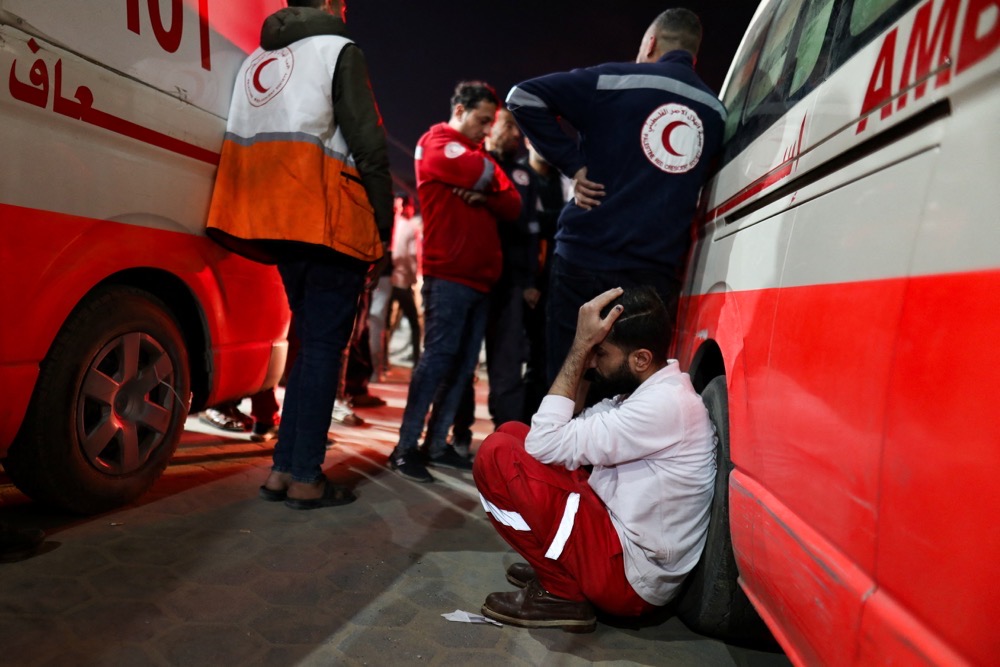
Nearly two years into the conflict, the health service is broken. (Reuters)
Yet despite their hardship, they are working to provide the best treatment possible to a people brutalized by Israel’s war.
“We are also facing a severe shortage of therapeutic infant formula,” Salah at the PFBS hospital said, focusing on the immediate challenges.
“Mothers are dehydrated and unable to breastfeed, and pregnant women are suffering complications and are at increased risk of miscarriage. Malnourished patients are deteriorating.
“Without urgent intervention, more lives will be lost.”