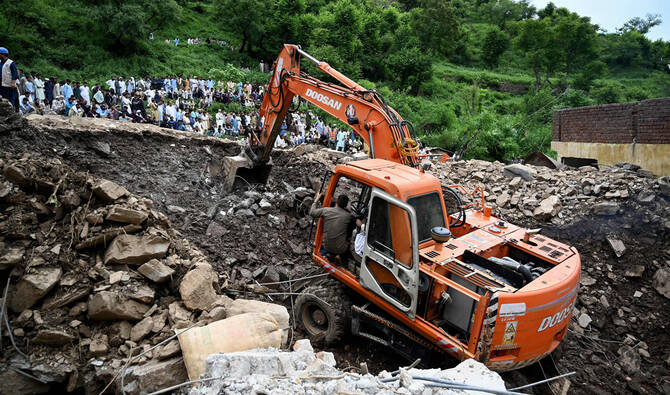

ISLAMABAD: Pakistan’s top economic body on Tuesday approved a relief package worth Rs5.8 billion ($20.8 million) to support people affected by recent rains and flash floods in the country’s northwest, state broadcaster Radio Pakistan reported.
The announcement comes as nearly 400 people have been killed during the latest spell of monsoon rains in northern Pakistan that began late last week. The National Disaster Management Authority (NDMA) reported that of the 400 deaths since Friday, 356 were in Khyber Pakhtunkhwa province, which has been lashed by cloudbursts, flash floods, lightning strikes and landslides in the deadliest downpour of this year’s monsoon season.
In total, 707 Pakistanis have died in monsoon rains since June 26, according to the NDMA.
“Economic Coordination Committee of the Cabinet has approved a relief package worth 5.8 billion rupees as federal assistance for the rain and flood affected people,” Radio Pakistan said in a report after a meeting of the ECC was held in Islamabad with Finance Minister Muhammad Aurangzeb in the chair.
“The ECC directed the Finance Division to immediately release 4 billion rupees of the approved package to mitigate the sufferings of affected people.”
Earlier in the day, while addressing a joint news conference on Tuesday, Pakistan’s army and government spokesmen and the chief of the NDMA said coordinated relief and rescue operations had been stepped up in affected parts of KP and the mountainous Gilgit-Baltistan (GB) region.
“Currently, there are eight units of the infantry and eight units of the FC [frontier constabulary] directly involved in search and rescue and flood relief operations,” Director General Inter-Services Public Relations (ISPR), Lt Gen Ahmed Sharif Chaudhry, told reporters in Islamabad.
“In the search and rescue work, 6,903 of children and adults have been rescued by the army units,” the army spokesman said, adding that over 6,300 people had also received medical treatment.
Chaudhry said logistics bases had been set up in Kanju and Daggar to supply food, tents and medicines, while helicopters were flying emergency aid to remote areas.
Information Minister Ataullah Tarar said 70 percent of the region’s power supply had also been restored, including in districts like Buner, Shangla, Swat and Bajaur, where electrical grids, poles and transformers were destroyed.
He said ministers for energy, communications and Kashmir affairs were deployed in the field to monitor relief operations.
“In Malakand division, the N-90 highway has been fully reopened after clearing all blockades,” Tarar added.
More than 1,200 tents, 3,000 kilograms of medicines and 40 tons of food rations have been dispatched to the flood-hit regions, with over 500 medical camps operational in the area.

Volunteers walks with umbrellas to avoid rain as they survey the damaged areas, following a storm that caused heavy rains and flooding in Bayshonai Kalay, in Buner district, in Khyber Pakhtunkhwa province, Pakistan, on August 18, 2025. (REUTERS)
Chairman of the NDMA, Lt Gen Inam Haider Malik, who also addressed the news conference, said at least 25,000 people had been rescued in total in the last four days.
He warned of continued risks from localized flooding and cloudbursts in KP, GB, and northern Punjab, with a new monsoon spell expected in the last week of August.
“A complete survey has been launched, which has been started to assess the damage of houses and public infrastructure,” Malik said, adding that its findings would be ready by early September.
Malik said more than 50 percent of landslides had been cleared and Prime Minister Shehbaz Sharif had approved a special ration package for affected districts.
Aid convoys to Swabi, Buner, Malakand, Bajaur, Shangla and Swat were also underway, with support from military formations and non-governmental organizations
“All arms of the state are mobilized in this national response,” he added.
TRAVEL ADVISORY
Separately, the NDMA issued a travel advisory on Tuesday warning of road closures and damage in the country’s north due to floods and landslides.
According to the advisory, tourists have been told to avoid travel on vulnerable stretches of the Karakoram Highway and connecting routes, including Torghar, Batagram, Shangla, Lower Kohistan, Tattapani, Gilgit and Hunza.
Road blockages due to floods and landslides were reported at several points on the Karakoram Highway, as well as at multiple locations along the Mingora–Swat road.
The NDMA also listed a number of damaged or closed bridges and roads in Gilgit-Baltistan, Skardu, Ghizer, Hunza and Astore.

Men retrieve a motorbike from a thick layer of mud, following a storm that caused heavy rains and flooding in Pacha Kalay Bazar, in Buner district, in Khyber Pakhtunkhwa province, Pakistan, on August 18, 2025. (REUTERS)
“Surmo Bridge, Ghanche: damaged; no alternate … Baghecha, Skardu: damaged; alternate: temporary causeway but unsafe,” the advisory said.
It added that the Astak Bridge on the Jaglot–Skardu road was partially open, while major routes such as Shandur, Ishkoman, Gulmit in Gojal, Hoper in Nagar, and the Skardu–Kargil road in Kharmang district were closed with no alternate routes available.
The advisory urged travelers to check updates regularly and avoid unnecessary movement in the affected areas until roads are cleared and safe for traffic.
PUNJAB ALERT
The Punjab Provincial Disaster Management Authority (PDMA) on Tuesday also issued a fresh alert for heavy monsoon rains across much of the province from Aug. 19–22.
“Severe thunderstorms are forecast in most districts, including Rawalpindi, Murree, Galiyat, Attock, Chakwal, Jhelum, Gujranwala, Lahore, Gujrat and Sialkot,” the PDMA spokesperson said, adding that downpours were also expected in Dera Ghazi Khan, Multan and Rajanpur.
PDMA Director General Irfan Ali Kathia said all commissioners and deputy commissioners had been directed to remain on alert in line with instructions from Punjab’s chief minister. He warned of rising water levels in rivers and streams, flash flooding in hill torrents, and the risk of urban flooding in major cities.

In this aerial picture, volunteers remove debris from a resident's home, after flash floods hit Buner district in northern Pakistan's mountainous Khyber Pakhtunkhwa province on August 18, 2025. (AFP)
“Citizens are urged to adopt precautionary measures during bad weather,” Kathia said. “Stay in safe places during storms, avoid unnecessary travel, and keep children away from low-lying areas and electricity poles and wires.”
The DG added that health, irrigation, communications, local government and livestock departments had all been placed on high alert. In case of emergency, people were advised to call the PDMA helpline at 1129.