Karachi under emergency as flash floods kill seven, paralyze Pakistan’s financial hub

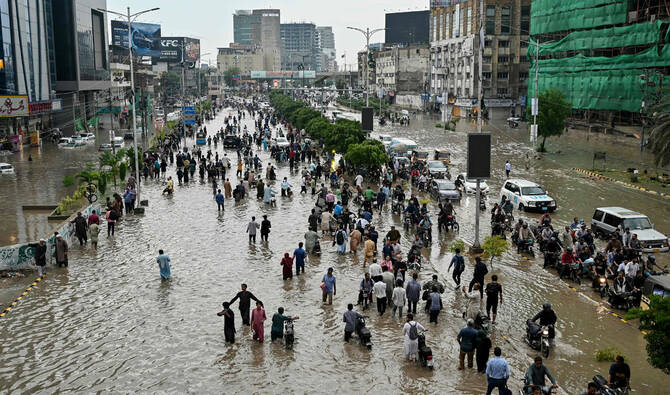
People wade through a flooded street after heavy rainfall in Karachi on August 19, 2025. (AFP)
Short Url
Updated 19 August 2025
Follow

Karachi under emergency as flash floods kill seven, paralyze Pakistan’s financial hub

  • The education department has announced closure of all schools and colleges in Karachi on Wednesday
  • Pakistan is currently witnessing an intense monsoon season that has killed over 700 people since June

KARACHI: Authorities in Pakistan’s Sindh province have imposed an emergency in Karachi, the country’s largest city and commercial capital, after flash floods triggered by heavy rain inundated vast swathes of the metropolis, killing at least seven people in separate incidents.

The downpour on Tuesday brought life to a standstill as several thoroughfares in the city of over 20 million were deluged by floodwaters. Rainwater entered homes in low-lying areas of the city, triggering power outages.

Local authorities advised people to avoid commuting as many returning from work and schools were stranded, with vehicles strewn along roads forcing many to navigate to safety in waist-deep water.

“The Mayor Karachi hereby declared Rain Emergency within the city of Karachi,” the Karachi Metropolitan Corporation (KMC), which oversees administrative affairs of the city, said in a notification.

“The municipal services, fire brigade and USAR (urban search and rescue) departments, KMC are directed to establish Rain Emergency Cell and coordinate with all Essential Services Departments.”

Separately, the provincial education department announced that all schools and colleges in Karachi will remain closed on Wednesday on account of the situation.

Hassaan Khan, a spokesperson for Sindh Rescue 1122 service, said their teams were working tirelessly across the city to respond to rain-related emergencies.

“Unfortunately, seven people have lost their lives in separate rain-related incidents, four in Gulistan-e-Jauhar after a house wall collapsed, one child in a wall collapse in Orangi and two by electrocution in North Karachi and Defense,” Khan told Arab News.


People wade through a flooded street after heavy rainfall in Karachi on August 19, 2025. (AFP)

Karachi, a city of more than 20 million with a dilapidated infrastructure, has often seen even moderate rains trigger flooding in parts of the city, threatening lives of residents and causing hours-long power outages.

The downpour in Karachi occurred at a time when Pakistan is witnessing an intense monsoon season that has already ravaged several areas, particularly in the country’s north where cloudburst-triggered deluges have killed nearly 400 people since Aug. 15.

In total, 707 Pakistanis have perished in this year’s monsoon season that began on June 26, according to the National Disaster Management Authority (NDMA). Two more spells of rains are expected in the country until mid-September, officials say.

The situation has raised fears of a repeat of the catastrophic 2022 floods that submerged a third of Pakistan and killed more than 1,700 people, besides causing $30 billion in economic losses.


Pakistan, Jordan agree to enhance cooperation in trade, energy, investment

Updated 4 sec ago
Follow

Pakistan, Jordan agree to enhance cooperation in trade, energy, investment

  • Pakistan, Jordan hold inter-ministerial commission meeting in Islamabad to discuss cooperation in several sectors
  • Both sides agree to form working group, Jordan-Pakistan Business Council to accelerate trade and investment cooperation

ISLAMABAD: Pakistan and Jordan have agreed to enhance cooperation in trade, investment, banking, energy and other economic sectors, Commerce Minister Jam Kamal Khan said on Thursday. 

The understanding was reached between the two sides at a meeting of the Pakistan-Jordan Inter-ministerial Commission in Islamabad on Thursday. 

Pakistan enjoys cooperation with Jordan in several sectors including trade, defense and minerals. Jordan was the fifth country to recognize Pakistan after it secured independence in 1947. The two nations established formal diplomatic ties in 1948. 

“Areas which cover a very diversified sectoral approach from trade and investment, industrial development, banking and finance, agriculture and livestock, higher education, vocational training, labor, health, climate change, maritime, energy, mineral resources and many more,” Khan said at a news conference with Jordanian Minister of Industry and Trade Yarub Qudah. 

The Pakistani minister said it was a “very good opportunity” for both sides to transform their brotherly relations into economic cooperation. 

Qudah agreed with Khan, saying it was time for Islamabad and Amman to take their economic and trade relations to “a totally different level.”

“We have also agreed to have a working group that will work this year on different sectors and also the establishment of the Pakistan-Jordan Business Council,” he said.

He invited Khan to Jordan to hold talks on further cooperation, adding that the 11th meeting of the inter-ministerial commission will be held in Jordan next year. 

The bilateral trade between Pakistan and Jordan stood at $46.58 million in 2023. Pakistan’s main exports to Jordan include textiles, rice, ethyl alcohol, polymers of styrene, sugar confectionaries, nuts and dried fruits.

Meanwhile, Pakistan mainly imports mineral and chemical fertilizers, ferrous waste and scrap, inorganic acids, chemicals, medicaments and seeds from Jordan.