

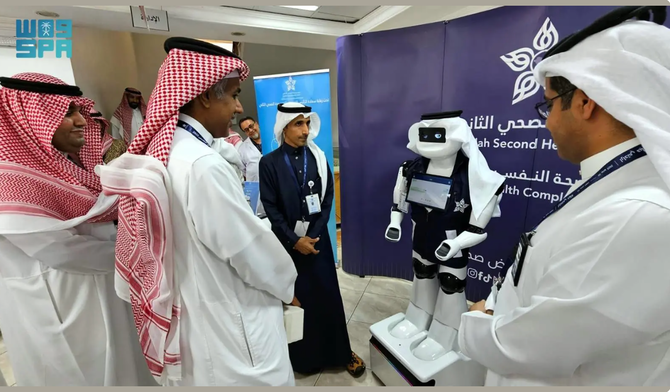
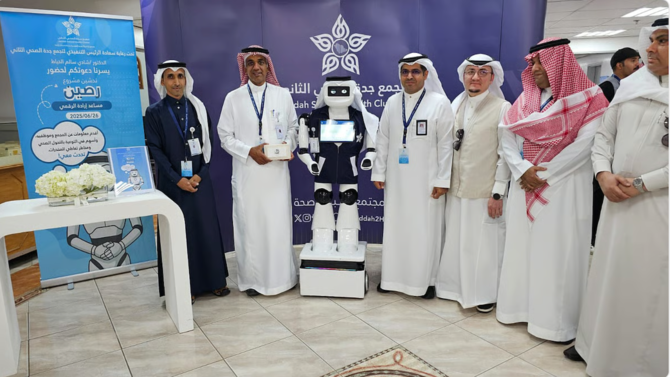

JEDDAH: Eradah Mental Health Complex in Jeddah recently unveiled a robot, named “Raseen,” as part of the digital health transformation underway in Saudi Arabia.
Raseen is Eradah’s digital assistant, designed to support patients on their recovery journey and raise community awareness about the dangers of substance abuse through advanced artificial intelligence and interactive educational content.
The name of the humanoid robot is derived from the Arabic word for sobriety, symbolizing a state of abstinence from drugs and alcohol while striving for balance in health, psychology, society and spirituality.
Unlike traditional robots that perform simple tasks such as serving drinks or working in restaurants, Raseen is an interactive humanoid.
Dressed in traditional Saudi attire, he listens to questions, analyses them, and responds with scientifically accurate answers.
Powered by advanced AI algorithms and precise scientific programming, Raseen exceeds the capabilities of ordinary chatbot systems, enabling its use in a variety of fields, including awareness campaigns, psychological support, administrative functions and more.
Dr. Khalid Al-Oufi, general supervisor of Eradah, told Arab News: “Raseen participates in international days, forums and conferences related to mental health and addiction.
“He also visits schools, universities, government facilities, walking tracks and sports clubs, where he privately listens to people’s concerns about mental health and addiction and provides clear, detailed responses.”
Al-Oufi, who is also a consultant psychiatrist, addiction specialist and head of the addiction division at the Saudi Psychiatric Association, added: “Raseen also raises awareness about the risks of mental illness and addiction, methods of early detection and intervention, available psychiatric services and how to access them, as well as prevention strategies to avoid relapse.”
In outpatient clinics and inpatient wards, Raseen plays a role in patient education during individual and group therapy sessions.
The robot explains the nature of psychiatric disorders and addiction, prevalence rates, causes and triggers, types of mental illnesses and narcotics, warning signs, complications, prognosis with or without treatment, and behavioral as well as pharmacological treatment options.
Al-Oufi further explained that Raseen supports administrative and professional development by educating staff about their rights and responsibilities, workplace policies and procedures, job descriptions and organizational structures.
He helps staff to understand Vision 2030 and the health sector transformation plan while offering suggestions for improvement and addressing employees’ inquiries.
AI in mental health: promise and challenges
The use of artificial intelligence in mental health is multifaceted. While there are concerns about job displacement, social isolation and ethical considerations, AI offers powerful opportunities to enhance access to care and strengthen mental health support.
Experts from the National Centre for Mental Health Promotion emphasize the importance of striking a careful and ethical balance between the benefits and challenges of AI to ensure a positive impact.
According to the NCMHP, AI has the potential to play a crucial role in diagnosis and treatment.
While this can improve medical outcomes, the NCMHP stresses that overreliance on AI could undermine the human connection between patients and caregivers, potentially leading to diminished trust.
Ethical issues remain at the forefront, particularly regarding data privacy and algorithmic bias. Data breaches or misuse of personal information could erode public trust in technology and fuel anxiety over privacy concerns.
Nevertheless, the NCMHP notes that the future of AI in mental health is promising. AI-driven applications and chatbots are being continuously developed to provide mental health support, and the number of AI tools in healthcare is expected to increase fivefold by 2035.


