

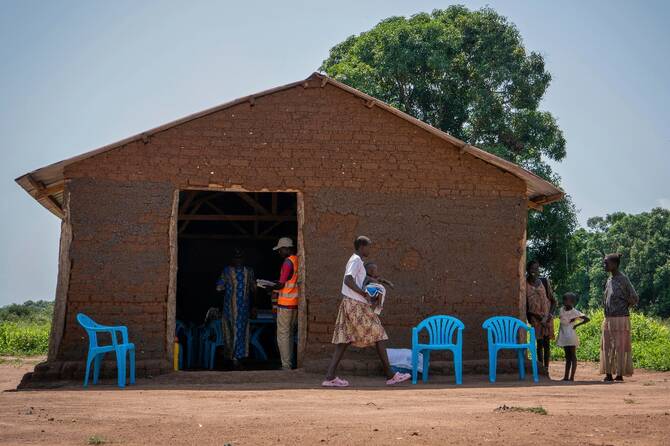

MUNDRI: Joy Falatiya said her husband kicked her and five children out of their home in March 2024 and that she fell apart after that. Homeless and penniless, the 35-year-old South Sudanese mother said she thought of ending her life.
“I wanted to take my children and jump in the river,” she said while cradling a baby outside a room with cracked mud walls where she now stays.
But she’s made a remarkable recovery months later, thanks to the support of well-wishers and a mental health clinic nearby where she’s received counseling since April.
She told The Associated Press that her suicidal thoughts are now gone after months of psycho-social therapy, even though she still struggles to feed her children and can’t afford to keep them in school.
The specialized clinic in her hometown of Mundri, in South Sudan’ s Western Equatoria state, is a rare and endangered facility in a country desperate for more such services. Now that the program’s funding from Italian and Greek sources is about to end and its future is unclear.
The clinic is in one of eight locations chosen for a project that aimed to provide mental health services for the first time to over 20,000 people across this East African country. Launched in late 2022, it proved a lifeline for patients like Falatiya in a country where mental health services are almost non-existent in the government-run health system.
Implemented by a group of charities led by Amref Health Africa, the program has partnered with government health centers, Catholic parishes, local radio stations.
Across South Sudan, there has been massive displacement of people in the civil war that began in 2013 when government troops loyal to President Salva Kiir fought those loyal to Vice President Riek Machar.
The eruption of fighting was a major setback for the world’s newest country, which became a major refugee-producing nation just over two years after independence from Sudan. Although a peace deal was reached in 2018, the resumption of hostilities since January led the UN to warn of a possible “relapse into large scale conflict.”
The violence persists even today, with Machar under house arrest and government forces continuing with a campaign to weaken his ability to wage war. And poverty — over 90 percent of the country’s people live on less than $2.15 per day, according to the World Bank — is rampant in many areas, adding to the mental health pressures many people face, according to experts.
In a country heavily dependent on charity to keep the health sector running, access to mental health services lags far behind. The country has the fourth-highest suicide rate in Africa and is ranked thirteenth globally, World Health Organization figures show.
In South Sudan, suicide affects mostly the internally displaced, fueled by confinement and pressures related to poverty, idleness, armed conflict, and gender-based violence, according to the International Organization for Migration.
“Mental health issues are a huge obstacle to the development of South Sudan,” said Jacopo Rovarini, an official with Amref Health Africa.
More than a third of those screened by the Amref project “show signs of either psychological distress or mental health disorders,” he said. “So the burden for the individuals, their families and their communities is huge in this country, and it has gone quite unaddressed so far.”
Last month, authorities in Juba raised an alarm after 12 cases of suicide were reported in just a week in the South Sudan capital. There were no more details on those cases.
Dr. Atong Ayuel Longar, one of South Sudan’s very few psychiatrists and the leader of the mental health department at the health ministry, said a pervasive sense of “uncertainty is what affects the population the most” amid the constant threat of war.
“Because you can’t plan for tomorrow,” she said. “Do we need to evacuate? People will be like, ‘No, no, no, there’s no war.’ Yet you don’t feel that sense of peace around you. Things are getting tough.”
In Mundri, the AP visited several mental health facilities in June and spoke to many patients, including women who have recently lost relatives in South Sudan’s conflict. In 2015, the Mundri area was ravaged by fighting between opposition forces and government troops, leading to widespread displacement, looting and sexual violence.
Ten years later, many have not recovered from this episode and fear similar fighting could resume there.
“There are many mad people in the villages,” said Paul Monday, a local youth leader, using a common derogatory word for those who are mentally unwell. “It’s so common because we lost a lot of things during the war. We had to flee and our properties were looted.”
“In our community here, when you’re mad you’re abandoned,” Monday said.
As one of the charities seeking to expand mental health services, the Catholic non-governmental organization Caritas organizes sessions of Self Help Plus, a group-based stress management course launched by WHO in 2021. Attended mostly by women, sessions offer simple exercises they can repeat at home to reduce stress.
Longar, the psychiatrist, said she believes the community must be equipped with tools “to heal and to help themselves by themselves, and break the cycle of trauma.”
But she worries about whether such support can be kept sustainable as funds continue to dwindle, reflecting the retreat by the United States from its once-generous foreign aid program.
The project that may have helped save Falatiya’s life, funded until November by the Italian Agency for Development Cooperation and the Athens-based Stavros Niarchos Foundation, will come to an end without additional donor funding. Specialized mental health services provided at health centers such as the Mundri clinic may collapse.
“What happened to me in the past was very dangerous, but the thought of bad things can be removed,” Falatiya said, surveying a garden she cultivates outside her small home where a local man has allowed her to stay after taking pity on her.
She said that she hopes the clinic will still be around if and when her “bad thoughts” return.


