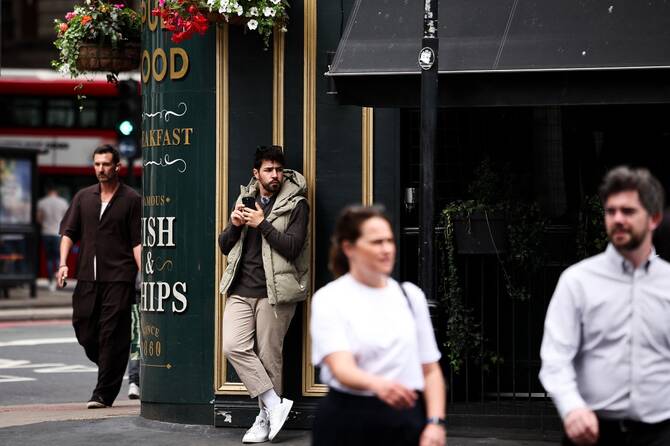

LONDON: On a recent weekday, Diego Galdino was on the hunt for pickpockets in central London, patrolling tourist hotspots for familiar suspects and telltale signs of those about to commit thefts.
Galdino, however, is not a policeman.
The Brazilian food app delivery rider has become a popular, social media-fueled vigilante targeting pickpocketing in the British capital.
He started filming — and then trying to disrupt — thieves in action after witnessing several incidents.
And his videos on Instagram, TikTok and other platforms under the handle “pickpocketlondon” have proved a hit.
One posted late July on TikTok amassed nearly 27 million views — another on Instagram showing a suspect spitting at him garnered more than 12 million.
“I didn’t know nothing about TikTok, I didn’t know nothing about uploading a video,” Galdino told AFP.
“I catch them stealing, I catch a lot of situations and I upload daily and grow very quickly,” he said.
Similar accounts have emerged in other European cities including Venice and Paris, as the era of mass tourism, social media and side hustles collides with crime and vigilantism.
Galdino said he was “completely surprised” by the response.
“My life’s changed a lot,” he added. Now, he said, he was inundated with media interview requests and got recognized by supporters and suspects alike.
Galdino, from a family of police officers in Brazil, said he has become expert at identifying likely thieves.
They appear well organized, are often women and work in pairs. They mainly target tourists, dressing like them to blend in, he said.
Standing outside Buckingham Palace, the 32-year-old said he could change his “perception” while patrolling to create a kind of tunnel vision.
A network of around 20 other delivery riders helps out, sending tip-offs via WhatsApp when suspects are spotted.
Once on the scene, Galdino swoops in filming with an attached camera, shouting a signature “pickypockets” warning to sound the alert.
“Watch out, pickypockets!” he yells.
His presence is not always welcomed though, and Galdino said he had faced violence.
But focus, adrenalin and a sense of “injustice” at the thefts overrode any fear, he said.
“I hate this kind of thing,” Galdino added. “These people get up in the morning ... (to) steal. They don’t pay tax, they don’t produce nothing to society.”
On the streets, locals as well as visitors seemed to appreciate his efforts.
“Keep doing what you’re doing!” said passerby Tom, 37, after recognizing Galdino.
“Hopefully tourists (who) come to London who maybe don’t know about the phone-snatchers see your videos.”
Sceptics however, have raised concerns about such vigilante content-creators, arguing they are ill-trained to intervene in potentially dangerous situations.
“We’ve got a kind of performative form of crime vigilantism for clicks,” criminologist Jennifer Fleetwood told AFP.
“I’m sure the guy is very well-meaning, but honestly this is not an effective form of crime control,” she added.
“He’s not going to be out there for the next 10 years, is he?” said Fleetwood, a university lecturer in criminology who wrote the book “What We Talk About When We Talk About Crime.”
London’s leaders insist they are tackling pickpocketing.
Labour Mayor Sadiq Khan boosted police numbers in the center to curb theft, robbery and antisocial behavior.
“We’ll be targeting hotspot areas with both plain-clothed and uniformed patrols, building on the progress we’ve already made,” the Metropolitan Police said.
Their statement did not comment directly on Galdino, but it did note a 15.6 percent reduction in “theft from the person” in the six weeks since their boost began April 6.
However, force’s statistics show it recorded more than 32,000 “thefts from the person” in the year to July in central Westminster.
That is up on the previous 12 months and a considerable increase on the year from July 2022.
Fleetwood argued the social media fixation on pickpocketing risked exaggerating the problem.
Statistics show such thefts are no more prevalent in the capital than other English cities and regions, she said.
“I’ve seen so much stuff on social media about London being unfriendly or London being dangerous.
“But ... is it the case that you’re more likely to be a victim of personal crime in London? Actually, no.”