WASHINGTON: The Trump administration on Friday reversed course and agreed to leave the Washington, D.C., police chief in control of the department, while Attorney General Pam Bondi, in a new memo, directed the District’s police to cooperate with federal immigration enforcement regardless of any city law.
The order from Bondi came after officials in the nation’s capital sued Friday to block President Donald Trump’s takeover of the Washington police. The night before, his administration had escalated its intervention into the city’s law enforcement by naming a federal official as the new emergency head of the department, essentially placing the police force under the full control of the federal government.
The attorney general’s new order represents a partial retreat for the Trump administration in the face of intense skepticism from a judge over the legality of Bondi’s earlier directive. But Bondi also signaled the administration would continue to pressure D.C. leaders to help federal authorities aggressively pursue immigrants in the country illegally, despite city laws on the books that limit cooperation between police and immigration authorities.
In a social media post Friday evening, Bondi criticized D.C. Attorney General Brian Schwalb, saying he “continues to oppose our efforts to improve public safety.” But she added, “We remain committed to working closely with Mayor Bowser, who is dedicated to ensuring the safety of residents, workers, and visitors in Washington, D.C.”
Mayor Muriel Bowser’s office said late Friday that it was still evaluating the Justice Department’s new order.
“What we know is that D.C. residents are worried and concerned and we have a surge of federal officers,” Bowser said during an earlier news conference outside the courthouse.
Metropolitan Police Department Chief Pamela Smith said Trump’s earlier move to sideline her would threaten law and order by upending the command structure. “In my nearly three decades in law enforcement, I have never seen a single government action that would cause a greater threat to law and order than this dangerous directive,” she said in a court filing.
The legal battle was the latest evidence of the escalating tensions in a mostly Democratic city that now has its police department largely under the control of the Republican president’s administration. Trump’s takeover is historic, yet it had played out with a slow ramp-up in federal law enforcement officials and National Guard troops to start the week.
As the weekend approached, though, signs across the city — from the streets to the legal system — suggested a deepening crisis over who controls the city’s immigration and policing policies, the district’s right to govern itself and daily life for the millions of people who live and work in the metro area.
A push for compromise
The two sides sparred in court for hours Friday before US District Judge Ana Reyes, who is overseeing the lawsuit. She indicated the law likely doesn’t grant the Trump administration power to fully take over city police, but it probably does give the president more power than the city might like.
“The way I read the statute, the president can ask, the mayor must provide, but the president can’t control,” said Reyes, who was nominated to the bench by Democratic President Joe Biden.
The judge pushed the two sides to make a compromise, promising to issue a court order temporarily blocking the administration from naming a new chief if they couldn’t agree.
An attorney for the Trump administration, Yaakov Roth, said in court that the move to sideline Smith came after an immigration order that still held back some aid to federal authorities. He argued that the president has broad authority to determine what kind of help police in Washington must provide.
The police takeover is the latest move by Trump to test the limits of his legal authorities to carry out his agenda, relying on obscure statutes and a supposed state of emergency to bolster his tough-on-crime message and his plans to speed up the mass deportation of people in the United States illegally.
It also marks one of the most sweeping assertions of federal authority over a local government in modern times. While Washington has grappled with spikes in violence and visible homelessness, the city’s homicide rate ranks below those of several other major US cities, and the capital is not in the throes of the public safety collapse the Trump administration has portrayed.
The president has more power over the nation’s capital than other cities, but D.C. has elected its own mayor and city council since the Home Rule Act was signed in 1973.
Trump is the first president to exert control over the city’s police force since it was passed. The law limits that control to 30 days without congressional approval, though Trump has suggested he’d seek to extend it.
Chief had agreed to share immigration information
Bondi’s Thursday night directive to place the head of the Drug Enforcement Administration, Terry Cole, in charge of the police department came even after Smith had told MPD officers hours earlier on Thursday to share information with immigration agencies regarding people not in custody, such as someone involved in a traffic stop or checkpoint. The Justice Department said Bondi disagreed with the police chief’s instructions because it allowed for continued practice of “sanctuary policies,” which generally limit cooperation by local law enforcement with federal immigration officers.
Meanwhile, immigrant advocates in Washington were trying to advise immigrants on how to respond to the new policies. Anusce Sanai, associate legal director for the Washington-based immigrant nonprofit Ayuda, said they’re still parsing the legal aspects of the policies.
“Even with the most anti-immigrant administration, we would always tell our clients that they must call the police, that they should call the police,” Sanai said. “But now we find ourselves that we have to be very careful on what we advise.”
Amy Fischer, an organizer with Migrant Solidarity Mutual Aid, said that before the federal takeover, most of what they had seen in the nation’s capital was Immigration and Customs Enforcement targeting specific individuals. But since last Friday night they’ve seen a “really significant change,” she said, with ICE and federal officers doing roving patrols around the city.
She said a hotline set up by immigration advocates to report ICE activity “is receiving calls almost off the hook.”
ICE said in a post on X that their teams had arrested “several” people in Washington Friday. A video posted on X showed two uniformed personnel putting handcuffs on someone while standing outside a white transport van.
Residents are seeing a significant show of force
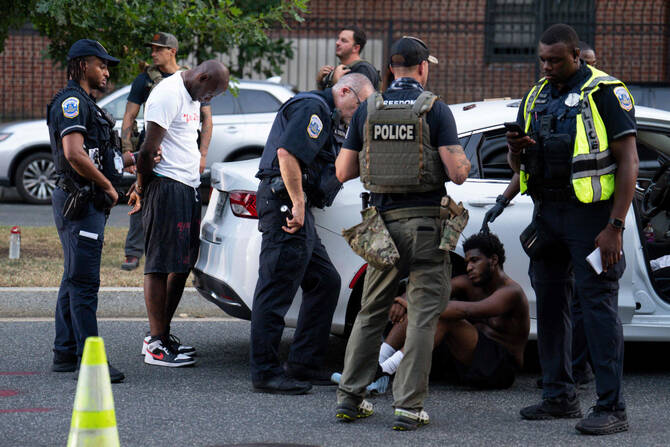
A population already tense from days of ramp-up has begun seeing more significant shows of force across the city. National Guard troops watched over some of the world’s most renowned landmarks, and Humvees took position in front of the busy main train station. Volunteers helped homeless people leave long-standing encampments — to where was often unclear.
Twenty federal law enforcement teams had fanned out across the city Thursday night with more than 1,750 people joining the operation, said a White House official, speaking on the condition of anonymity to discuss the operation. They made 33 arrests, including 15 migrants who did not have permanent legal status, the official said. Others were arrested on warrants for murder, rape and driving under the influence.
As the District challenged the Trump administration in court Friday, more than 100 protesters gathered less than a block away in front of police headquarters for a rally, chanting “Protect home rule!” and waving signs saying “Resist!“


![]()

Trump administration agrees to keep DC police chief in place, but with immigration enforcement order
Short Url
https://arab.news/zqq59
Trump administration agrees to keep DC police chief in place, but with immigration enforcement order
- Partial retreat came as DC officials sued to block President Trump’s takeover of the national capital's police
- In a new memo, Attorney General Bondi directed the District’s police to cooperate with immigration enforcement regardless of any city law


Latest updates


© 2026 SAUDI RESEARCH & PUBLISHING COMPANY, All Rights Reserved And subject to Terms of Use Agreement.