

Washington, D.C. residents protest as White House says federal agents will be on patrol 24/7

1 / 2
Members of the FBI and Police patrol near the Navy Yard on Aug. 13, 2025, after US President Donald Trump's announcement of the federal take over of the Metropolitan Police Department to assist in crime prevention in the nation's capital. (REUTERS)
2 / 2
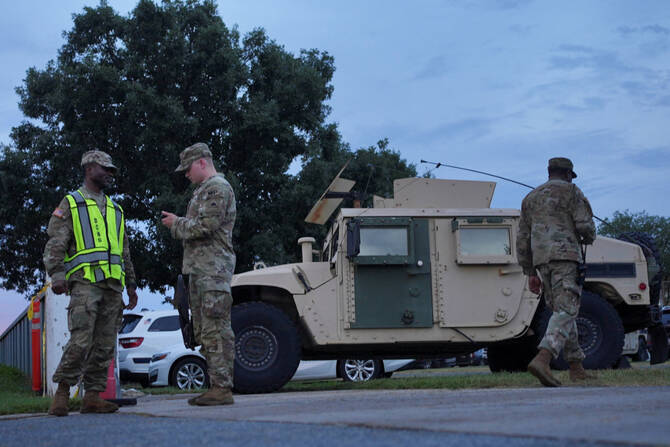
A member of the DC national guard and a member of the military police stand near a military vehicle at the US Park Police Anacostia Operations Facility in Washington, D.C., on August 13, 2025. (REUTERS)
Short Url
Updated 14 August 2025
Follow

Washington, D.C. residents protest as White House says federal agents will be on patrol 24/7

  • Trump has said crime in the city was at emergency levels that only such federal intervention could fix, even though DC leaders pointed to statistics showing violent crime at a 30-year low after a sharp rise two years ago

WASHINGTON: Residents in one Washington, D.C., neighborhood lined up Wednesday to protest the increased police presence after the White House said the number of National Guard troops in the nation’s capital would ramp up and federal officers would be the streets around the clock.
After law enforcement set up a vehicle checkpoint along the busy 14th Street Northwest corridor, hecklers shouted, “Go home, fascists” and other insults. Some protesters stood at the intersection before the checkpoint and urged drivers to turn away from it.
The action intensified a few days after President Donald Trump’s unprecedented announcement that his administration would take over the city’s police department for at least a month.
The city’s Democratic mayor walked a political tightrope, referring to the takeover as an “authoritarian push” at one point and later framing the infusion of officers as boost to public safety, though one with few specific barometers for success. The Republican president has said crime in the city was at emergency levels that only such federal intervention could fix — even as District of Columbia leaders pointed to statistics showing violent crime at a 30-year low after a sharp rise two years ago.
For two days, small groups of federal officers have been visible in scattered areas of the city. But a significant increase was expected Wednesday at the Guard’s armory and troops were expected to start doing more missions in Washington on Thursday, according to a Guard spokesman who spoke on condition of anonymity to describe the planning process.
On Wednesday, agents from Homeland Security Investigations patrolled the popular U Street corridor. Drug Enforcement Administration officers were seen on the National Mall, while National Guard members were parked nearby. DEA agents also joined Metropolitan Police Department officers on patrol in the Navy Yard neighborhood, while FBI agents stood along the heavily trafficked Massachusetts Avenue.


Residents of the area yell at agents of the Department of Homeland Security Investigations as they join Washington Metropolitan Police Department officers to conduct traffic checks in northwest Washington on ug. 13, 2025. (AP)

Hundreds of federal law enforcement and city police officers who patrolled the streets Tuesday night made 43 arrests, compared with about two dozen the night before.
D.C. Councilmember Christina Henderson downplayed the arrest reports as “a bunch of traffic stops” and said the administration was seeking to disguise how unnecessary this federal intervention is.
“I’m looking at this list of arrests and they sound like a normal Saturday night in any big city,” said Henderson.

Unlike in other US states and cities, the law gives Trump the power to take over Washington’s police for up to 30 days. Extending his power over the city for longer would require approval from Congress, and that could be tough in the face of Democratic resistance.
Trump suggested that he could seek a longer period of control or decide to call on Congress to exercise authority over city laws his administration sees as lax on crime. “We’re gonna do this very quickly. But we’re gonna want extensions. I don’t want to call a national emergency. If I have to, I will,” he said.
Later, on his Truth Social site, Trump reiterated his claims about the city, writing, “D.C. has been under siege from thugs and killers, but now, D.C. is back under Federal Control where it belongs.”
Henderson, who worked for Sen. Chuck Schumer of New York before running for the D.C. Council, said she was already in touch with “friends on the Hill” to rally opposition for any Trump extension request. She added, “It’s Day Three and he’s already saying he’s going to need more time?”
Targeting a variety of infractions

The arrests made by 1,450 federal and local officers across the city included those for suspicion of driving under the influence and unlawful entry, as well as a warrant for assault with a deadly weapon, according to the White House. Seven illegal firearms were seized.
There have now been more than 100 arrests since Trump began beefing up the federal law enforcement presence in Washington last week, White House spokeswoman Taylor Rogers said. “President Trump is delivering on his campaign promise to clean up this city and restore American Greatness to our cherished capital,” she said.

The president has full command of the National Guard and has activated up to 800 troops to support law enforcement, though exactly what form remains to be determined.
Neither Army nor District of Columbia National Guard officials have been able to describe the training backgrounds of the troops who have so far reported for duty.
While some members are military police, others likely hold jobs that would have offered them little training in dealing with civilians or law enforcement.
The federalization push also includes clearing out encampments for people who are homeless, Trump has said. US Park Police have removed dozens of tents since March, and plan to take out two more this week, White House press secretary Karoline Leavitt has said. People are offered the chance to go to shelters and get addiction treatment, if needed, but those who refuse could be fined or jailed, she said.
City officials said they are making more shelter space available and increasing their outreach.
Violent crime has dropped in the district
The federal effort comes even after a drop in violent crime in the nation’s capital, a trend that experts have seen in cities across the US since an increase during the coronavirus pandemic.


Caption

On average, the level of violence Washington remains mostly higher than averages in three dozen cities analyzed by the nonprofit Council on Criminal Justice, said the group’s president and CEO, Adam Gelb.
Police Chief Pamela Smith said during an interview with the local Fox affiliate that the city’s Metro Police Department has been down nearly 800 officers. She said the increased number of federal agents on the streets would help fill that gap, at least for now.
Mayor Muriel Bowser said city officials did not get any specific goals for the surge during a meeting with Trump’s attorney general, Pam Bondi, and other top federal law enforcement officials Tuesday. But, she said, “I think they regard it as a success to have more presence and take more guns off the street, and we do too.”
She had previously called Trump’s moves “unsettling and unprecedented” while pointing out he was within a president’s legal rights regarding the district, which is the seat of American government but is not a state.
For some residents, the increased presence of law enforcement and National Guard troops is nerve-racking.
“I’ve seen them right here at the subway ... they had my street where I live at blocked off yesterday, actually,” Washington native Sheina Taylor said. “It’s more fearful now because even though you’re a law-abiding citizen, here in D.C., you don’t know, especially because I’m African American.”
___
Associated Press writers Alanna Durkin Richer, Konstantin Toropin and Will Weissert, photographer Jacquelyn Martin and video journalist River Zhang contributed to this report.


How an Australian citizen of Syrian origin became the hero of Bondi Beach and his nation

Updated 3 sec ago
Follow

How an Australian citizen of Syrian origin became the hero of Bondi Beach and his nation

  • Ahmed Al-Ahmed tackled an armed attacker during the Sydney terror assault, sustaining injuries but saving countless lives
  • The son of Syrian Muslim immigrants from Idlib has been applauded by Australian and world leaders as a true national hero

LONDON: Bondi Beach, one of Australia’s most beloved seaside destinations, became the site of unspeakable violence on Sunday evening. What started as a joyful Hanukkah celebration attended by families and tourists transformed in moments into a scene of chaos and bloodshed.
Gunmen opened fire on crowds gathered for the “Chanukah by the Sea” event, leaving multiple people dead and dozens wounded. But amid the terror and panic, a single act of courage stood out.
An unarmed man tackled one of the attackers, wrestled a rifle from his hands and placed it out of reach, likely saving scores of lives. The man was Ahmed Al-Ahmed, a 43-year-old father of two, a fruit-shop owner and a Muslim Australian of Syrian heritage.
Before that night, Al-Ahmed was far from a public figure. He ran a modest fruit shop in Sydney’s Sutherland Shire, greeting customers by name and living a life centered on family, faith and community.
But his actions that evening transformed him from a quiet local business owner into a symbol of bravery recognized around the world.

According to his cousin Mustafa Al-Asaad, who spoke to Australian media after the attack, Al-Ahmed acted not out of calculation but conscience.
“When he saw people dying and their families being shot, he couldn’t bear to see people dying,” Al-Asaad said. “It was a humanitarian act, more than anything else. It was a matter of conscience.
“He’s very proud that he saved even one life. When he saw this scene, people dying of gunfire, he told me, ‘I couldn’t bear this. God gave me strength. I believe I’m going to stop this person killing people’.”
The footage that emerged soon after the attack captured the moment Al-Ahmed ran toward danger.
With chaos erupting around him, he sprinted at a gunman and brought him to the ground, disarming the attacker in the process. The images spread across television and social media, shocking viewers in Australia and beyond.

But the act of confronting an armed assailant came at great personal cost. Al-Ahmed was shot twice during the struggle, sustaining serious injuries to his hand and shoulder.
He was rushed to hospital and underwent surgery, where he remained in serious but stable condition as tributes poured in.
The attack itself has been widely condemned. Australian authorities quickly characterized it as a terrorist act, and Prime Minister Anthony Albanese made a public address praising the courage of civilians who confronted the gunmen.
“We have seen Australians today run towards danger in order to help others,” he said. “These Australians are heroes, and their bravery has saved lives.”
In a separate statement, New South Wales Premier Chris Minns wrote on Facebook: “His incredible bravery no doubt saved countless lives when he disarmed a terrorist at enormous personal risk.” 

New South Wales Premier Chris Minns visits Ahmed Al-Ahmed, who was identified on social media as the bystander who hid behind parked cars and seized a rifle from one of the gunmen during the deadly shooting at Bondi Beach on Sunday, at a hospital in Sydney, Australia, December 15, 2025. (Reuters)

Minns, who visited the injured Al-Ahmed at a hospital in Sydney on Sunday, said it was an honor to “to pass on the thanks of people across NSW.”
“There is no doubt that more lives would have been lost if not for Al-Ahmed’s selfless courage.”
Across the Pacific, US political leaders also weighed in. President Donald Trump, speaking at the White House, commended Al-Ahmed’s decisive action.
“It’s been a very, very brave person … who went and attacked frontally one of the shooters and saved a lot of lives,” Trump said. He referred to the Bondi Beach attack as “a terrible situation” but emphasized the courage that shone through in a moment of crisis. 

People pay respects at Bondi Pavilion to victims of a shooting during a Jewish holiday celebration at Bondi Beach, in Sydney, Australia, December 15, 2025. (Reuters)

For many observers, the images of Al-Ahmed intervening challenged simplistic narratives about identity and violence.
Here was a Muslim of Middle Eastern heritage, acting not out of ideology, but out of a sense of moral obligation and human solidarity, intervening to protect people — many of them Jewish — at a festival of light.
It was a moment that not only captured global attention but resonated deeply with communities confronting rising Islamophobia and antisemitism alike.
Muslim leaders in Australia and abroad condemned the violent attack while highlighting Al-Ahmed’s response as reflective of values shared across faith traditions. 

A police officer removes police tape from outside the house of the suspects of a shooting incident on a Jewish holiday celebration at Bondi Beach, in Bonnyrigg, Sydney, Australia, December 15, 2025. (Reuters)

His father, Mohamed Fateh Al-Ahmed, told reporters through an interpreter that he was proud of his son’s actions.
“He has the urge to protect people,” he said. “When he saw people lying on the ground and blood everywhere, his conscience and soul immediately compelled him to pounce on one of the terrorists and snatch the gun from him.
“I feel pride and honor — because my son is a hero of Australia.”
His mother, Malakeh Hasan Al-Ahmed, echoed her husband’s sentiments. 

People pay respects at Bondi Pavilion to victims of a shooting during a Jewish holiday celebration at Bondi Beach, in Sydney, Australia, December 15, 2025. (Reuters)

“He saw they were dying, and people were losing their lives, and when that guy (the shooter) ran out of ammo, he took it from him, but he was hit,” she said. “We pray that God saves him.”
Al-Ahmed’s family background is rooted in the Syrian diaspora. Relatives say his parents emigrated from the Idlib region, a part of northwest Syria marked by decades of conflict and displacement.
In Australia, they built a new life, working hard, raising children and becoming part of a multicultural society where people from many backgrounds live and work side by side.
It was in that environment — shaped by community ties yet rarely thrust into the spotlight — that Al-Ahmed grew up. A practising Muslim, he attended local mosque events and was known as a generous presence in his neighborhood. 

Health workers move a woman on a stretcher to an ambulance after a shooting incident at Bondi Beach in Sydney on December 14, 2025. (AFP)

His life before the attack was defined by ordinary concerns: early mornings at the fruit shop, football games with his children, weekend dinners with extended family. Nothing in his personal history suggested that he would become a symbol of defiance and courage in the face of terror.
After the attack, though, his community rallied around him. Messages of support and admiration came from across Australia, with neighbors who knew him before the tragedy expressing shock at the sudden spotlight.
Fundraisers were established to assist with medical costs and support his family, contributions arriving from customers, strangers, and community organisations alike.
Some donors said they contributed not only because of his heroism, but because his story felt like a reminder of shared humanity. 

A view of the scene at the Bondi Pavilion in the aftermath of the Bondi Beach shootings in Sydney on December 15, 2025. (AFP)

Yet Al-Ahmed himself, according to those close to him, has been humble about the attention. Friends said he does not seek accolades or applause.
The broader impact of the Bondi Beach attack has sparked national debate in Australia about public safety, religious tolerance, and how to confront extremism without dividing communities.
But across those conversations, Al-Ahmed’s act of bravery has offered a rare point of unity — a moment in which people of different backgrounds, religions and political views have recognized not just courage, but compassion.
In interviews with international outlets, scholars and civil society leaders have described Al-Ahmed’s intervention as a striking example of moral courage — an instinctive choice to protect others even at great risk to oneself. 

People gather in solidarity with victims of the Bondi beach attack in Sydney and to light the first candle of Hannukah, in front of the Australian embassy in Paris, France December 14, 2025. (Reuters)

International reaction to Al-Ahmed’s courage has also come from Jewish community leaders in Australia and abroad, many of whom expressed deep gratitude for his actions.
Some saw in his intervention an affirmation that solidarity can cross centuries-old divides, even in moments of profound fear.
When asked how he felt about the worldwide attention, one of his close friends said Al-Ahmed was overwhelmed but grateful, insisting that he hoped his story would not be used to sow division, but to encourage unity.
“I am proud that my son helped people, he saved lives, souls,” Al-Ahmed’s mother said. “God will not harm him because he was a benefactor. My son has always been brave, he helps people, that’s who he is.”