

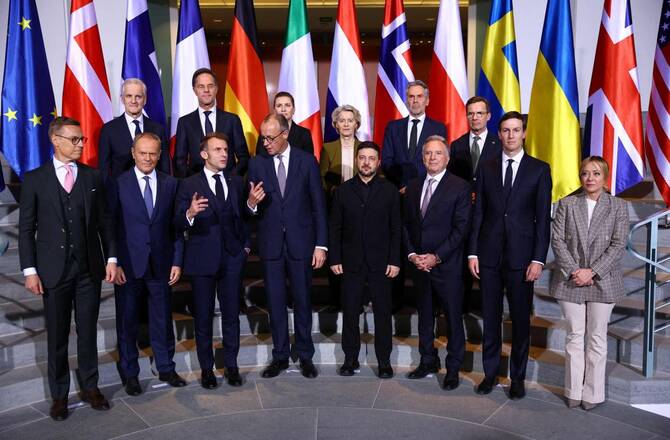
Zelensky hails ‘real progress’ in Berlin talks with Trump envoys

Ukrainian President Volodymyr Zelensky said Monday that talks in Berlin with US President Donald Trump’s envoys on ending the war with Russia were “not easy” but brought “real progress” on the question of security guarantees. (AFP)
Short Url
Updated 15 December 2025
Follow

Zelensky hails ‘real progress’ in Berlin talks with Trump envoys

  • Zelensky met for a second day with Trump’s special envoy Steve Witkoff and the president’s son-in-law Jared Kushner for talks

BERLIN: Ukrainian President Volodymyr Zelensky said Monday that talks in Berlin with US President Donald Trump’s envoys on ending the war with Russia were “not easy” but brought “real progress” on the question of security guarantees.
Zelensky met for a second day with Trump’s special envoy Steve Witkoff and the president’s son-in-law Jared Kushner for talks aimed at ending the war that started with Russia’s 2022 full-scale invasion, building on a proposal initially put forward by Trump.
He hailed new security guarantees offered by Washington but also said differences remained on the question of what territories Ukraine would have to cede to battlefield enemy Russia.
“There has been sufficient dialogue on the territory, and I think that, frankly speaking, we still have different positions,” Zelensky told reporters.
An upbeat German Chancellor Friedrich Merz said the talks had created the “chance for a real peace process” and praised the US for offering “substantial” security guarantees.
From Washington, Trump said he would hold a phone call later Monday with Zelensky and a group of European leaders set to meet in Berlin, among them UK Prime Minister Keir Starmer and French President Emmanuel Macron.
Also expected were Italian Prime Minister Giorgia Meloni, Polish premier Donald Tusk and Finland’s President Alexander Stubb and other leaders, as well as NATO chief Mark Rutte and European Commission head Ursula von der Leyen.
The United States said it had offered strong, NATO-like security guarantees to Ukraine and voiced confidence that Russia would accept, in what Washington said would be a breakthrough in ending the war.

- ‘Very strong deterrence’ -

US officials described the hours of talks in Berlin as positive and said Trump in his call would seek to push forward the deal.
The US officials warned Ukraine must accept the deal, which they said would provide security guarantees in line with NATO’s Article Five — which calls an attack on one ally an attack on all.
“The basis of that agreement is basically to have really, really strong guarantees — Article Five-like — also a very, very strong deterrence” in the size of Ukraine’s military, a US official said on condition of anonymity.
“Those guarantees will not be on the table forever. Those guarantees are on the table right now if there’s a conclusion that’s reached in a good way,” he said.
Trump has previously ruled out a formal entry of Ukraine into NATO and sided with Russia in calling Kyiv’s aspirations to the alliance a reason for the full-scale invasion by Moscow.
Merz said any ceasefire must be “secured by substantial legal and material security guarantees from the United States and Europe, which the United States has put on the table here in Berlin in terms of legal and material guarantees.”
“This is truly remarkable. This is a very important step forward, which I very much welcome,” he said.

- ‘Criminal attack’ -

Zelensky said about the talks with the US side that “these conversations are always not easy” but that it had been “a productive conversation.”
An official briefed on the US-Ukrainian talks earlier told AFP that US negotiators still want Ukraine to cede control of the eastern Donbas — made up of the Donetsk and Lugansk regions.
Moscow controls almost all of Lugansk and about 80 percent of the Donetsk region, according to the US-based Institute for the Study of War.
Russian President Vladimir Putin “wants territory,” said the official, adding that the United States was demanding that Ukraine “withdraw” from the regions and that Kyiv was refusing.
One of the US officials acknowledged that there was no agreement on territory.
Trump has called it inevitable that Ukraine would need to surrender territory to Russia, an outcome anathematic to Zelensky after his country’s defense of nearly four years.
Russia, meanwhile, has signalled it will insist on its core demands, including on territory and on Ukraine never joining NATO.
Kremlin spokesman Dmitry Peskov said on Monday that Russia was expecting the United States to “provide us with the concept that is being discussed in Berlin today.”
Merz vowed sustained support for Ukraine as it fights back against what he labelled “Putin’s criminal attack.”
“We will only be able to achieve lasting peace in Europe together, with a free and sovereign Ukraine, a strong Ukraine that can defend itself against Russian attacks now and in the future,” he said.
“The fate of Ukraine is the fate of all Europe.”



Australia to toughen gun laws as it mourns deadly Bondi attack

Updated 16 December 2025
Follow

Australia to toughen gun laws as it mourns deadly Bondi attack

  • Footage showed one man, identified by local media as fruit seller Ahmed al Ahmed, grabbing one of the gunmen as he fired
  • Prime Minister Anthony Albanese convened a meeting of leaders of Australia’s states and territories in response on Monday, agreeing with them “to strengthen gun laws across the nation”

SYDNEY: Australia’s leaders have agreed to toughen gun laws after attackers killed 15 people at a Jewish festival on Bondi Beach, the worst mass shooting in decades decried as antisemitic “terrorism” by authorities.
Dozens fled in panic as a father and son fired into crowds packing the Sydney beach for the start of Hanukkah on Sunday evening.
A 10-year-old girl, a Holocaust survivor and a local rabbi were among those killed, while 42 others were rushed to hospital with gunshot wounds and other injuries.
Prime Minister Anthony Albanese convened a meeting of leaders of Australia’s states and territories in response on Monday, agreeing with them “to strengthen gun laws across the nation.”
Albanese’s office said they agreed to explore ways to improve background checks for firearm owners, bar non-nationals from obtaining gun licenses and limit the types of weapons that are legal.
Mass shootings have been rare in Australia since a lone gunman killed 35 people in the town of Port Arthur in 1996, which led to sweeping reforms long seen as a gold standard worldwide.
Those included a gun buyback scheme, a national firearms register and a crackdown on ownership of semi-automatic weapons.
But Sunday’s shooting has raised fresh questions about how the two suspects — who public broadcaster ABC reported had possible links to the Daesh group — obtained the guns.

- ‘An act of pure evil’ -

Police are still unraveling what drove Sunday’s attack, although authorities have said it targeted Jews.
Albanese called it “an act of pure evil, an act of antisemitism, an act of terrorism on our shores.”
A string of antisemitic attacks has spread fear among Australia’s Jewish communities after the October 7, 2023, Hamas assault on Israel and the ensuing war in Gaza.
The Australian government this year accused Iran of orchestrating a recent wave of antisemitic attacks and expelled Tehran’s ambassador nearly four months ago.
But Israeli Prime Minister Benjamin Netanyahu accused Australia’s government of “pouring oil on the fire of antisemitism” in the months before the shooting, referring to Canberra’s announcement that it would recognize Palestinian statehood in August.
Other world leaders expressed revulsion, with US President Donald Trump condemning the “antisemitic attack.”
The gunmen opened fire on an annual celebration that drew more than 1,000 people to the beach to mark Hanukkah.
They took aim from a raised boardwalk at a beach packed with swimmers cooling off on the steamy summer evening.
Witness Beatrice was celebrating her birthday and had just blown out the candles when the shooting started.
“We thought it was fireworks,” she told AFP. “We’re just feeling lucky we’re all safe.”
Carrying long-barrelled guns, they peppered the beach with bullets for 10 minutes before police shot and killed the 50-year-old father.
The 24-year-old son was arrested and remains under guard in hospital with serious injuries.
Australian media named the suspects as Sajid Akram and his son Naveed Akram.
Tony Burke, the home affairs minister, said the father arrived in Australia on a student visa in 1998 and had become a permanent resident. The son was an Australia-born citizen.
Hours after the shooting, police found a homemade bomb in a car parked close to the beach, saying the “improvised explosive device” had likely been planted by the pair.
Rabbi Mendel Kastel said his brother-in-law was among the dead.
“We need to hold strong. This is not the Australia that we know. This is not the Australia that we want.”
Wary of reprisals, police have so far avoided questions about the attackers’ religion or ideological motivations.
Misinformation spread quickly online after the attacks, some of it targeting immigrants and the Muslim community.
Police said they responded to reports on Monday of several pig heads left at a Muslim cemetery in southwestern Sydney.

- Panic and bravery -

A brave few dashed toward the beach as the shooting unfolded, wading through fleeing crowds to rescue children, treat the injured and confront the gunmen.
Footage showed one man, identified by local media as fruit seller Ahmed al Ahmed, grabbing one of the gunmen as he fired.
The 43-year-old wrestled the gun out of the attacker’s hands, before pointing the weapon at him as he backed away.
A team of off-duty lifeguards sprinted across the sand to drag children to safety.
“The team ran out under fire to try and clear children from the playground while the gunmen were firing,” said Steven Pearce from Surf Life Saving New South Wales.
Bleeding victims were carried across the beach atop surfboards turned into makeshift stretchers.
On Monday evening, a flower memorial next to Bondi Beach swelled in size as mourners gathered.
Hundreds, including members of the Jewish community, sang songs, clapped and held each other.
Leading a ceremony to light a menorah candle, a rabbi told the crowd: “The only strength we have is if we bring light into the world.”
