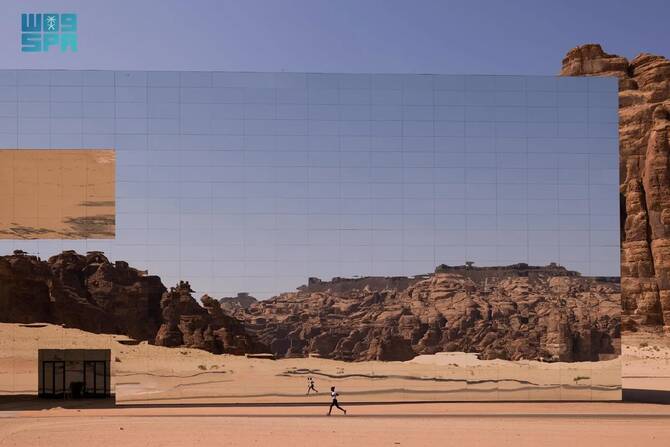

RIYADH: AlUla Desert Blaze, an annual race, kicked off again this year on Friday with over 500 runners from various countries taking up the challenge.
The event is held over two days and is open to all levels of runners, from professionals to amateurs. Four race distances — 5 km, 10 km, 21.1 km (half marathon), and 42.2 km (full marathon) — take the competitors through AlUla’s dramatic landscapes, from sand dunes to historical landmarks.
For 42-year-old Mohammed Dakhil, AlUla holds a special place in his heart as it is where he had his first 50 km ultramarathon trail run in 2023.
“That was the first time I ever got to experience running in the landscape of AlUla and just seeing the natural beauty of it. Any opportunity I get to come and run is something that I always look forward to, because for some reason, it’s the one place that really allows me to disconnect and feel like I can really connect with myself and be present when I’m running,” he told Arab News.
Dakhil will take part in the race on Saturday. The courses begin at Hegra, a UNESCO World Heritage Site, while the full marathon route passes near the Maraya building and other prominent AlUla sites.
As a regular runner and chief operating officer of the gym chain N2Fitness, Dakhil is a dedicated trainer — whether endurance, strength, or functional training. For him, running is more mental than physical. “In terms of actual marathon running, the 42 km distance, during my training, I would take the distances up to 21 km, 25 km, and so on. So that enables me to be able to do the distance comfortably,” he said.
Distance runners frequently hit a mental block that hinders the body’s capacity to continue under pain and pressure — this is where the “real training” happens to prepare for such races.
“No matter how much physical training I do, to get through a marathon and to do it in a positive way, a big part of it is really more mental than people think,” Dakhil said.
“What attracts me to this is I still get to see the beautiful landscape of AlUla, but it presents a different challenge, and that challenge is that it’s extremely hot. To really see how far I can go and I can withstand and continue to push through the summer heat while under the sun is a different challenge of its own. And, honestly, that’s something that I love doing. I just love pushing myself to the limit.”
Saudi Arabia launched its first official marathon in 2022 and is committed to expanding the fitness scene, so it comes as no surprise that the annual marathon attracts international participation.
“I feel very proud every year as a Saudi to see these events being hosted in Saudi and to see, year over year, how the community grows, and the amount of people that come to these events grows,” Dakhil said.
“We notice it. And the best part about it is that you see people from all around the world, and it really makes us proud.”
The race takes place in the same month as Dakhil’s birthday — an opportunity he takes to celebrate the occasion and achieve a new goal.
Lebanese American competitor Ali Younes also shares a birthday in August. The run is partly a celebration, but also a chance to give back to the place where his running journey began. Younes started taking running more seriously when he moved to the Kingdom a year ago and joined the running community We Run.
“Everybody that comes to this group, sometimes (starting) from scratch, has found their way and path to develop, and they found the support from the coaches and even from the running mates,” he said.
Younes has lived in several countries due to his job in the UN, but said that “I haven’t seen such a supportive community in any other place.”
He spent four months preparing for the race, and also plans to run the Chicago Marathon in October.
Younes, who trains with the We Run group and his personal coach Hadeel Ashour, said that running is also “about nutrition, hydrating your body, sleeping well, and mental toughness.”
He added: “Running is always easy to do. If you want to run, run a 1 km, but if you really want to experience life with all its ups and downs and challenges, you need to run a marathon.”
While the summer heat might discourage some, especially in the midst of the desert, the runners said that the challenge will only add to the satisfaction of finishing their races.
Aghiad Massarani, who also began running two years ago after joining We Run, has been training for the past six weeks for AlUla Desert Blaze. “I’ve done a mix of speed sessions, long runs, and heat runs. I even did a couple of afternoon runs to help my body adapt to the climate,” he said.
The race takes place amid AlUla’s diverse natural landscapes, offering participants an exceptional sporting experience in a destination that celebrates the beauty of nature and the spirit of community and adventure.
The race is considered one of the key events in the AlUla Moments calendar activities held throughout the year, allowing visitors and participants the opportunity to explore the rich natural and historical landmarks of the region.