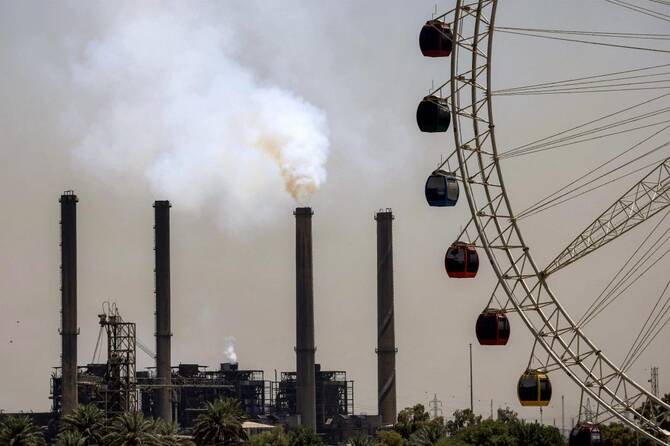
BAGHDAD: Electricity supply returned to all Iraq’s provinces on Tuesday, a government official told AFP, expecting the grid’s full recovery within a day after a nationwide power outage.
Electricity shortages are a frequent complaint in Iraq, suffering from endemic corruption and dilapidated public infrastructure.
Most households rely on private generators, acquired to compensate for daily power cuts to public electricity.
On Monday, the electricity ministry said that “a record rise in temperatures” coupled with a surge in demand resulted in the shutdown of transmission lines, which then led to a total outage.
A senior ministry official, speaking on condition of anonymity, told AFP on Tuesday that “since midnight, all provinces have seen the return” of power supply.
The official cautioned that “it is happening gradually,” with the central province of Karbala, where millions of Shiite Muslim pilgrims were expected for a major religious commemoration, being “the first to recover its electricity.”
In the capital Baghdad, the grid was back to 95 percent of its normal capacity, said the official.
The outage came amid a heatwave that Iraqi meteorological services expect to last more than a week, with temperatures climbing as high as 50C in parts of the country.
While the vast majority of Iraqis rely on private generators, they often cannot power all household appliances, especially air conditioners.
Iraq is sometimes rocked by protests when outages worsen in the hot summer months.
To avoid outages during peak demand, Iraq would need to produce around 55,000 megawatts of electricity.
This month, for the first time, the country’s power plants reached the 28,000-megawatt threshold.
The electricity ministry official said that “the system has returned to normal and is stable,” producing 24,000 megawatts and expected to reach 27,000 once the final malfunctions related to Monday’s outage are resolved.

Iraq electricity gradually back after nationwide outage
https://arab.news/cyrvt
Iraq electricity gradually back after nationwide outage
- Most households rely on private generators, acquired to compensate for daily power cuts to public electricity
- In the capital Baghdad, the grid was back to 95 percent of its normal capacity, said the official
Iran war chokes aid corridors, obstructing global relief efforts
- “People in dire need of assistance will have to wait longer for food,” said Bauer
- Tents, tarpaulins and lamps destined for Gaza and the West Bank have become stuck in the supply chain, the IOM said
GENEVA: Key humanitarian air, sea and land routes are being constricted by disruption from the war in the Middle East, delaying life-saving shipments to some of the world’s worst crises, 10 aid officials have told Reuters.
The US–Israeli war on Iran entered its seventh day on Friday, convulsing global markets and disrupting supply chains with airspace closures and the halt of shipping through the critical Strait of Hormuz.
Aid to Gaza and Sudan is grinding to a halt and costs are soaring for help to the hundreds of millions suffering hunger crises around the world.
“People in dire need of assistance will have to wait longer for food,” said Jean-Martin Bauer, Director of Food Security at the World Food Programme.
Already, tents, tarpaulins and lamps destined for the Israeli-occupied Palestinian territories of Gaza and the West Bank have become stuck in the supply chain, the International Organization for Migration said.
DUBAI AID HUB HOBBLED BY AIR AND SEA RESTRICTIONS
Aid groups say higher operational costs are straining budgets already facing massive donor cuts. The IOM said shipping firms were demanding emergency surcharges of approximately $3,000 per container.
Humanitarian groups stocking goods for rapid regional deployment at warehouses in Dubai’s Humanitarian Hub face challenges moving supplies onto transit routes.
The International Federation of Red Cross and Red Crescent Societies cannot move trauma kits to help the Iranian Red Crescent with search and rescue from its Dubai hub, where they sit in a estimated 1 million Swiss franc ($1.28 million) pre-positioned emergency stockpile, said Cecile Terraz, a director at the IFRC.
The group cannot move stock through Jebel Ali port — the region’s largest container terminal, which was set on fire by the debris of an intercepted missile — from where cargo normally moves onto planes or into the Strait of Hormuz.
The World Health Organization’s Dubai hub operations are also frozen, regional director Hanan Balkhy said, obstructing 50 emergency requests from 25 countries and hampering operations such as polio vaccination.
Ripple effects farther afield are also likely.
Famine-struck Sudan is particularly exposed due to additional restrictions since February 28 on the Suez Canal and the Bab el-Mandeb Strait at the southern entrance to the Red Sea, the UNHCR said.
“We are particularly concerned about Africa,” said a spokeswoman, adding that some cargoes were being sent around the Cape of Good Hope. The route takes up to three weeks longer.
Costs for fuel, transportation and insurance are also rising, and Terraz said the IFRC may have to cut deliveries to the Iranian Red Crescent.
Emma Maspero, senior manager in Copenhagen of the supply division of the UN children’s body UNICEF, said she hoped flights carrying perishable humanitarian goods such as vaccines could be prioritized amid the airspace restrictions.