

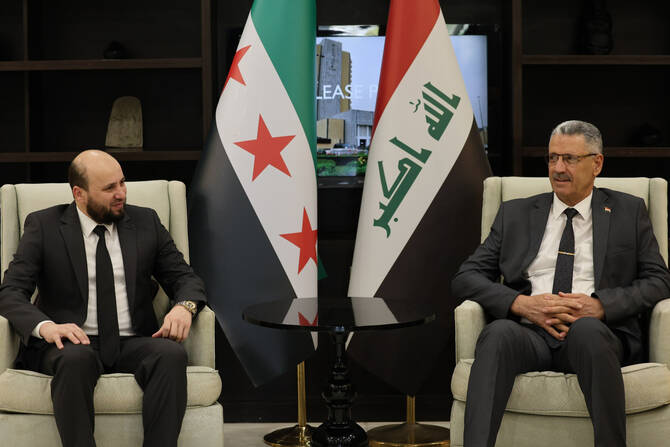
Syrian, Iraqi energy ministers discuss Kirkuk–Baniyas oil pipeline

The Syrian Arab Republic’s Energy Minister Mohammed Al-Bashir and Iraq’s Deputy Prime Minister and Oil Minister Hayan Abdul Ghani. (SANA)
Short Url
Updated 12 August 2025
Follow

Syrian, Iraqi energy ministers discuss Kirkuk–Baniyas oil pipeline

  • Pumping stations along route largely destroyed, need restoration
  • Discussions included plans for laying optical cables alongside pipelines, connecting them to Lebanon

LONDON: The Syrian Arab Republic’s Energy Minister Mohammed Al-Bashir on Tuesday discussed strengthening bilateral cooperation in the energy sector with Iraq’s Deputy Prime Minister and Oil Minister Hayan Abdul Ghani.

Al-Bashir stressed Syria’s need for oil imports, and proposed linking pipelines between the two countries, noting that the Kirkuk-Baniyas line was no longer functional.

Iraq’s deputy prime minister spoke of his country’s interest in reactivating the 850 km pipeline and suggested evaluating whether to repair it or build a new one due to regional events affecting oil exports, the Syrian Arab News Agency reported.

Pumping stations along the Kirkuk–Baniyas route are largely destroyed and need full restoration, the SANA added.

Discussions in Baghdad also included plans for laying optical cables alongside the oil pipelines and connecting them to Lebanon. Both parties agreed to establish joint technical teams and a primary coordination committee.

Syrian Deputy Energy Minister Ghiyath Diab also attended the meeting.


Syrian army chief, SDF delegation discuss integration measures

The meeting addressed military deployment and administrative arrangements. (SANA)
Updated 9 sec ago
Follow

Syrian army chief, SDF delegation discuss integration measures

  • Iraqi and Syrian security officials told The Associated Press that the US military had begun moving its forces and equipment from the Qasrak base in Syria to Iraq’s semi-autonomous Kurdish region

DAMASCUS: Syrian Chief of Staff Maj. Gen. Ali Al-Naasan on Sunday met a delegation from the Syrian Democratic Forces to discuss steps for integrating SDF units into several brigades of the Syrian Arab Army.
The Defense Ministry said that the meeting also addressed military deployment and administrative arrangements.
Syria announced on Jan. 29 a comprehensive agreement with the SDF that includes a ceasefire, a phased integration of forces, and the return of state institutions and border crossings to government control.

BACKGROUND

Syria announced on Jan. 29 a comprehensive agreement with the SDF that includes a ceasefire and a phased integration of forces.

The media directorate of the presidency earlier announced that Brig. Gen. Ziad Al-Ayesh has been appointed as a presidential envoy to implement the Jan. 29 agreement.
The directorate said in a statement to SANA that the agreement enhances the state’s presence, removes obstacles and activates government services for citizens.
The deal includes a phased integration of military and administrative bodies, the deployment of security forces into Hasaka and Qamishli, and the state’s administration of civil institutions and border crossings.
The UN Security Council has welcomed the agreement. The council also praised the start of implementation and reaffirmed its commitment to Syria’s sovereignty and territorial integrity.
In a recent press statement, council members said the agreement must be upheld to ensure civilian protection, unhindered humanitarian access and Syria’s continued recovery.
Meanwhile, US forces were withdrawing from Qasrak base in northeastern Syria, in what appears to be part of a larger drawdown of US forces in the country.
Iraqi and Syrian security officials told The Associated Press that the US military had begun moving its forces and equipment from the Qasrak base in Syria to Iraq’s semi-autonomous Kurdish region.
AP journalists in the city of Qamishli in northeast Syria saw a convoy of dozens of trucks carrying military vehicles and equipment on Monday, with military helicopters circling overhead, moving toward the Iraqi border.
A senior Iraqi security official said evacuation of the base had begun Sunday and that on Monday, US forces and military equipment coming from the base crossed into Iraq’s semi-autonomous northern Kurdish region.
A Syrian security official said about 200 soldiers remained at the base on Monday and that work was underway to dismantle military jamming and air defense systems, and the engineering section at the base.
Earlier this month, CENTCOM and Syria’s Defense Ministry announced that US troops had left another base, Al-Tanf, located in eastern Syria near the border with Jordan.
Meanwhile, Syrian authorities are repairing key infrastructure at Deir Ezzor Civil Airport ahead of flights being resumed. 
Syria’s General Authority of Civil Aviation and Air Transport announced on Monday that technical and engineering teams were repairing the runway, essential facilities, and rebuilding the airport’s perimeter fence to meet international safety and security standards.