

Thousands take to streets across Pakistan to protest US-Israeli strikes on Iran

Police stand guard near containers in Islamabad, Pakistan, on March 6, 2026. (AN Photo)
Short Url
Updated 07 March 2026
Follow

Thousands take to streets across Pakistan to protest US-Israeli strikes on Iran

  • Protests were called by religio-political parties Jamaat-e-Islami and Majlis-e-Wahdatul Muslimeen
  • Nationwide protests over the war in Iran have left 26 people dead in clashes with law enforcement

ISLAMABAD: Thousands of protesters rallied in cities across Pakistan on Friday, answering the call of major religio-political parties to condemn ongoing US-Israeli strikes on Iran and the killing of Iranian Supreme Leader Ayatollah Ali Khamenei.

The demonstrations come amid a volatile regional climate marked by Iran’s retaliatory strikes on Israel and US interests in the Gulf.

Khamenei was killed in the first hours of the US-Israeli air campaign that began on Saturday in the first assassination of a country’s top ruler by an airstrike.

The joint air assault, now nearing the end of its first week, has sparked violent unrest in Pakistan. At least 26 protesters have been killed in clashes with law enforcement since the war began in the region last Saturday.

In the capital, a protest was held outside the central Imam Bargah in Sector G-6 under the banner of the Majlis-e-Wahdatul Muslimeen (MWM). The protest drew hundreds of participants, according to MWM Islamabad leader Mazhar Shigri.

“We intended to march from the central Imam Bargah to D-Chowk to register our peaceful protest, but the route was blocked with containers,” he said. “We held the rally outside the Imam Bargah to express solidarity with Iran and draw attention of the international community to Israeli and American attacks.”

Security was beefed up and routes leading to sensitive government and diplomatic buildings in Pakistan’s capital had been closed by authorities to prevent any untoward incident.
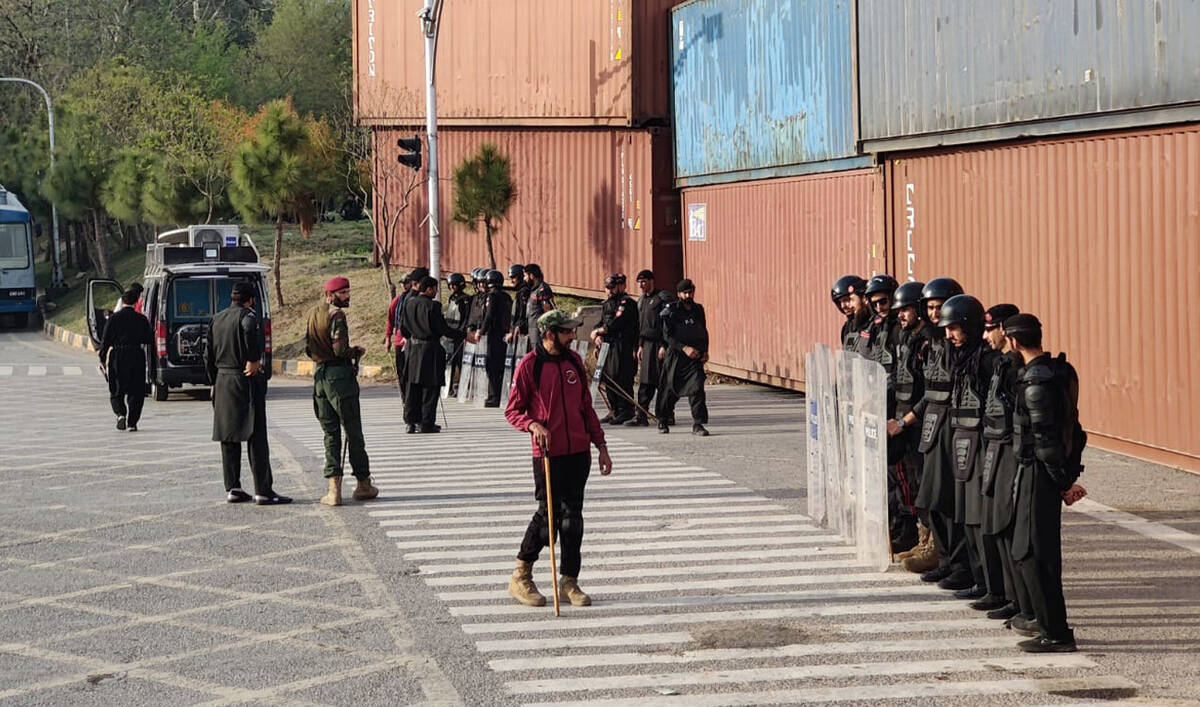


Police stand guard near containers cordoning off protests routes in Islamabad, Pakistan, on March 6, 2026. (AN Photo)

In Islamabad’s Aabpara area, another religio-political party Jamaat-e-Islami’s (JI) leader Nasrullah Randhawa and Secretary General Zubair Safdar addressed protesters.

“The US and Israel attacked Iran under the pretext of its nuclear program. Such aggression is not just against Iran but against the entire Muslim world,” Randhawa addressed the rally.

Shakil Tarabi, central information secretary of JI told Arab News that demonstrations were carried out under its banner in every district headquarters across the country, with large turnouts in major cities including Islamabad.

Peaceful protests by JI in Sindh, Khyber Pakhtunkhwa and Multan condemned US-Israeli attacks on Iran and the killing of Khamenei, with participants calling for the Muslim Ummah and Pakistan’s withdrawal from the “Board of Peace” led by US President Donald Trump.

In Karachi, a protest organized by MWM was held, alongside a rally by Dukhtaran-e-Millat on M.A. Jinnah Road. A large number of women and children attended, holding pictures of the late Iranian Supreme Leader, placards and banners condemning the US and Israel. Female organizers from JI’s women’s wing, along with lawyers and civil society members, joined the demonstration.

Demonstrators in Pakistan’s southern port city of Karachi stormed the US Consulate on Sunday, smashing windows and attempting to burn the building. Police responded with batons and tear gas. Reuters reported that US Marines inside the building shot at the protesters, leaving 10 dead and more than 50 injured.

The US embassy and its consulates in Karachi and Lahore canceled visa appointments and American Citizen Services this week, citing security concerns.


On International Women’s Day, activist Abia Akram urges women with disabilities not to hide

Updated 6 sec ago
Follow

On International Women’s Day, activist Abia Akram urges women with disabilities not to hide

  • With over two decades of advocacy, Akram says disability is her identity to be celebrated
  • Women with disabilities face four times higher GBV risk, often overlooked by rights movements

ISLAMABAD: On this International Women’s Day, Abia Akram has a message for young women with disabilities: do not hide.

Born with a physical mobility impairment, the 40-year-old Pakistani activist has spent more than two decades advocating for the rights of women with disabilities while working with governments and international organizations to push for greater inclusion and a rights-based approach to disability.

For Akram, International Women’s Day is also an opportunity to challenge stigma and encourage women with disabilities to speak openly about their identities and experiences.

“I would say disability is nothing to worry about, and it’s not an issue that we need to address,” she said. “It’s just a thing to celebrate it, with all its diversity and impact. There’s no need to worry about disability, just enjoy life with it.”

Akram’s advocacy journey began in 1997, when public perceptions of disability in the region were often shaped by stereotypes representing two extremes.

“They are very close to Allah, so we have to respect them,” she said, recalling one such view. “Or on the other extreme, people were thinking they are a punishment.”

Activist Abia Akram speak to Arab News in Islamabad, Pakistan, on March 7, 2026. (AN photo)

As a woman from a developing country without a “strong background,” she said the fight for recognition and rights came with its own challenges.

In 2009, she founded the National Forum of Women with Disabilities, an initiative that helped bring attention to the challenges faced by women and girls with disabilities who were often overlooked even within their own families.

“Many parents used to pray that their daughters die before them, because there was no support system available,” she said.

Her own experience, however, was different. She credits her parents for encouraging her education and independence from an early age.

“My parents were really supportive because they were telling me like education is the most important thing. If you are qualified, if you are educated, then you have the world to contribute to.”

Today, Akram’s work extends beyond Pakistan. She serves as chair of the Global Forum on the Leadership of Women with Disabilities and is a trustee for Sightsavers, working with organizations including the UK’s Foreign, Commonwealth &

Development Office (FCDO) and humanitarian groups to promote a shift from a medical model of disability to a rights-based approach.

She is also currently chair of the Aging Disability Diversity Task Force, chief executive of the National Forum of Women with Disabilities and an executive member of the Commonwealth Disability Forum.

Akram says women with disabilities often face multiple layers of discrimination — within their families, in education, in employment and in public life.

According to advocacy data she cited, women with disabilities experience four times greater gender-based violence (GBV) and sexual harassment than women without disabilities.

Her work includes training programs that address systemic barriers and collaboration with government institutions such as Pakistan’s National Assembly, the Ministry of Human Rights and the National Commission on the Status of Women.

In recent years, Akram has also focused on using technology to address these challenges.

Last month at the Zero Project Conference in Vienna, she received a global award for “Noor AI,” an accessible mobile application designed to assist women with disabilities who are survivors of gender-based violence.

Akram argues that the difficulties often associated with disability arise not from individuals themselves but from environments that fail to accommodate different needs.

She illustrates the point with an analogy comparing wheelchairs to cars.

“Are you using a wheelchair? But you came in a car, which has the wheels and the chair. So, you are also using the wheelchair, but you park your wheelchair outside and mine is inside,” she said.

“It’s just about the diversity, accepting the diversity, not fixing the person.”

In Pakistan, she says there has been legislative progress in protecting the rights of persons with disabilities, pointing to the Rights of Persons with Disabilities Act 2020 in Islamabad and similar laws in Sindh and Balochistan.

However, she believes more work is needed in regions such as Azad Jammu and Kashmir and Khyber Pakhtunkhwa to strengthen legal protections and implementation.

Despite receiving international recognition, including the Zero Project Award and the Human Rights Award, Akram says such honors mainly reinforce her sense of responsibility.

She remains particularly focused on addressing what she describes as “double discrimination,” where women with disabilities are sometimes overlooked both within mainstream women’s movements and within male-dominated disability advocacy spaces.

As the world marks International Women’s Day, Akram says the goal must remain justice, empowerment and equality that includes everyone.

“Disability is my identity and I’m very proud of it. It’s about how we take that identity in a positive way, in a dignified way,” she said.

“It’s not about just celebrating, but also taking that positive initiative, the commitment, like how we can change the life of other people.”