

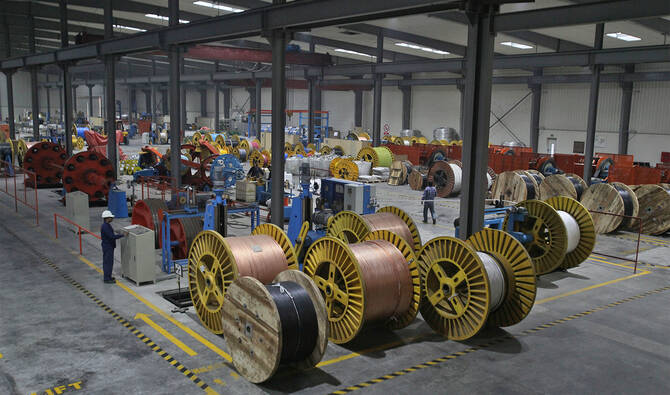

ISLAMABAD: Pakistan’s commerce ministry has finalized a strategy for a recently negotiated tariff deal with the United States that Islamabad says could unlock American investment in the country’s vast copper reserves, and submitted it to Prime Minister Shehbaz Sharif for approval, an official said on Tuesday.
The agreement, announced last month by US President Donald Trump, set a reduced tariff rate of 19 percent on Pakistani imports, the government says is the lowest in the region and will help revive bilateral trade while paving the way for US firms to participate in Pakistan’s mines and minerals sector.
The South Asian nation ranks fifth globally in copper deposits, with major sites in Balochistan and Khyber Pakhtunkhwa positioning it as a potential major supplier to international markets.
“The commerce ministry has formulated a strategy for the tariff deal, which includes US investment in the mines and minerals sector, particularly copper, and forwarded it to the Prime Minister’s Office,” Naveed Kallu, a public relations officer at the ministry, told Arab News. “The final decision will be made by the prime minister and after approval further work will proceed as per that strategy.”
Kallu said the most significant aspect of the deal was the US commitment to invest in Pakistan’s minerals sector, noting that in similar agreements with countries like South Korea, Japan and the United Kingdom, those nations invested in the US in return for tariff reductions.
“The working group between the US and Pakistan is finalizing the modalities, and the American side will recommend its companies for copper exports from Pakistan,” he added.
No memorandum of understanding related to the arrangement has been signed yet, but talks are said to be progressing well.
Pakistan is also in advanced-stage discussions with Middle Eastern companies to export minerals, the official said.
In a report to the National Assembly earlier this week, the country’s commerce minister, Jam Kamal Khan, confirmed that during reciprocal tariff talks, the US expressed interest in investing in copper mining and processing in Pakistan, without naming companies.
He noted that while Washington has imposed 50 percent tariffs on imports of copper, iron, steel and aluminum, refined copper has been exempted, making value-added copper exports more attractive for Pakistani producers.
By focusing on value-added exports, such as refined copper, bars, rods and alloys, rather than raw ores, the minister said Pakistan could capture greater economic benefits from its mineral resources.
He recommended detailed geological mapping by the Geological Survey of Pakistan (GSP) and improvements to infrastructure such as mine access roads and dedicated power supply to attract private sector investment and technology transfer
“Streamlining regulatory frameworks and addressing infrastructural gaps, such as mine access roads and dedicated power supply, will attract private sector involvement and technological innovation,” the statement added.
Arab News sought comment from the US Embassy in Islamabad, the US Commerce Department and the GSP but received no responses before the publication of this story.
Industry leaders say Pakistan’s mineral wealth remains underexploited due to a lack of refineries and quality-testing facilities.
“Pakistan has vast mineral reserves including copper but lacks proper refineries to process them,” said Meer Behrose Regi, president of the All Pakistan Mines & Minerals Association.
He said with adequate investment in refinery infrastructure, the country could export high-quality finished products rather than raw materials.
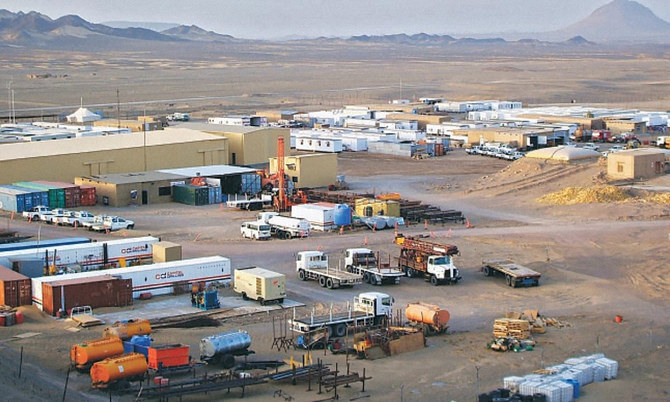
A file photo of the site of the gold and copper mine exploration project of Tethyan Copper Company (TCC) in Reko Diq, in Balochistan, Pakistan. (Photo courtesy: TCC)
Dr. Umer Aziz, a geologist, said US firms could play a transformative role if they invested in processing facilities.
“Pakistan needs substantial investment in refineries and other infrastructure, and if US firms are ready to invest, it would be an excellent opportunity to tap the sector’s vast potential,” he said, adding that projects like Reko Diq, which holds both copper and gold reserves, would be a natural target.


