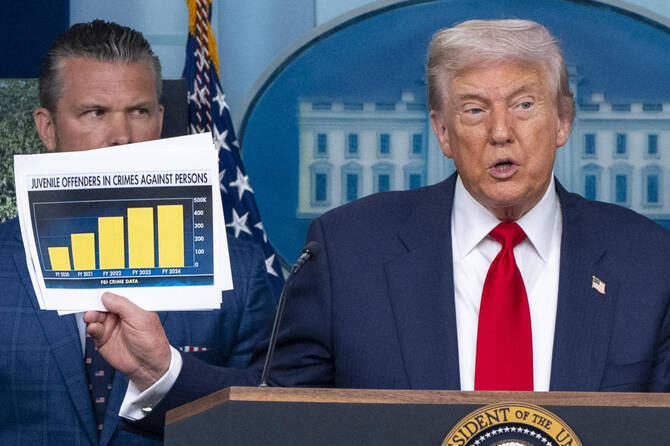

WASHINGTON: US President Donald Trump said on Monday he was deploying 800 National Guard troops to Washington and temporarily taking over the city’s police department, an extraordinary assertion of presidential power in the nation’s capital.
Trump’s move, which bypassed the city’s elected leaders, was emblematic of his second-term approach, which has seen him wield executive authority in ways with little precedent in modern US history and in defiance of political norms.
The president cast his actions as necessary to “rescue” Washington from a purported wave of lawlessness. Statistics show that violent crime shot up in 2023 but has been rapidly declining since.
“Our capital city has been overtaken by violent gangs and bloodthirsty criminals,” Trump told a news conference at the White House.
It is the second time this summer that the Republican president has deployed troops to a Democratically governed city. A federal trial began on Monday in San Francisco on whether Trump violated US law by deploying National Guard troops to Los Angeles in June without the approval of California Governor Gavin Newsom.
And Trump signaled that other major US cities with Democratic leadership could be next, including Chicago, a city that has long been beset by violent crime, although it was down significantly in the first half of the year.
“If we need to, we’re going to do the same thing in Chicago, which is a disaster,” Trump said at the White House, adding, “Hopefully L.A. is watching.”
During Trump’s election campaign his law and order platform often had racial undertones. He singled out majority Democratic cities like Baltimore, Chicago and Washington — all cities with large Black populations — when he spoke about rampant crime in urban areas.
Hundreds of officers and agents from more than a dozen federal agencies have fanned out across Washington in recent days. Attorney General Pam Bondi will oversee the police force, Trump said.
The US Army said the National Guard troops would carry out a number of tasks, including “administrative, logistics and physical presence in support of law enforcement.” Between 100 and 200 of the troops would be supporting law enforcement at any given time.
The Democratic mayor of Washington, Muriel Bowser, has pushed back on Trump’s claims of unchecked violence, noting that violent crime hit its lowest level in more than three decades last year.
Violent crime, including murders, soared in 2023, turning Washington into one of the nation’s deadliest cities. However, violent crime dropped 35 percent in 2024, according to federal data, and it has fallen an additional 26 percent in the first seven months of 2025, according to city police.
Bowser struck a diplomatic tone at a news conference, saying she and other members of her administration would work with the federal government, even as she again rejected Trump’s claim of widespread crime.
While Bowser said the law appeared to give the president broad power to take temporary control of the police force, the city’s attorney general, Brian Schwalb, earlier called Trump’s actions “unlawful” and said his office was “considering all of our options.”
Over the past week, Trump has intensified his messaging, suggesting he might attempt to strip the city of its local autonomy and implement a full federal takeover.
The District of Columbia operates under the Home Rule Act, which gives Congress ultimate authority but allows residents to elect a mayor and city council.
Trump on Monday invoked a section of the act that allows the president to take over the police force for 30 days when “emergency” conditions exist. Trump said he was declaring a “public safety emergency” in the city.
Trump’s own Federal Emergency Management Agency is cutting security funding for the National Capital Region, an area that includes D.C. and parts of Maryland and Virginia. The region will receive $20 million less this year from the federal urban security fund, amounting to a 44 percent year-on-year cut.
Trump also vowed to remove homeless encampments, without providing details on how or where homeless people would be moved.
The federal government owns much of Washington’s parkland, so the Trump administration has legal authority to clear homeless encampments in those areas, as President Joe Biden did while in office. But the federal government cannot force people to move out of the city because they lack shelter, advocates for the homeless said.
The president has broad authority over the 2,700 members of the D.C. National Guard, unlike in states where governors typically hold the power to activate troops.
Guard troops have been dispatched to Washington many times, including in response to the January 6, 2021, attack on the US Capitol by Trump supporters, and during 2020 protests over police brutality.