

Pakistan PM Sharif to seek clarity on troops for Gaza in US visit, sources say

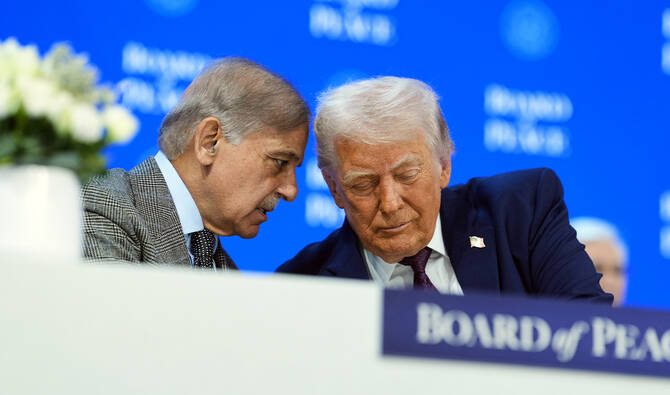
US President Donald Trump speaks with Prime Minister of Pakistan Shehbaz Sharif (left) during a signing of the Board of Peace charter on the sidelines of the Annual Meeting of the World Economic Forum in Davos, Switzerland, on January 22, 2026. (AP/File)
Short Url
Updated 18 February 2026
Follow

Pakistan PM Sharif to seek clarity on troops for Gaza in US visit, sources say

  • Trump’s 20-point Gaza plan calls for ‌a force from Muslim nations to oversee transition period for reconstruction and economic recovery
  • Sharif ‌wants to understand goal of ISF, what authority they would ​operate ‌under, ​what ⁠chain of command is before deploying troops

ISLAMABAD: Before Pakistan commits to sending troops to Gaza as part of the International Stabilization Force it ​wants assurances from the United States that it will be a peacekeeping mission rather than tasked with disarming Hamas, three sources told Reuters.

Pakistan’s Prime Minister Shehbaz Sharif is set to attend the first formal meeting of President Donald Trump’s Board of Peace in Washington on Thursday, alongside delegations from at least 20 countries.

Trump, who will chair the meeting, is expected to announce a multi-billion dollar reconstruction plan for Gaza and detail plans for a UN-authorized stabilization force for the Palestinian enclave.

Three government sources said during the Washington visit Sharif ‌wanted to better ‌understand the goal of the ISF, what authority they were ​operating ‌under ⁠and ​what the ⁠chain of command was before making a decision on deploying troops.

“We are ready to send troops. Let me make it clear that our troops could only be part of a peace mission in Gaza,” said one of the sources, a close aide of Sharif.

“We will not be part of any other role, such as disarming Hamas. It is out of the question,” he said.

Pakistan’s foreign ministry did not respond to a Reuters request for a comment.

FORCE ⁠TO OVERSEE RECONSTRUCTION AND RECOVERY

Trump’s 20-point Gaza plan calls for ‌a force from Muslim nations to oversee a ‌transition period for reconstruction and economic recovery in the devastated ​Palestinian territory, and Washington has been pressing ‌Islamabad to join.

Analysts say Pakistan would be an asset to the multinational force, with ‌its experienced military that has gone to war with arch-rival India and tackled insurgencies.

“We can send initially a couple of thousand troops anytime, but we need to know what role they are going to play,” the source added.

Two of the sources said it was likely Sharif, who has met Trump ‌earlier this year in Davos and late last year at the White House, would either have an audience with him on ⁠the sidelines of the ⁠meeting or the following day at the White House.

BALANCING FACTORS

Initially designed to cement Gaza’s ceasefire, Trump sees the Board of Peace, launched in late January, taking a wider role in resolving global conflicts. Some countries have reacted cautiously, fearing it could become a rival to the United Nations.

While Pakistan has supported the establishment of the board, it has voiced concerns against the mission to demilitarise Gaza’s Islamist militant group Hamas.

Analysts say Islamabad will need to strike a balance between pleasing Trump by providing troops and any potential domestic fallout in a predominantly Muslim nation.

Husain Haqqani, a former Pakistan ambassador to the United States, said the Pakistani public supported sending troops to Gaza only to help protect Palestinians.

“If developments ​in Gaza after the deployment do ​not improve the position of Palestinians, there could be a massive reaction at the public level in Pakistan,” said Haqqani, currently a scholar at the Hudson Institute in Washington.


Tens of thousands of Afghans displaced by Pakistan conflict

Updated 5 sec ago
Follow

Tens of thousands of Afghans displaced by Pakistan conflict

  • UN says violence displaced approximately 20,000 families across multiple provinces
  • Pakistan accuses Afghanistan of supporting militant groups, a charge the Taliban denies

KABUL: Tens of thousands of Afghans have been forced from their homes by fighting with Pakistani forces along the border in recent days, the United Nations said Tuesday.

The neighbors have clashed along the frontier since Thursday, when Afghanistan launched a border offensive in retaliation for Pakistani air strikes.

Islamabad has hit back along the border and with fresh air strikes, bombing multiple sites including the former US air base at Bagram, the capital Kabul and the southern city of Kandahar.

The violence has triggered “displacement of approximately 20,000 families” across multiple provinces, the UN World Food Programme (WFP) said.

“Approximately 160,000 people have been impacted by the suspension of emergency food distributions,” the WFP added, with people in multiple areas already experiencing acute malnutrition.

In Kunar province, a laborer told AFP that the violence had prevented people from getting to the market.

“Thousands of families have left the village” of Sirkanay, said Asadullah, who only gave one name.

“In some houses, only one person has stayed to guard the home, and the rest have left. The village has become empty,” the 30-year-old added.

At least 42 civilians have been killed and 104 wounded since Thursday, including children, the UN mission in Afghanistan reported.

Afghanistan said the latest casualties include three children killed in a “crime committed by the Pakistani military regime” in Kunar province, deputy government spokesman Hamdullah Fitrat said Monday.

Pakistan has not commented on Afghan civilian casualties.

As civilians flee, Afghanistan’s defense ministry reported “extensive and heavy offensive and revenge attacks” across seven provinces over the past day.

The government acknowledged earlier air strikes on Bagram for the first time, with the defense ministry saying “there were no casualties or damage.”

Two residents told AFP on Sunday that they had heard air strikes in Bagram, north of the capital.

Pakistani security sources said strikes at Bagram were based on “credible intelligence” to disrupt the “supply of critical equipment and stores” for Afghan soldiers and militants fighting Pakistani forces along the frontier.

Pakistani fighter jets also flew nighttime sorties over Kabul, another security source told AFP.

‘Finish this menace’

Islamabad’s confirmation that its aircraft flew over the Afghan capital came hours after AFP journalists in the city heard multiple explosions.

The blasts were heard alongside anti-aircraft weapons and gunfire from across the city.

An AFP journalist in Jalalabad city, between Kabul and the frontier, reported hearing explosions and various weapons being fired.

At the nearest border crossing, around 50 kilometers (30 miles) from Jalalabad, residents in Torkham told AFP the days-long fighting was ongoing.

Pakistan said its February air strikes that sparked the escalation were targeting militants.

Islamabad accuses Afghanistan of failing to act against militant groups that carry out attacks in Pakistan, which the Taliban government rejects.

Pakistan’s Foreign Minister Ishaq Dar said on Tuesday it was “never too late to talk,” but warned: “We will finish this menace.”

Afghanistan’s defense ministry spokesman, Enayatullah Khowarazmi, said more than 25 soldiers have been killed.

He estimated Pakistani fatalities among troops at around 150, while Pakistan says more than 430 Afghan soldiers have been killed.

Casualty claims from both sides are difficult to verify independently.

The violence of recent days is the worst since October fighting killed more than 70 people on both sides, with land borders between the neighbors largely shut since.