

US designates Balochistan Liberation Army, active in Pakistan, as ‘foreign terrorist organization’

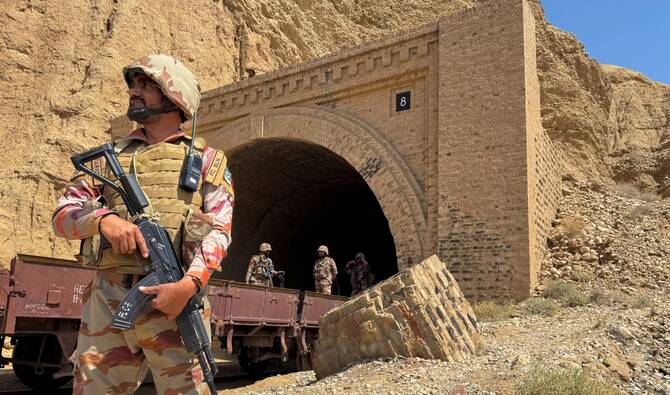
Pakistan army soldiers stand at a tunnel where the Jaffar Express train was attacked by separatist militants, in Bolan, Balochistan, Pakistan, March 15, 2025. (REUTERS)
Short Url
Updated 11 August 2025
Follow

US designates Balochistan Liberation Army, active in Pakistan, as ‘foreign terrorist organization’

  • The BLA is the most prominent of separatist groups operating in Pakistan’s Balochistan, the site of a long-running insurgency
  • The foreign terrorist organization designation by US triggers restrictions on providing financial support, other aid to such groups

KARACHI: The United States (US) is designating the Balochistan Liberation Army (BLA), a separatist militant group active in Pakistan’s southwestern Balochistan province, as a “foreign terrorist organization,” the State Department said on Monday.

Balochistan, Pakistan’s largest but most impoverished province, has been the site of a long-running insurgency that has intensified in recent months, with separatist militants attacking security forces, government officials and installations and people from other provinces.

The BLA, which also uses the alias of ‘The Majeed Brigade,’ is the most prominent of separatist groups in Balochistan, which borders Iran and Afghanistan and is home to key China-led infrastructure projects, including a port and a gold-copper mine.

In March, the group claimed responsibility for the hijacking of the Jaffar Express train traveling from Quetta to Peshawar, killing 31 civilians and security personnel and holding hostage over 300 train passengers. In 2024, it claimed suicide attacks on Chinese nationals in Karachi and Gwadar.

“Today’s action taken by the Department of State demonstrates the Trump Administration’s commitment to countering terrorism,” Secretary of State Marco Rubio was quoted as saying by the State Department.

“Terrorist designations play a critical role in our fight against this scourge and are an effective way to curtail support for terrorist activities.”

The foreign terrorist organization designation by the US triggers restrictions on providing financial support and other aid to the group.

The US designation of the BLA comes amid a spike in militant violence in Pakistan’s Balochistan, which Islamabad has blamed on India and Afghanistan. New Delhi and Kabul deny the allegation.

On Monday, Pakistan Railways suspended all train services to and from the insurgency-hit southwestern province for four days after separatists blew up a railway track, derailing six cars of the Jaffar Express train, officials said. The BLA claimed responsibility for the attack, which came as Pakistan prepares to mark its 79th Independence Day on Aug. 14.

Separatist groups operating in the mineral-rich region accuse the central government of stealing their resources to fund development elsewhere in the country. The federal government denies the allegations and says it is working for the uplift of local communities in Balochistan.


Pakistan’s annual consumer price rose 5.8 percent year on year in January — statistics bureau

Updated 26 min 7 sec ago
Follow

Pakistan’s annual consumer price rose 5.8 percent year on year in January — statistics bureau

  • The reading comes a week after the Pakistani central bank held its policy rate at 10.50 percent
  • It said inflation may exceed its ‌5-7 percent ​medium-term ‌target range for a few months this year

ISLAMABAD: Pakistan’s consumer price inflation rose 5.8 percent year-on-year in January, official data showed on ​Monday, underscoring the central bank’s warning that price pressures could temporarily breach its target band as economic activity picks up.

The reading comes a week after the central bank held its policy rate at 10.50 percent, ‌saying inflation ‌could exceed its ‌5 percent ⁠to 7 percent ​medium-term ‌target range for a few months this year, even as growth gains momentum and imports push the trade deficit wider.

The reading from the Pakistan Bureau of Statistics compared with 5.6 percent in ⁠December, when prices fell on a monthly ‌basis due to lower perishable ‍food costs.

On ‍a month-on-month basis, inflation increased by ‍0.4 percent in January.

The State Bank of Pakistan said it viewed the real policy rate as sufficiently positive to stabilize inflation ​over the medium term, even as it flagged stronger domestic demand ⁠and external pressures as upside risks to prices.

Pakistan’s finance ministry had projected inflation would remain within a 5 percent to 6 percent range in January.

An International Monetary Fund staff report has cautioned against premature monetary easing under Pakistan’s $7 billion loan program, urging policymakers to remain data-dependent to anchor inflation expectations and rebuild ‌external buffers.