

Colombia ex-president sentenced to 12 years of house arrest, document shows

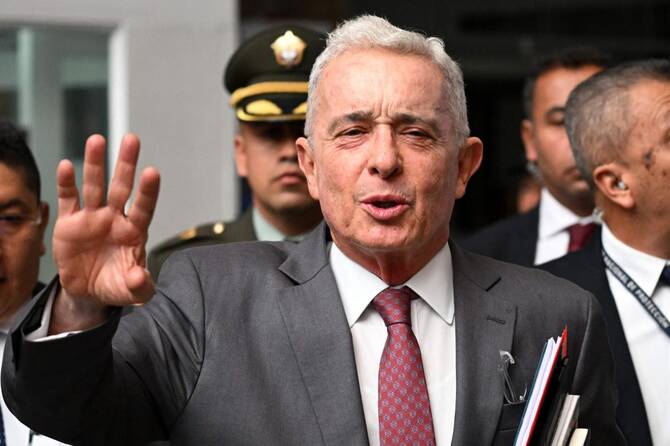
Colombian former President Alvaro Uribe gestures as he speaks to the press outside a court complex at the end of his trial in Bogota on February 10, 2025. (AFP)
Short Url
Updated 01 August 2025
Follow

Colombia ex-president sentenced to 12 years of house arrest, document shows

  • Uribe was convicted of the two charges on Monday by Judge Sandra Liliana Heredia
  • Uribe will be fined $578,000 in the case, the document showed

BOGOTA: Former Colombian President Alvaro Uribe will be sentenced on Friday to 12 years of house arrest for abuse of process and bribery of a public official, according to a document seen by Reuters and a source with knowledge of the matter.

Uribe was convicted of the two charges on Monday by Judge Sandra Liliana Heredia in a witness-tampering case that has run for about 13 years. He has always maintained his innocence.

The information, also published by local media, came hours ahead of the hearing where Heredia will read the sentence in court.

Uribe will be fined $578,000 in the case, the document showed.

The conviction made him the country’s first ex-president to ever be found guilty at trial and came less than a year before Colombia’s 2026 presidential election, in which several of Uribe’s allies and proteges are competing for top office.

It could also have implications for Colombia’s relationship with the US: Secretary of State Marco Rubio said this week Uribe’s conviction is a “weaponization of Colombia’s judicial branch by radical judges” and analysts have said there could be cuts to US aid in response.

Uribe, 73, and his supporters have always said the process is a persecution, while his detractors have celebrated it as deserved comeuppance for a man who has been accused for decades of close ties with violent right-wing paramilitaries but never convicted of any crime until now.


Australia hits Afghan Taliban officials with sanctions, travel bans

Updated 6 sec ago
Follow

Australia hits Afghan Taliban officials with sanctions, travel bans

  • The Taliban has said it respects women’s rights, in line with its interpretation of Islamic law and local custom
  • The measures were part of a new Australian government framework that enabled it to “directly impose its own sanctions and travel bans to increase pressure on the Taliban, targeting the oppression of the Afghan people,” Wong said

SYDNEY: Australia on Saturday imposed financial sanctions and travel bans on four officials in Afghanistan’s Taliban government over what it said was a deteriorating human rights situation in the country, especially for women and girls.
Australia’s Foreign Minister Penny Wong said the officials were involved “in the oppression of women and girls and in undermining good governance or the rule of law” in the Taliban-run country.
Australia was one of several nations which in August 2021 pulled troops out of Afghanistan, after being part of a NATO-led international force that trained Afghan security forces and fought the Taliban for two decades after Western-backed forces ousted the Islamist militants from power.
The Taliban, since regaining power in Afghanistan, has been criticized for deeply restricting the rights and freedoms of women and girls through bans on education and work.
The Taliban has said it respects women’s rights, in line with its interpretation of Islamic law and local custom.
Wong said in a statement the sanctions targeted three Taliban ministers and the group’s chief justice, accusing them of restricting access for girls and women “to education, employment, freedom of movement and the ability to participate in public life.”
The measures were part of a new Australian government framework that enabled it to “directly impose its own sanctions and travel bans to increase pressure on the Taliban, targeting the oppression of the Afghan people,” Wong said.
Australia took in thousands of evacuees, mostly women and children, from Afghanistan after the Taliban retook power in the war-shattered South Asian country, where much of the population now relies on humanitarian aid to survive.