

US trade deal likely to bring huge investments to Pakistan, army chief tells overseas Pakistanis

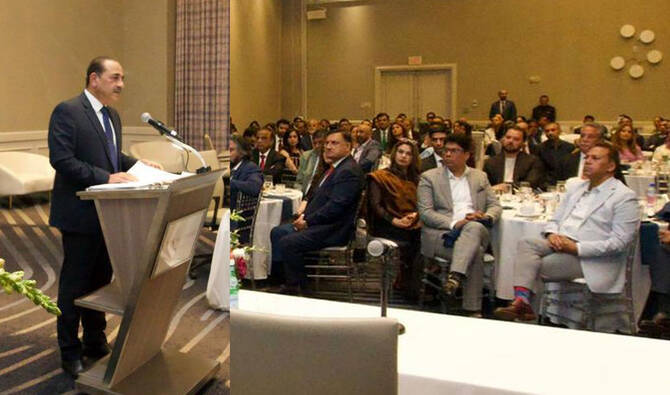
Pakistan Army Chief Field Marshal Asim Munir addresses a group of overseas Pakistanis in the US on August 10, 2025. (Radio Pakistan)
Short Url
Updated 10 August 2025
Follow

US trade deal likely to bring huge investments to Pakistan, army chief tells overseas Pakistanis

  • The statement comes during Field Marshal Asim Munir’s second visit to the US in less than two months
  • Field Marshal Munir says his visits aim to take bilateral ties to ‘constructive, sustainable and positive path’

KARACHI: Pakistan’s recent trade deal with the United States (US) is expected to bring huge investments to the South Asian country, Pakistani military sources said on Sunday, citing Army Chief Field Marshal Asim Munir who is on a visit to the US.

Field Marshal Munir has engaged with senior American military and political leadership during his ongoing visit, after years of strained relations mainly due to disagreements over counter‑terrorism issues.

Pakistan eyes greater collaboration with the US under President Donald Trump and both nations have appeared to be keen to rebuild their military and economic relationship in recent months.

On Sunday, the army chief met a group of overseas Pakistanis and spoke with them about his visits and a host of issues of national significance for Islamabad, according to Pakistani military sources.

“My second visit after a gap of just one and a half months marks a new dimension in Pakistan-US relations,” Field Marshal Munir was quoted as saying.

“The aim of these visits is to take the relationship on a constructive, sustainable and positive path. A possible trade deal with the US is expected to bring in huge investments.”

Both countries last month reached a trade deal according to which the US will charge a 19 percent tariff on imports from Pakistan, compared to a 29 percent reciprocal tariff announced in April that had raised alarm in Islamabad. Separately, President Trump has highlighted a partnership with Pakistan to develop the country’s oil reserves.

Field Marshal Munir said the implementation of various Memoranda of Understanding (MoUs) with the US, Saudi Arabia, the United Arab Emirates (UAE) and China was underway to promote economic cooperation and investment.

“Our progress and prosperity are linked to Pakistanis living around the world,” he said, adding the country’s 64 percent young population has immense potential to build a promising future of the country.

Under Trump’s renewed outreach, Washington has praised Pakistan’s leadership and reinstated military cooperation previously curtailed over Afghanistan-related concerns. Islamabad, in turn, seeks to balance its longstanding partnership with China, including arms supply and defense infrastructure, with growing engagement with the US.

Pakistan’s powerful military, which has ruled the country directly for nearly half of its history and holds sway in political matters even when not in power, plays a central role in shaping its foreign and security policies.

This is the Pakistani army chief’s second visit to the US since June, when Trump hosted him for an unprecedented lunch at the White House, signifying growing closeness between the two countries. Both leaders discussed the tensions in the Middle East, particularly the 12-day Iran-Israel military conflict.

During his ongoing visit, Field Marshal Munir also attended the retirement ceremony of outgoing United States Central Command (CENTCOM) Commander General Michael E. Kurilla and witnessed the handover of command to Admiral Brad Cooper in Tampa, according to the Inter-Services Public Relations (ISPR), the Pakistani military’s media wing.

Munir lauded General Kurilla’s leadership and his contributions to strengthening bilateral military cooperation between Pakistan and the US. He extended his best wishes to Admiral Cooper, expressing confidence in continued collaboration to address shared security challenges. The Pakistani army chief also met US Joint Chiefs of Staff Chairman General Dan Caine and discussed with him matters of professional interest.

“On the sidelines, COAS (chief of army staff) interacted with Chiefs of Defense from friendly nations,” the ISPR said on Sunday, without mentioning the names of the countries.


Pakistan offers Kyrgyzstan Arabian Sea access as two states sign 15 cooperation accords

Updated 5 sec ago
Follow

Pakistan offers Kyrgyzstan Arabian Sea access as two states sign 15 cooperation accords

  • Pakistan and Kyrgyzstan sign MOUs spanning trade, energy, agriculture, ports, education, security cooperation
  • Kyrgyz president is on first visit to Pakistan in 20 years as both sides push connectivity and CASA-1000 power links

ISLAMABAD: Pakistan on Thursday offered Kyrgyzstan the shortest and most economical route to the Arabian Sea as the two countries signed 15 agreements and memoranda of understanding aimed at boosting cooperation across trade, energy, agriculture, education, customs data-sharing and port logistics.

The accords were signed during a visit to Islamabad by President Sadyr Zhaparov, the first by a Kyrgyz head of state to Pakistan in two decades, and part of Islamabad’s renewed push to link South Asia with landlocked Central Asian economies through ports, power corridors and transport routes.

For Pakistan, Kyrgyzstan offers access to hydropower through CASA-1000, a $1.2 billion regional electricity transmission project designed to carry surplus summer electricity from Kyrgyzstan and Tajikistan through Afghanistan into Pakistan. For Bishkek, Pakistan provides overland access to warm-water ports on the Arabian Sea, creating a shorter commercial route to global markets.

“President Asif Ali Zardari has reiterated Pakistan’s readiness to offer Kyrgyzstan the shortest and most economical route to the Arabian Sea,” Radio Pakistan reported after Zhaparov met the Pakistani president. 

The two leaders also discussed expanding direct flights to deepen business, tourism and people-to-people ties.

Zardari welcomed Kyrgyzstan’s completion of its segment of the CASA-1000 project and “reaffirmed Pakistan’s commitment to completing its part of the project, which is now at an advanced stage,” the state broadcaster said. 

Zhaparov thanked Islamabad for supporting Bishkek’s candidacy for a non-permanent UN Security Council seat and invited Zardari to visit Kyrgyzstan at a time of his convenience. Both sides expressed satisfaction with progress under the Quadrilateral Traffic in Transit Agreement, designed to facilitate road movement between Pakistan, Kyrgyzstan, Kazakhstan and China.

Earlier, both governments exchanged 15 sectoral cooperation documents covering commerce, mining, geosciences, power, agriculture, youth programs, the exchange of convicted persons, customs electronic data systems and a sister-city linkage between Islamabad and Bishkek.

According to APP, the MOUs were signed by ministers representing foreign affairs, commerce, economy, energy, power, railways, interior, culture, health and tourism. Agreements also covered cooperation between Pakistan’s Foreign Service Academy and the Diplomatic Academy of Kyrgyzstan, as well as collaboration between universities, youth ministries and cultural institutions.

“Our present mutual trade, comprising of about $15–16 million will be enhanced to $200 million in the next two years,” Prime Minister Shehbaz Sharif said after the agreements were signed, calling them “a framework for structured, result-oriented engagement and closer institutional linkages.”

Sharif said Pakistan was ready to serve as a maritime outlet for the landlocked Central Asian republic, offering access to Karachi, Port Qasim and Gwadar to help Kyrgyz goods reach regional and global markets.