

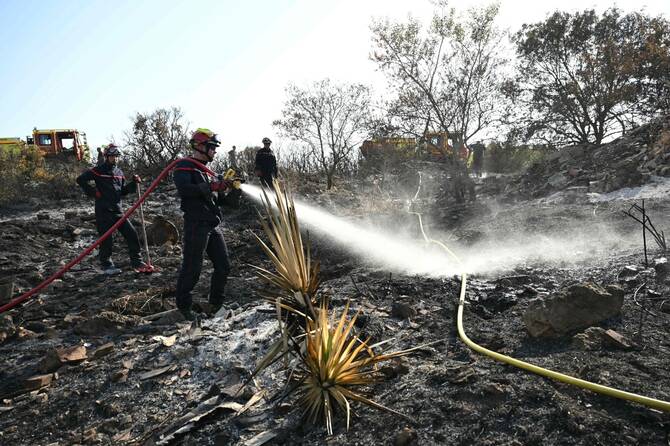
Challenging day for firefighters battling huge blaze in France

A firefighter uses a water hose to put out hot ashes near Coustouge, southern France. (AFP)
Short Url
Updated 10 August 2025
Follow

Challenging day for firefighters battling huge blaze in France

  • Authorities said that hot, dry winds on Sunday similar to those on the day the blaze began and a heatwave would make the work of firefighters more difficult
  • The blaze, the largest in at least 50 years, tore through 16,000 hectares of vegetation, disaster officials said

FONTJONCOUSE: Firefighters have contained a massive wildfire in southern France but local officials warned on Sunday that scorching heat and dry conditions could reignite the blaze, as parts of the Mediterranean region face a heatwave.

The fire has ravaged a vast area of France’s southern Aude department at the peak of the summer tourist season, killing one person and injuring several others.

Authorities said that hot, dry winds on Sunday — similar to those on the day the blaze began — and a heatwave would make the work of firefighters more difficult.

“It’s a challenging day, given that we are likely to be on red alert for heatwave from 4:00 pm, which will not make things any easier,” said Christian Pouget, prefect of the Aude department.

The fire is no longer spreading but is still burning within a 16,000-hectare area, said Christophe Magny on Saturday, chief of the region’s firefighter unit, adding it would not be under control until Sunday evening.

But the blaze will “not be extinguished for several weeks,” he said.

Some 1,300 firefighters were mobilized to prevent the blaze from reigniting amid fears that the tramontane wind, which officials said picked up overnight Saturday to Sunday, could fan lingering hot spots.

Temperatures this weekend are expected to hit 40 degrees Celsius in some areas, and Monday is forecast to be the “hottest day nationwide,” according to national weather service Meteo France.

In Saint-Laurent-de-la-Cabrerisse, a 65-year-old woman was found dead on Wednesday in her home, which was devastated by flames.

Authorities said one resident suffered serious burns and four others were lightly injured, while 19 firefighters were hurt, including one with a head injury.

Experts say European countries are becoming ever more vulnerable to such disasters due to intensifying summer heatwaves linked to global warming.

The blaze — the largest in at least 50 years — tore through 16,000 hectares of vegetation, disaster officials said.

For livestock farmers in Fontjoncouse, the fire has ravaged grazing land and wiped out much of their flocks, fueling outrage among those who said they did not have time to evacuate their herds.

Emmanuelle Bernier said she was “extremely angry” when she returned to a devastating scene, finding the pen that had housed her herd of goats in ruins, with 17 animals — some close to giving birth — lost in the fire.

“I will definitely change jobs. This will change my whole life,” she said.

Bernier’s property now holds only a few geese and two sick goats after she had to temporarily entrust her surviving sheep to a local winegrower, as the damage to the farm was so extensive that they could no longer stay.

“Everything here was built around the sheep, and seeing the flock leave was incredibly difficult for me,” she said.

But as she surveyed the scorched landscape, Bernier voiced some hope for the future.

“There’s still a little life left,” she said.


Tug of war: how US presidents battle Congress for military powers

Updated 01 March 2026
Follow

Tug of war: how US presidents battle Congress for military powers

  • The last official declaration of war by Congress was as far back as World War II

WASHINGTON, United States: Donald Trump’s unleashing of operation “Epic Fury” against Iran has once more underscored the long and bitter struggle between US presidents and Congress over who has the power to decide on foreign military action.
In his video address announcing “major combat” with the Islamic republic, Trump didn’t once mention any authorization or consultation with the US House of Representatives or Senate.
In doing so he sidelined not only Democrats, who called for an urgent war powers vote, but also his own Republican party as he asserts his dominance over a largely cowed legislature.
A US official said Secretary of State Marco Rubio had called top congressional leaders known as the “Gang of Eight” to give them a heads up on the Iran attack — adding that one was unreachable.
Rubio also “laid out the situation” and consulted with the same leaders on Tuesday in an hour-long briefing, the US official said.
According to the US Constitution, only Congress can declare war.
But at the same time the founding document of the United States first signed in 1787 says that the president is the “commander in chief” of the military, a definition that US leaders have in recent years taken very broadly.
The last official declaration of war by Congress was as far back as World War II.
There was no such proclamation during the unpopular Vietnam War, and it was then that Congress sought to reassert its powers.
In 1973 it adopted the War Powers Resolution, passed over Richard Nixon’s veto, to become the only lasting limit on unilateral presidential military action abroad.
The act allows the president to carry out a limited military intervention to respond to an urgent situation created by an attack against the United States.
In his video address on Saturday, Trump evoked an “imminent” threat to justify strikes against Iran.

- Sixty days -

Yet under this law, the president must still inform Congress within 48 hours.
It also says that if the president deploys US troops for a military action for more than 60 days, the head of state must then obtain the authorization of Congress for continued action.
That falls short of an official declaration of war.
The US Congress notably authorized the use of force in such a way after the September 11, 2011 attacks on the United States by Al-Qaeda. Presidents have used it over the past two decades for not only the 2001 invasion of Afghanistan but a series of operations in several countries linked to the “War on Terror.”
Trump is far from the first US president to launch military operations without going through Congress.
Democrat Bill Clinton launched US air strikes against Kosovo in 1999 as part of a NATO campaign, despite the lack of a green light from skeptical lawmakers.
Barack Obama did the same for airstrikes in Libya in 2011.
Trump followed their example in his first term in 2018 when he launched airstrikes in Syria along with Britain and France.
But since his return to power the 79-year-old has sought to push presidential power to its limits, and that includes in the military sphere.
Trump has ordered strikes on alleged drug trafficking boats in Latin America without consulting Congress, and in June 2025 struck Iran’s nuclear facilities.
Perhaps the most controversial act was when he ordered the capture of Venezuelan president Nicolas Maduro in a lightning military raid on January 3.
Republicans however managed to knock down moves by Democrats for a rare war powers resolution that would have curbed his authority over Venezuela operations.
Trump has meanwhile sought to extend his powers over the home front. Democrats have slammed the Republican for deploying the National Guard in several US cities in what he calls a crackdown on crime and immigration.