
UKYIV/LONDON A: European leaders on Saturday welcomed US President Donald Trump’s plans to meet Russian President Vladimir Putin on ending the war in Ukraine, while stressing the need to keep pressure on Moscow and protect Ukrainian and European security interests.
Trump plans to meet Putin in Alaska on Friday, saying the parties, including Ukrainian President Volodymyr Zelensky, were close to a deal that could resolve the three-and-a-half-year-old conflict.
The US president is open to a trilateral summit with Putin and Zelensky, but for now the White House is planning a bilateral meeting as requested by Putin, a White House official said. Russian and Ukrainian officials could not immediately be reached for comment on the prospects of a trilateral meeting.
Details of a potential deal have not been announced, but Trump said it would involve “some swapping of territories to the betterment of both.” It could require Ukraine to surrender significant parts of its territory, an outcome Zelensky and his European allies say would only encourage Russian aggression.
US Vice President JD Vance met British Foreign Secretary David Lammy and representatives of Ukraine and European allies on Saturday at Chevening House, a country mansion southeast of London, to discuss Trump’s push for peace.

Vice President JD Vance and Britain's Foreign Secretary David Lammy during a meeting at Chevening House in Kent, England, on Aug. 8, 2025. (AP / pool)
A joint statement from the French, Italian, German, Polish, British and Finnish leaders and the president of the European Commission welcomed Trump’s efforts, while stressing the need to maintain support for Ukraine and pressure on Russia.
“We share the conviction that a diplomatic solution must protect Ukraine’s and Europe’s vital security interests,” they said.
“We agree that these vital interests include the need for robust and credible security guarantees that enable Ukraine to effectively defend its sovereignty and territorial integrity,” the statement said, adding: “The path to peace in Ukraine cannot be decided without Ukraine.”
The leaders said “they remain committed to the principle that international borders must not be changed by force,” and added: “The current line of contact should be the starting point of negotiations.”
They said negotiations could only take place in the context of a ceasefire or reduction of hostilities.
‘Front line, not a border’
Zelensky’s chief of staff, Andriy Yermak, who took part in the talks with European leaders and US officials, said Ukraine was grateful for their constructive approach.
“A ceasefire is necessary — but the front line is not a border,” Yermak said on X, reiterating Kyiv’s position that it will reject any territorial concessions to Russia.
Yermak also thanked Vance for “respecting all points of view” and his efforts toward a “reliable peace.”
European representatives put forward a counterproposal, a European official said, declining to provide details.
The Wall Street Journal said the counterproposal included demands that a ceasefire must take place before any other steps are taken and that any territorial exchange must be reciprocal, with firm security guarantees.
“You can’t start a process by ceding territory in the middle of fighting,” the newspaper quoted a European negotiator as saying.
A US official said hours-long meetings at Chevening “produced significant progress toward President Trump’s goal of bringing an end to the war in Ukraine, ahead of President Trump and President Putin’s upcoming meeting in Alaska.”
The White House did not immediately respond when asked about the European counterproposals.
British Prime Minister Keir Starmer and French President Emmanuel Macron spoke and pledged to find a “just and lasting peace” in Ukraine and “unwavering support” for Zelensky while welcoming Trump’s efforts to end the fighting, a Downing Street spokesperson said.
Flurry of calls
It was not clear what, if anything, had been agreed at Chevening, but Zelensky called the meeting constructive.
“The path to peace for Ukraine should be determined together and only together with Ukraine, this is the key principle,” he said in his evening address to Ukrainians.
Macron stressed the need for Ukraine to play a role in any negotiations.
“Ukraine’s future cannot be decided without the Ukrainians, who have been fighting for their freedom and security for over three years now,” he wrote on X after what he said were calls with Zelensky, German Chancellor Friedrich Merz and Starmer. “Europeans will also necessarily be part of the solution, as their own security is at stake.”
Zelensky has made a flurry of calls with Ukraine’s allies since Trump envoy Steve Witkoff visited Moscow on Wednesday, where, Trump said, he achieved “great progress.”
Ukraine and the EU have pushed back on proposals that they view as ceding too much to Putin, whose troops invaded Ukraine in February 2022. Russia justifies the war on the grounds of what it calls threats to its security from a Ukrainian pivot toward the West.
Kyiv and its Western allies say the invasion is an imperial-style land grab.
Moscow has claimed four Ukrainian regions – Luhansk, Donetsk, Zaporizhzhia and Kherson – as well as the Black Sea peninsula of Crimea, which was annexed in 2014.

Skepticism on implementing deal
Russian forces do not fully control all the territory in the four regions, and Russia has demanded that Ukraine pull out its troops from the parts that they still control.
Ukraine says its troops still have a small foothold in Russia’s Kursk region a year after they crossed the border to try to gain leverage in any negotiations. Russia said it had expelled Ukrainian troops from Kursk in April.
Tatiana Stanovaya, a senior fellow at the Carnegie Russia Eurasia Center, said the current peace push was the first “more or less realistic” attempt to stop the war but she remained skeptical about the agreements being implemented.
“There is virtually no doubt that the new commitments could be devastating for Ukraine,” she said.
Fierce fighting is raging along the more than 1,000-km (620-mile) front line in eastern and southern Ukraine, where Russian forces hold around a fifth of the country’s territory.
Russian troops are slowly advancing in Ukraine’s east, but their summer offensive has so far failed to achieve a major breakthrough, Ukrainian military analysts say.
Ukrainians remain defiant.
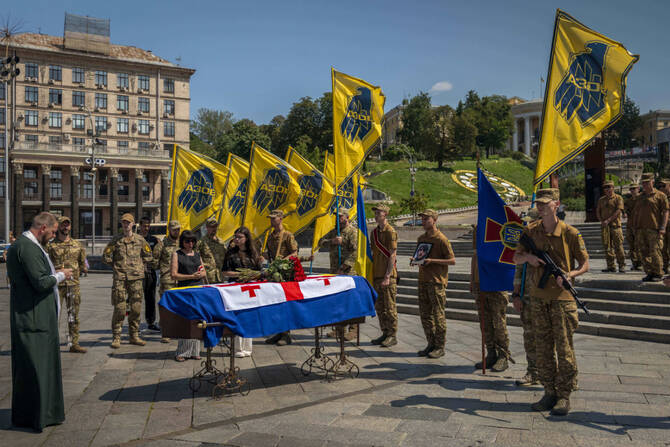
“Not a single serviceman will agree to cede territory, to pull out troops from Ukrainian territories,” Olesia Petritska, 51, told Reuters as she gestured to hundreds of small Ukrainian flags in the Kyiv central square commemorating fallen soldiers.