

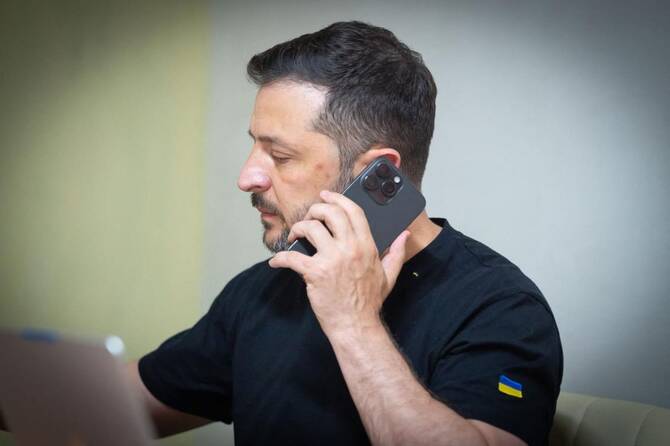

KYIV: Ukrainian President Volodymyr Zelensky dismissed Saturday the planned summit between US President Donald Trump and Russian President Vladimir Putin, warning that any peace deal excluding Kyiv would lead to “dead solutions.”
The Trump-Putin meeting, scheduled for Friday in Alaska, is seen as a potential breakthrough in the more than three-year war.
Trump had previously agreed to meet with Putin even if the Russian leader would not meet with Zelensky, stoking fears Ukraine could be sidelined in efforts to stop the continent’s biggest conflict since World War II.
In a statement posted to Telegram, Zelensky said Ukraine’s territorial integrity, enshrined in the constitution, must be non-negotiable and emphasized that lasting peace must include Ukraine’s voice at the table.
Zelensky said Ukraine “will not give Russia any awards for what it has done” and that “Ukrainians will not give their land to the occupier.”
Touching on Ukrainian anxieties that a direct meeting between Putin and Trump could marginalize Kyiv and European interests, Zelensky said: “Any decisions that are without Ukraine are at the same time decisions against peace. They will not bring anything. These are dead decisions. They will never work.”
Ukrainian officials had previously told the Associated Press privately that Kyiv would be amenable to a peace deal that would de facto recognize Ukraine’s inability to regain lost territories militarily.
The summit
Trump said he will meet with Putin to discuss ending the war in Ukraine.
“It seems entirely logical for our delegation to fly across the Bering Strait simply, and for such an important and anticipated summit of the leaders of the two countries to be held in Alaska,” Putin’s foreign affairs adviser, Yuri Ushakov, said Saturday in a statement posted to the Kremlin’s news channel.
The summit may prove pivotal in a war that began when Russia invaded its western neighbor and has led to tens of thousands of deaths, although there’s no guarantee it will stop the fighting since Moscow and Kyiv remain far apart on their conditions for peace.
In comments to reporters at the White House before his post confirming the date and place, Trump suggested that any agreement would likely involve “some swapping of territories,” but he gave no details. Analysts, including some close to the Kremlin, have suggested that Russia could offer to give up territory it controls outside of the four regions it claims to have annexed.
Trump said his meeting with Putin would come before any sit-down discussion involving Zelensky. His announcement that he planned to host one of America’s adversaries on US soil broke with expectations that they’d meet in a third country. The gesture gives Putin validation after the US and its allies had long sought to make him a pariah over his war against Ukraine.
Nigel Gould-Davies, an associate fellow of Chatham House, told The Associated Press the “symbology” of holding the summit in Alaska was clear, and that the location “naturally favors Russia.”
“It’s easy to imagine Putin making the point … we once had this territory and we gave it to you, therefore Ukraine had this territory and now should give it to us,” he said, referring to the 1867 transaction known as the Alaska Purchase when Russia sold Alaska to the United States for $7.2 million.
Ultimatums and sanctions
Exasperated that Putin did not heed his calls to stop bombing Ukrainian cities, Trump, almost two weeks ago, moved up his ultimatum to impose additional sanctions on Russia and introduce secondary tariffs targeting countries that buy Russian oil if the Kremlin did not move toward a settlement.
The deadline was Friday. But the White House did not answer questions that evening about the state of possible sanctions after Trump announced an upcoming meeting with Putin.
Gould-Davies likened attempts to understand what seems to be Trump’s latest pivot toward Moscow to “Kremlinology,” the Cold War-era practice of deciphering opaque signals from Soviet leadership.
“We’re … looking for clues and for hints … about what the hell is going on; what the mix of influences around Trump and indeed in Trump’s head is propelling his latest statement,” he said.
“It’s as if his disillusionment with Putin … never happened,” Gould-Davies noted, pointing to a sudden return to the more conciliatory Russia policy Trump embraced at the start of his presidency.
Prior to Trump announcing the meeting with Putin, his efforts to pressure Russia into stopping the fighting had delivered no progress. The Kremlin’s bigger army is slowly advancing deeper into Ukraine at great cost in troops and armor while it relentlessly bombards Ukrainian cities. Russia and Ukraine are far apart on their terms for peace.
Russia and Ukraine trade attacks
Two people died and 16 were wounded Saturday when a Russian drone hit a minibus in the suburbs of the Ukrainian city of Kherson, regional Gov. Oleksandr Prokudin said. Two others died after a Russian drone struck their car in the Zaporizhzhia region, according to regional Gov. Ivan Fedorov.
Ukraine’s air force said Saturday it intercepted 16 of the 47 Russian drones launched overnight, while 31 drones hit targets across 15 different locations. It also said it shot down one of the two missiles Russia deployed.
Meanwhile, Russia’s Defense Ministry said its air defenses shot down 97 Ukrainian drones over Russia and the Black Sea overnight and 21 more on Saturday morning.


