

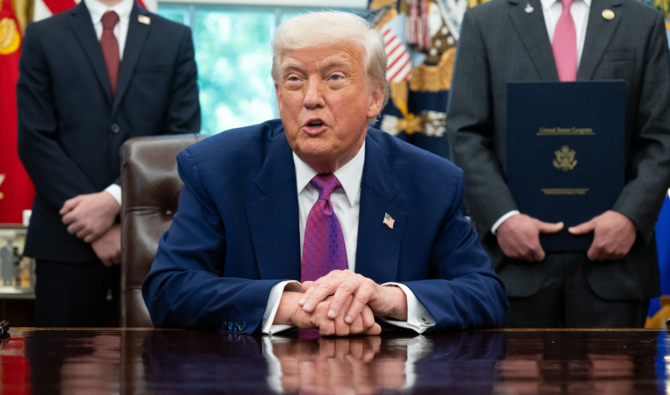

KARACHI: US President Donald Trump’s move to double tariffs on Indian goods presents a “strategic opening” for Islamabad to deepen its trade partnership with Washington, Pakistan’s finance adviser Khurram Schehzad said on Thursday.
Trump signed an executive order on Wednesday to place an additional 25 percent tariff on India on top of a 25 percent tariff that went into effect on Thursday. The move made India one of the most heavily taxed US trading partners in Asia.
Pakistan, India’s traditional arch-rival, has meanwhile improved its ties with Washington. Pakistan and the US finalized a trade agreement last week under which a 19 percent tariff was imposed on a wide range of Pakistani goods. The new rate marked a considerable reduction from the initially proposed 29 percent under a sweeping executive order signed by Trump.
“The US tariff hike on Indian goods presents a strategic opening for Pakistan,” Schehzad told Arab News.
Washington’s 19 percent tariff on Pakistani goods makes them less expensive than Indian goods, making Pakistan one of the countries with the lowest tariff profiles in the region.
“We see this as a moment of opportunity to deepen trade and economic ties with the United States,” the finance official added.
The US is Pakistan’s largest export destination, State Minister for Finance Bilal Azhar Kayani said on Thursday. He added that out of $32 billion of Pakistan’s exports in the last fiscal year, $6 billion went to the US.
Pakistan’s tariff deal with the US took place at a time when Islamabad is pushing for an economic revival, buoyed by a $7 billion financial bailout package by the International Monetary Fund (IMF).
Pakistan has undertaken financial reforms over the past two years. Prime Minister Shehbaz Sharif has tasked authorities to ensure Islamabad’s $32 billion annual exports surge to over $60 billion by fiscal year 2028-29.
Pakistan, having one of the lowest regional tariff profiles and also attracting a growing US investment interest, is positioned to expand its exports, particularly in textiles, pharmaceuticals, agriculture, technology, mining & minerals, and other value-added manufacturing, Schehzad said.
“This agreement will help us realize the long-term export targets we have set under Uraan Pakistan program,” he said, referring to the government’s economic plan that aims to make Pakistan a trillion-dollar economy by 2035.
‘MAJOR OBSTACLES’
Pakistani businesspersons, especially those related to textiles, think otherwise.
Atif Ikram Sheikh, president of the Federation of Pakistan Chamber of Commerce and Industry (FPCCI), said the US has imposed the lowest trade tariffs in the region on Pakistan, which Islamabad should take full advantage of.
However, he said higher production costs in Pakistan could neutralize this benefit.
“Taxes and high electricity and gas prices for the industry are major obstacles to taking advantage of low tariffs,” Sheikh said.
The textile industry is Pakistan’s biggest foreign exchange earner, fetching $18 billion during the last fiscal year, most of which came from the US.
Kamran Arshad, chairman of the All Pakistan Textile Mills Association (APTMA), was also unsure whether the new trade agreement with the US would benefit Pakistan significantly.
“The costly power and high interest rates would not allow us to compete (in the global textile market) at this 19 percent tariff,” Arshad told Arab News.
Last week, Pakistan’s central bank kept the policy rate unchanged at 11 percent, adopting a cautious approach.
According to the APTMA, Pakistan has a higher interest rate of 11 percent, compared to India’s 5.5 percent, Bangladesh’s 10 percent, Vietnam’s 4.5 percent, Sri Lanka’s 7.75 percent, Indonesia’s 5.25 percent and Cambodia’s 3 percent.
The power tariff for industries in Pakistan, meanwhile, stands at $0.16 kilowatt per hour as compared to $0.096 in India, $0.10 in Bangladesh, $0.08 in Vietnam, $0.06 in Sri Lanka, $0.07 in Indonesia and $0.135 in Cambodia, the data shows.
Pakistani businesses are paying 29 percent corporate income tax and as much as 10 percent super tax compared to the 27.5 percent preferential taxes their competitors from India, Bangladesh, Vietnam, Sri Lanka, Indonesia and Cambodia are paying on incomes.
“Pakistan’s corporate tax, policy rate, labor costs, electricity rate put us at a disadvantage with India, Bangladesh, Vietnam, Sri Lanka and Indonesia,” Arshad noted.
Shankar Talreja, head of research at Karachi-based brokerage firm Topline Securities, said the US is a “big market” for pharmaceuticals, textiles and food products.
“If Pakistan gets preferential treatment in the US market, this will help our companies grow further,” he said.


