

Bangladesh ex-PM palace becomes revolution museum

Short Url
Updated 04 August 2025
Follow

Bangladesh ex-PM palace becomes revolution museum

  • Hasina’s rule saw widespread human rights abuses, including mass detention and extrajudicial killings of opponents
  • Bangladesh’s Muhammad Yunus, who heads caretaker government, says museum would “preserve memories of her misrule”

DHAKA: Once a heavily guarded palace, the former official residence of Bangladesh’s ousted prime minister Sheikh Hasina is being turned into a museum as a lasting reminder of her autocratic rule.

Photographs of jubilant flag-waving crowds clambering onto the rooftop of the Dhaka palace after Hasina fled by helicopter to India were a defining image of the culmination of student-led protests that toppled her government on August 5, 2024.

One year later, with the South Asian nation of around 170 million people still in political turmoil, the authorities hope the sprawling Ganabhaban palace offers a message to the future.

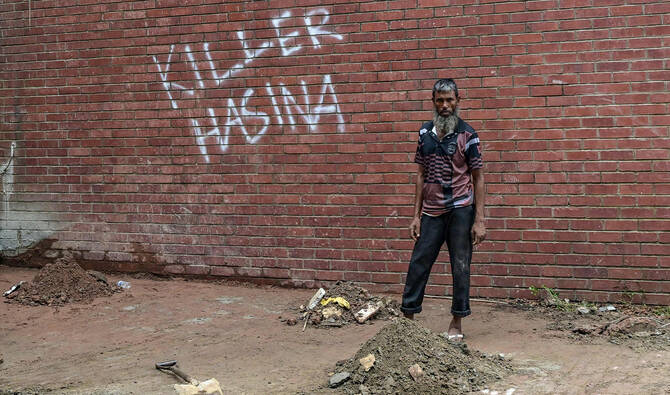
Graffiti daubed on the walls condemning her regime remains untouched.

“Freedom,” one message reads. “We want justice.”

Hasina’s rule saw widespread human rights abuses, including the mass detention and extrajudicial killings of her political opponents.

Up to 1,400 people were killed between July and August 2024 in her failed bid to cling to power, according to the United Nations.

The 77-year-old has defied court orders to attend her ongoing trial on charges amounting to crimes against humanity in Dhaka, accusations she denies.

“Dictator,” another message reads, among scores being protected for posterity. “Killer Hasina.”

Muhammad Yunus, the 85-year-old Nobel Peace Prize winner who is leading the caretaker government until elections are held in early 2026, said the conversion to a museum would “preserve memories of her misrule and the people’s anger when they removed her from power.”

Mosfiqur Rahman Johan, 27, a rights activist and documentary photographer, was one of the thousands who stormed the luxurious palace, when crowds danced in her bedroom, feasted on food from the kitchens, and swam in the lake Hasina used to fish in.

“It will visualize and symbolize the past trauma, the past suffering — and also the resistance,” he said.

“Ganabhaban is a symbol of fascism, the symbol of an autocratic regime.”

The complex was built by Hasina’s father, the first leader of Bangladesh, Sheikh Mujibur Rahman, and Hasina made it her official residence during her 15 years in power.

Tanzim Wahab, the curator of the under-construction museum, told AFP that exhibits would include artefacts of the protesters killed.

Their life stories will be told through films and photographs, while plaques will host the names of the people killed by the security forces during the longer period of Hasina’s rule.

“The museum’s deeper purpose is retrospective, looking back at the long years of misrule and oppression,” said Wahab.

“That, I believe, is one of the most important aspects of this project.”

Wahab said the museum would include animation and interactive installations, as well as documenting the tiny cells where Hasina’s opponents were detained in suffocating conditions.
“We want young people... to use it as a platform for discussing democratic ideas, new thinking, and how to build a new Bangladesh,” Wahab said.

That chimes with the promised bolstering of democratic institutions that interim leader Yunus wants to ensure before elections — efforts slowed as political parties jostle for power.

The challenges he faces are immense, warned Human Rights Watch ahead of the one-year anniversary of the revolution.

“The interim government appears stuck, juggling an unreformed security sector, sometimes violent religious hard-liners, and political groups that seem more focused on extracting vengeance on Hasina’s supporters than protecting Bangladeshis’ rights,” HRW said.

But while Hasina’s palace is being preserved, protesters have torn down many other visible signs of her rule.

Statues of Hasina’s father were toppled, and portraits of the duo torn and torched.

Protesters even used digger excavators to smash down the home of the late Sheikh Mujibur Rahman — that Hasina had turned into a museum to her father.


Zelensky says peace proposals to end the war in Ukraine could be presented to Russia within days

Updated 53 min 40 sec ago
Follow

Zelensky says peace proposals to end the war in Ukraine could be presented to Russia within days

  • But issues like the status of Ukrainian territory occupied by Russia remain unresolved. US-led peace efforts are gaining momentum
  • But Russian President Vladimir Putin may resist some proposals including security guarantees for Ukraine

KYIV: Ukrainian President Volodymyr Zelensky says proposals being negotiated with US officials for a peace deal to end his country’s nearly four-year war with Russia could be finalized within days, after which American envoys will present them to the Kremlin before further possible meetings in the United States next weekend.
Zelensky told reporters late Monday that a draft peace plan discussed with the US during talks in Berlin earlier in the day is “very workable.” He cautioned, however, that some key issues — notably what happens to Ukrainian territory occupied by invading Russian forces — remain unresolved.
U.S-led peace efforts appear to be picking up momentum. But Russian President Vladimir Putin may balk at some of the proposals thrashed out by officials from Washington, Kyiv and Western Europe, including postwar security guarantees for Ukraine.
Kremlin spokesman Dmitry Peskov repeated Tuesday that Russia wants a comprehensive peace deal, not a temporary truce.
If Ukraine seeks “momentary, unsustainable solutions, we are unlikely to be ready to participate,” Peskov said.
“We want peace — we don’t want a truce that would give Ukraine a respite and prepare for the continuation of the war,” he told reporters. “We want to stop this war, achieve our goals, secure our interests, and guarantee peace in Europe for the future.”
American officials on Monday said that there’s consensus from Ukraine and Europe on about 90 percent of the US-authored peace plan. US President Donald Trump said: “I think we’re closer now than we have been, ever” to a peace settlement.
Plenty of potential pitfalls remain, however.
Zelensky reiterated that Kyiv rules out recognizing Moscow’s control over any part of the Donbas, an economically important region in eastern Ukraine made up of Luhansk and Donetsk. Russia’s army doesn’t fully control either.
“The Americans are trying to find a compromise,” Zelensky said, before visiting the Netherlands on Tuesday. “They are proposing a ‘free economic zone’ (in the Donbas). And I want to stress once again: a ‘free economic zone’ does not mean under the control of the Russian Federation.”
The land issue remains one of the most difficult obstacles to a comprehensive agreement.
Putin wants all the areas in four key regions that his forces have seized, as well as the Crimean Peninsula, which Moscow illegally annexed in 2014, to be recognized as Russian territory.
Zelensky warned that if Putin rejects diplomatic efforts, Ukraine expects increased Western pressure on Moscow, including tougher sanctions and additional military support for defense. Kyiv would seek enhanced air defense systems and long-range weapons if diplomacy collapses, he said.
Ukraine and the US are preparing up to five documents related to the peace framework, several of them focused on security, Zelensky said.
He was upbeat about the progress in the Berlin talks.
“Overall, there was a demonstration of unity,” Zelensky said. “It was truly positive in the sense that it reflected the unity of the US, Europe, and Ukraine.”