Philippine, Indian navies begin first joint South China Sea patrols

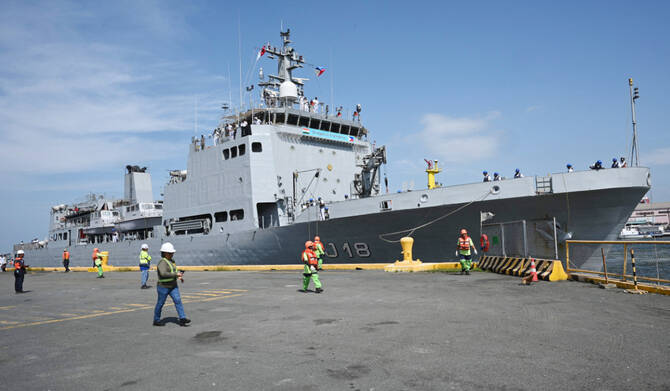
The Indian Navy survey vessel INS Sandhayak docks at the international port of Manila on August 1, 2025. (AFP)
Short Url
Updated 04 August 2025
Follow

Philippine, Indian navies begin first joint South China Sea patrols

  • While in India, Marcos is expected to sign pacts in such fields as law, culture and technology, according to Foreign Affairs Assistant Secretary Evangeline Ong Jimenez-Ducrocq, but all eyes will be on any potential defense agreements

MANILA: Indian Navy warships have begun patrolling areas of the disputed South China Sea with their Philippine counterparts for the first time, Manila’s military said Monday.
The two-day sail includes three Indian vessels and started Sunday, a day ahead of Philippine President Ferdinand Marcos’ scheduled trip to New Delhi for talks with Indian Prime Minister Narendra Modi.
The Philippines has heightened defense cooperation with a range of allies over the past year after a series of clashes in the contested waterway.
Beijing claims nearly the entirety of the South China Sea despite an international ruling that its assertion has no legal basis.
India’s naval vessels arrived in Manila for a port visit late last week.
The patrol “started yesterday afternoon, then it’s ongoing up to this moment... the activity at the moment is replenishment at sea,” Lt. Col. John Paul Salgado told AFP.
While in India, Marcos is expected to sign pacts in such fields as law, culture and technology, according to Foreign Affairs Assistant Secretary Evangeline Ong Jimenez-Ducrocq, but all eyes will be on any potential defense agreements.
The Philippines has previously purchased BrahMos supersonic cruise missiles from India, a weapon which has a top speed of 3,450 kilometers (2,140 miles) per hour.
India, which has engaged in border clashes with China in the Himalayas, is a member of the so-called Quad, a group that includes fellow democracies the United States, Japan and Australia.
Beijing has repeatedly alleged that the four-way partnership, first conceived by late Japanese prime minister Shinzo Abe, was created as a way of containing China.


Tanzania police ban proposed rallies after poll violence

Updated 11 sec ago
Follow

Tanzania police ban proposed rallies after poll violence

DAR ES SALAAM: Tanzania’s police have banned proposed rallies next week, following a violent crackdown by security forces on election demonstrations.
Polls on October 29 erupted into days of violent protests over claims that President Samia Suluhu Hassan had rigged the polls and was behind a campaign of murders and abductions of her critics.
She was declared winner with 98 percent of the vote.
More than 1,000 people were shot dead by security forces over several days of unrest, according to the opposition and rights groups, though the government has yet to give a final toll.
Despite attempts to suppress information, anger within the east African nation has grown with some saying they will return to the streets on December 9.
In a statement in Swahili late Friday, police spokesperson David Misime said officials had seen the calls on social media but noted: “No identifiable person has so far submitted formal notification for the planned demonstrations.”
Citing police guidelines, the statement said that “given the unlawful tactics that have surfaced,” the proposed rally “no longer meets the legal requirements to be authorized.”
“Therefore, the Police Force, as of today, bans the planned demonstrations described as peaceful and indefinite,” it said.
The statement added calls for the proposed rally were being coordinated by individuals using “telephone numbers based both inside and outside Tanzania, as well as anonymous online accounts managed by persons outside the country.”
It follows a decision by Meta earlier this week to suspend the Instagram accounts of two Tanzanian activists after they posted images of the violent crackdown on election protests.
International criticism has grown, with the United States stating it would be “comprehensively reviewing” its relationship with the country following the election violence.