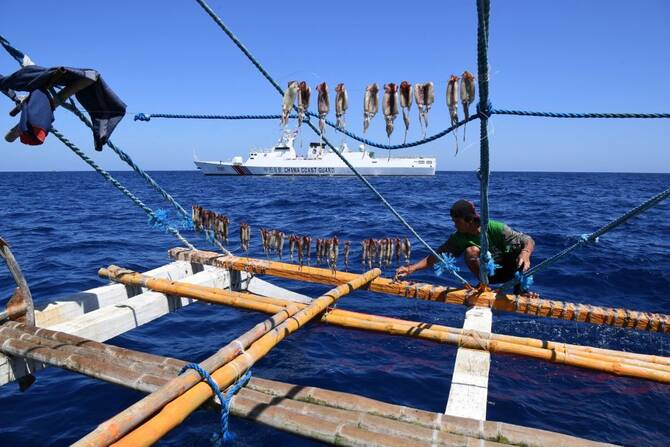

MANILA: Pulled from screens days before its premiere, a Philippine documentary about the daily struggles of Filipino fishermen and coast guards is now winning big abroad, turning the spotlight onto the disputed South China Sea and Manila’s tensions with Beijing.
“Food Delivery: Fresh from the West Philippine Sea,” by Filipino filmmaker Baby Ruth Villarama, was initially set for a Philippine premiere in March. However, it was dropped from the lineup of the PureGold CinePanalo Film Festival in Manila with organizers citing “external factors.”
The film’s title refers to the Philippine part of the South China Sea lying within the country’s exclusive economic zone, an area central to a long-running dispute over the strategic waterway between Manila and Beijing.
Seeking to highlight the “human” side of tensions beyond geopolitical framing, it centers on the story of Filipino fishermen “who risk their lives every day” and the quiet efforts of Philippine coast guard personnel to keep them safe despite limited resources, Villarama told Arab News.
“They see it as their duty, their lifeblood, and their birthright. What struck us most was not anger or fear, but a deep sense of quiet dignity. These are men who wake before sunrise, not minding what dangers await them, yet they sail because they must feed their families and uphold traditions passed down for generations,” she said.
“They don’t use the word ‘patriotism,’ but they live it. For them, the West Philippine Sea isn’t an idea. It’s home. It’s where they survive, dream, and stand their ground. Their courage is unassuming, but it is fierce.”
The documentary went on to have its world premiere at the Doc Edge Festival in New Zealand, where it won the Tides of Change prize earlier this month.
“International recognition gave the film credibility, but it was really the solidarity of communities here and abroad that could make the screening possible on the 27th (of July),” Villarama said. “We’re just hoping for the best.”
Before the film made its international debut in New Zealand, it faced pressure from the Chinese Consulate-General in Auckland, which lodged a formal protest to festival organizers and requested the film’s scheduled screenings were canceled.
Despite a 2016 international tribunal ruling in favor of the Philippines’ claims China continues to assert its historical claims to the waters, through which an estimated $5.3 trillion worth of commercial goods transit annually.
In a letter to organizers later posted online, the Chinese consulate said the film was “rife with disinformation and false propaganda, serving as a political tool for Philippines to pursue illegitimate claims in the South China Sea.”
But for its creators, the film was always about the Filipino audience.
“We made ‘Food Delivery’ to hold up a mirror to the truth — not to divide, but to help us see more clearly what is happening in our own waters. Because no matter where we stand on politics or personal beliefs, one thing is certain: The West Philippine Sea is part of our story. It is part of who we are,” Chuck Gutierrez, co-founder of documentary producer Voyage Studios, told Arab News.
“The truth is, we did not make this film to antagonize anyone. Our goal was simple — to show the day-to-day reality faced by Filipinos at the West Philippine Sea. What we captured came from firsthand experiences, not secondhand narratives. These are voices that have long been unheard.”
Winning the award in New Zealand was a “deeply affirming moment” for Gutierrez and his team.
“It means that telling the truth, especially when it is inconvenient or uncomfortable, is still worth fighting for,” he said. “Despite the forces that tried to silence the story we were telling, the truth found its voice and resonated with an international audience.”