

Islamabad says new tariff arrangement to help Pakistan expand footprint in US market

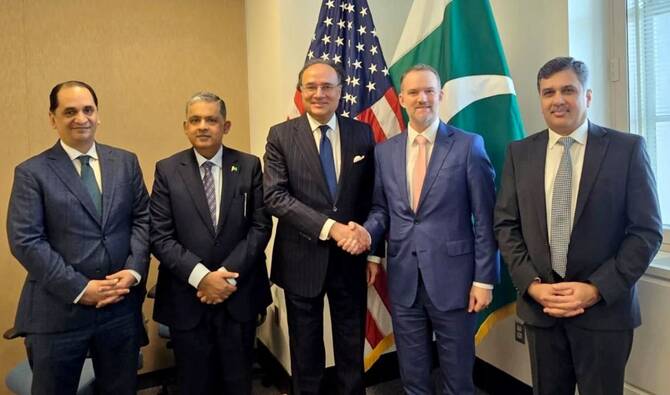
Pakistan’s Finance Minister Muhammad Aurangzeb shaking hands with U.S. Secretary of Commerce Howard Lutnick in Washington, D.C. on July 31, 2025. (Ministry of Finance)
Short Url
Updated 01 August 2025
Follow

Islamabad says new tariff arrangement to help Pakistan expand footprint in US market

  • The US is Pakistan’s top export destination, with shipments totaling $5.44 billion in fiscal year 2023-2024, according to official data
  • It is now essential for Pakistani exporters to adopt focused marketing strategy to capitalize on this development, Pakistani ministry says

ISLAMABAD: Pakistan’s new trade tariff arrangement with the United States (US) will help expand its footprint in the US market, the Pakistani finance ministry said on Friday.

The statement came a day after the White House said the US will charge a 19 percent tariff on imports from Pakistan, compared to a 29 percent reciprocal tariff announced in April that had raised alarm in Islamabad.

The US is Pakistan’s top export destination, with shipments totaling $5.44 billion in fiscal year 2023-2024, according to official data. From July 2024 to February 2025, exports rose 10 percent from a year earlier.

Pakistan’s finance ministry said the White House decision reflects a “balanced and forward-looking approach” by US authorities that kept Pakistan competitive in relation to other South and Southeast Asian nations.

“In particular, this tariff level is expected to support Pakistan’s export potential, especially in key sectors such as textiles, which remain the backbone of the country’s export economy,” the ministry said.

“The Ministry of Finance... believes that the current tariff arrangement presents a significant opportunity to expand Pakistan’s footprint in the US market.”

The previous US announcement of 29 percent tariff shook Pakistan, currently on a path to economic recovery under a $7 billion International Monetary Fund (IMF) program.

The two nations reached the deal just ahead of the August 1 deadline, followed by Finance Minister Muhammad Aurangzeb’s talks with US Commerce Secretary Howard Lutnick and Trade Representative Jamieson Greer in Washington.

“It is now essential for Pakistani exporters and trade bodies to adopt an aggressive and focused marketing strategy to capitalize on this development,” the Pakistani finance ministry said.

“In addition to textiles, there is substantial potential for growth in other sectors, and the government is committed to facilitating exporters through policy support, market intelligence, and trade promotion initiatives.”

Meanwhile, Pakistan’s largest refiner Cnergyico will import 1 million barrels of oil from Vitol in October, Reuters reported, citing its Vice Chairman Usama Qureshi.

Qureshi said the West Texas Intermediate light crude cargo will be loaded from Houston this month and is expected to arrive in Karachi in the second half of October, marking the country’s first-ever purchase of US crude following the trade deal.

“This is a test spot cargo under our umbrella term agreement with Vitol. If it is commercially viable and available, we could import at least one cargo per month,” he said, adding that the shipment was not meant for resale.

The finance ministry said it was looking forward to further positive engagements and close cooperation with the US in areas of investment, artificial intelligence, cryptocurrency, mines and minerals, energy and other emerging sectors.

“Pakistan will continue to engage closely with President Trump and the US administration to promote the shared goals of economic development and mutual prosperity,” it said.



Pakistan says defense pact with Saudi Arabia elevated brotherly ties to ‘new heights’

Updated 25 February 2026
Follow

Pakistan says defense pact with Saudi Arabia elevated brotherly ties to ‘new heights’

  • Pakistan, Saudi Arabia signed strategic defense pact last year pledging aggression against one will be treated as attack on both
  • Deputy PM Ishaq Dar says enduring bonds with Islamic and Arab nations form vital pillar of Pakistan’s foreign policy 

ISLAMABAD: Deputy Prime Minister Ishaq Dar said on Wednesday that Pakistan’s defense pact with Saudi Arabia elevated its brotherly ties with the Kingdom to “new heights,” stressing that close ties with Arab and Islamic nations form a key pillar of Islamabad’s foreign policy. 

Pakistan and Saudi Arabia signed a Strategic Mutual Defense Agreement on Sept. 17 last year, pledging that aggression against one country would be treated as an attack on both, enhancing joint deterrence and formalizing decades of military and security cooperation.

Both nations agreed in October 2025 to launch an economic cooperation framework to strengthen trade and investment ties. 

“In the Middle East, our landmark Strategic Mutual Defense Agreement with Saudi Arabia has elevated our brotherly ties to new heights,” Dar said while speaking at the Pakistan Governance Forum 2026 event in Islamabad. 

The Pakistani deputy prime minister was speaking on the topic “Navigating International Relations Amidst Changing Geo-Politics.”

Dar noted that Pakistan has reinforced partnerships with other Middle Eastern nations such as the UAE, Qatar, Jordan, Oman, Egypt and Bahrain. He said these partnerships have yielded “concrete agreements” in investment, agriculture, infrastructure, and energy sectors. 

“Our enduring bonds with Islamic and Arab nations form a vital pillar of our foreign policy, and we will continue to expand our partnerships across Asia, Latin America, and Africa,” he said. 

Dar pointed out that the presidents of Kazakhstan, Uzbekistan and Kyrgyzstan have undertaken visits to Pakistan in recent months, reflecting Central Asian nations’ desire to boost cooperation with Islamabad.

On South Asia, the Pakistani deputy PM said Pakistan has successfully transformed its fraternal ties with Bangladesh into “a substantive partnership.”

“Similarly, the trilateral mechanism involving China, Pakistan, and Bangladesh has been launched with a view to expanding and deepening regional cooperation and synergy,” the Pakistani minister said. 

He said Islamabad has strengthened its “all-weather” partnership with China via the second phase of the multi-billion-dollar China-Pakistan Economic Corridor agreement and “unwavering support” from both sides for each other’s core interests. 

Dar said Pakistan had also reinvigorated its partnership with the US, advancing cooperation in trade, technology, investment, and regional stability. 

“This calibrated approach has enhanced our ability to navigate complexity with skill and confidence, ensuring that our national interests are served without compromising our core foreign policy principles,” he said.