

ISLAMABAD: President Asif Ali Zardari visited Sany Heavy Industry Co. Ltd. in Changsha in China’s Hunan province in a bid to boost industrial cooperation and technology partnership between Pakistan and China, the president’s office said on Sunday.
The development comes amid Zardari’s week-long visit to China, which began on Saturday, to strengthen trade, economic and strategic cooperation under the China-Pakistan Economic Corridor between the two countries.
During his visit to Sany Heavy Industry, the president was briefed on the company’s advanced manufacturing systems, product lines and ongoing investments in research and development by its chairman Tang Xiuguo.
The president witnessed the company’s operations, including its core business areas of concrete machinery, excavators, cranes, piling equipment and road machinery, and was informed of its financial and operational performance, including its 2024 operating revenue which was $11.27 billion.
“President Zardari appreciated the scale, sophistication and technological depth of SANY’s manufacturing ecosystem,” the president’s office said in a statement.
“He emphasized the importance of strengthening cooperation in industrial technology, skill development and joint ventures that could support Pakistan’s infrastructure and industrial growth. He also highlighted the potential for collaboration in areas such as construction machinery, digital manufacturing, clean energy and engineering solutions.”
China is a major ally and investor in Pakistan, pledging over $65 billion in investment in road, infrastructure and development projects under CPEC. The project is part of Chinese President Xi Jinping’s ambitious Belt and Road Initiative.
The president was also given a round of the company’s digitally integrated manufacturing facility, recognized for its advanced automation and data-driven production systems. He was briefed on the factory’s intelligent operations, high automation rate and its role as a benchmark for modern industrial manufacturing.
“He noted the scale of technological integration and its relevance for countries seeking to modernize industrial production and improve efficiency,” the president’s office said.
“Mr Tang Xiuguo underlined the company’s commitment to innovation, digitalization and international partnerships and informed about country’s ongoing operations in Pakistan and expressed the willingness to explore opportunities for increased collaboration with Pakistan in manufacturing, technology exchange and capacity building.”
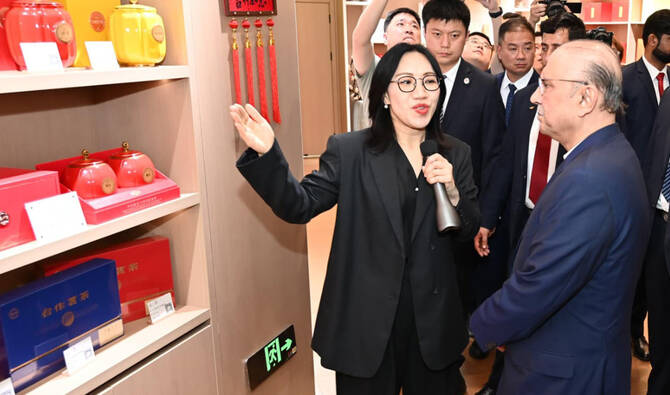
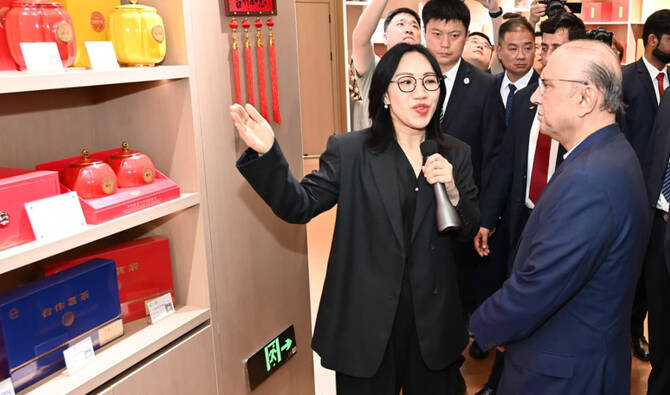
Zardari later visited the Hunan Tea Group Co., Ltd. where he was briefed by its chairman, Zhou Zhongwang, on the company’s operations, supply chain and international market presence, according to his office.
The president was apprised of the group’s end-to-end model, which brings together cultivation, processing, research, marketing and tea culture within a single industrial framework. The briefing outlined how ecological tea garden bases, specialized production facilities and distribution systems are organized to support both domestic sales and exports.
“The president noted the scope for cooperation in value addition, agro-processing and export development, and invited the Group to explore opportunities for collaboration with Pakistan in these areas,” Zardari’s office said.
Zardari’s visit to China takes place as Islamabad attempts to forge closer trade, economic and investment ties with Beijing, Middle Eastern countries and other regional allies.
Pakistan’s push for economic diplomacy has increased in recent months as it eyes sustainable economic growth, driven by exports and reforms as mandated by the International Monetary Fund.


