UAE-led AI pact aims to narrow digital divide in Global South

The partnership comes amid rising global concern that emerging technologies could exacerbate inequality. WAM
Short Url
Updated 01 August 2025
Follow

UAE-led AI pact aims to narrow digital divide in Global South

RIYADH: Artificial intelligence adoption in the Global South is set to accelerate under a new UAE-led partnership with Malaysia and Rwanda aimed at expanding ethical AI use and knowledge sharing. 

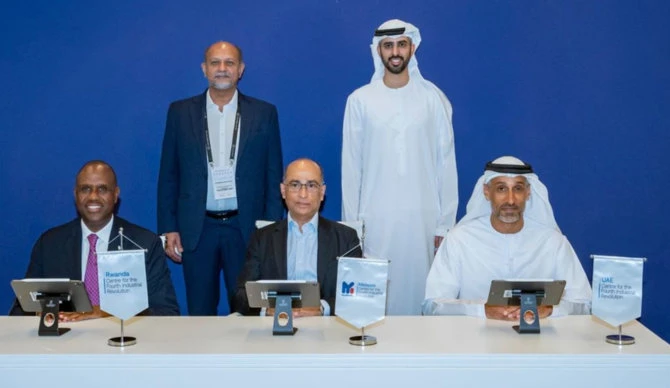
The agreement, signed under the World Economic Forum’s Center for the Fourth Industrial Revolution global network, builds on an initiative launched by the UAE and Rwanda at the 2024 WEF Annual Meeting in Davos, according to a press release. 

The partnership comes amid rising global concern that emerging technologies could exacerbate inequality. The UN estimates the AI market will reach $4.8 trillion by 2033, warning that without inclusive frameworks, the Global South risks being left behind. 

Gobind Singh Deo, minister of digital in Malaysia, said his country “is proud to join forces with the UAE and Rwanda in this visionary initiative to bridge global AI expertise and accelerate digital transformation for a more inclusive and sustainable future.” 

He added: “This partnership involving Malaysia Center4IR, C4IR UAE, and C4IR Rwanda reflects our collective goal for a future that is driven by responsible AI innovation.” 

Singh Deo expressed hope that the C4IR Network AI Fellowship Program, developed through the collaboration, would act as a crucial bridge connecting AI leaders and experts across continents. 

“By sharing knowledge, exchanging talent, and co-creating solutions, we aim to address the critical challenges and harness the immense potential of AI for the benefit of not only our nations, but the wider global community,” he added. 

The memorandum of understanding was witnessed by UAE Minister of State for Artificial Intelligence Omar Al-Olama and Malaysia’s Singh Deo. It aims to deepen South-South collaboration on technology policy, research, and skills development. 

With Malaysia now joining, the expanded C4IR AI Fellowship Program will support talent exchange, joint innovation, and responsible governance frameworks led by Global South countries. 

“This expanded partnership will help the Global South to unlock greater value from AI and Fourth Industrial Revolution applications,” said Khalfan Belhoul, CEO of Dubai Future Foundation. 

“Guided by our leadership, the UAE is committed to building and strengthening global collaboration to achieve inclusive, sustainable development through technology and knowledge sharing,” he added. 

Crystal Rugege, managing director of the Rwanda Center for the Fourth Industrial Revolution, noted that the strategic partnership complemented Rwanda’s flagship initiatives, including the AI Innovation Lab and the Global AI Summit on Africa, thereby enhancing efforts to promote cutting-edge research, knowledge transfer, and capacity building. 

“By strengthening responsible AI governance and accelerating practical AI adoption, we are committed to empowering Rwanda, our partner countries, and the global AI ecosystem to fully leverage AI for sustainable and inclusive development,” she added. 

The Global Center for the Fourth Industrial Revolution Network brings together public and private sector partners to harness emerging technologies while managing their risks. It promotes the responsible use of these technologies through a global network of independent centers.
Saudi waste sector offers opportunities worth $112bn

Updated 6 sec ago
Follow

Saudi waste sector offers opportunities worth $112bn

JEDDAH: Saudi Arabia’s waste management sector is undergoing a structural transformation, positioning itself as a promising investment avenue.

The shift is driven by a modern regulatory framework, a national strategy aligned with Vision 2030, and environmental and economic targets.

The National Center for Waste Management, known as MWAN, told Al-Eqtisadiah that investment opportunities in the sector are estimated at about SR420 billion ($112 billion) by 2040, primarily targeting private sector participation.

According to MWAN’s licensing database, the number of licensed entities in the sector reached 1,348, with an additional 145 permits for recycling facilities, bringing the total number of investing companies to 1,493, underscoring the sector’s growing investment base and the diversity of activities.

Leap in treatment indicators, reduced landfilling

MWAN reported notable improvements in 2024, with the proportion of waste diverted from landfills reaching 18 percent, signaling progress in recycling and treatment initiatives.

The comprehensive national plan aims to increase this figure to 90 percent by 2040, with the private sector as the main driver.

The center oversees all waste types in the Kingdom, excluding radioactive and military waste, spanning seven main categories: municipal solid waste, industrial waste, and healthcare waste, as well as sludge, agricultural waste, construction and demolition debris, and special waste such as tires and electronic devices.

230 landfills … shifting from dumping to value

Saudi Arabia currently has more than 230 landfills, ranging from engineered sites that meet environmental standards to traditional facilities, with Riyadh’s Al-Sulay landfill among the largest.

However, strategic priorities have shifted from expanding landfill capacity to reducing it and turning waste into an economic resource through recycling, advanced treatment, and waste-to-energy initiatives.

Sustainability and circular economy

Saudi Arabia’s waste management model is based on circular economy principles, maximizing resource utilization, minimizing environmental impact, and promoting investment in advanced technologies and smart solutions.

MWAN is also developing an electronic waste transport document system, enabling tracking from source to final destination, enhancing oversight, preventing irregular practices, and providing a reliable database to support long-term investment planning.

Landfill scientifically selected

The Saudi Geological Survey confirmed that landfill locations are chosen based on rigorous technical criteria, including geological, environmental, and hydrological factors, ensuring urban needs are met for at least 25 years.

Waheed Baamer, director of the Applied Geology Center, said studies have been conducted for major cities, including Riyadh, Tabuk, and Taif, to protect natural resources and minimize environmental impact, supporting sustainable development.

Jeddah figures reflects market size 

Jeddah Municipality reported that its landfills received nearly 5 million tonnes of waste in the first half of 2025, including 3.9 million tonnes of construction and demolition debris and 693,000 tonnes of household and bulky waste collected through cleaning contracts.

The municipality added that the Corniche area alone recorded 4,237 tonnes, underlining the urgent need for advanced treatment and recycling investment solutions.

Promising market for the private sector by 2040

The sector is expected to offer SR420 billion in investment opportunities by 2040, reflecting its transformation from a service burden to a fully-fledged economic industry.

With a clear regulatory framework, rising demand, and adoption of sustainability and circular economy principles, the waste management sector is set to become a key long-term investment path in Saudi Arabia and a vital contributor to environmental and economic targets.