

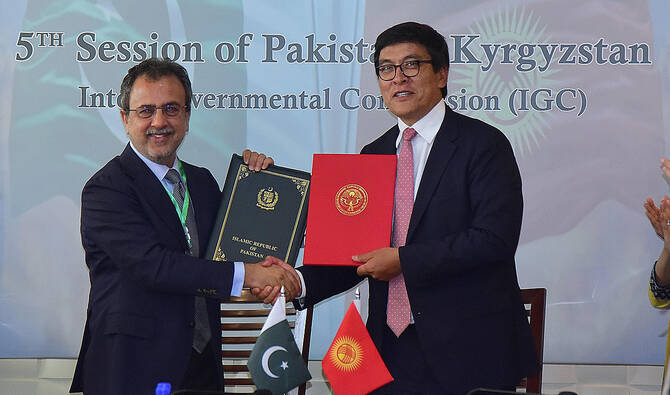

ISLAMABAD: Pakistan and Kyrgyzstan have signed multiple protocols and memorandums of understanding to deepen their economic and technical cooperation and take the bilateral trade volume to $100 million, Pakistan’s Press Information Department said on Monday.
The statement came after the 5th session of the Pakistan-Kyrgyzstan Inter-Governmental Commission (IGC) on Trade, Economic, Scientific and Technical Cooperation in Islamabad. The meeting marked a significant advancement in the bilateral relationship between the Islamic Republic of Pakistan and the Kyrgyz Republic, reflecting a shared commitment to expand cooperation in diverse sectors of mutual interest.
Both sides held in-depth discussions at the session, co-chaired by Pakistan’s Energy Minister Awais Leghari and Kyrgyz Cabinet of Ministers’ deputy chairman Edil Baisalov, and reviewed progress made since their last meeting, with a renewed focus on strengthening economic and technical collaboration.
During the talks, Leghari said the Pakistan-Kyrgyzstan bilateral trade volume had declined from $11.2 million in 2022-23 to $5.18 million in 2024-25, stressing the need to revitalize trade engagement between the two countries.
“The two sides reaffirmed their resolve to boost bilateral trade, setting a target to raise trade volume to USD 100 million,” the PID said in a statement.
“They agreed to work on diversification of exports and imports, revive the Pakistan-Kyrgyz Joint Business Council, and organize business forums, trade fairs, and B2B (business-to-business) exchanges.”
The development comes at a time when Pakistan, faced with an economic slowdown, is trying to leverage its strategic geopolitical position to enhance its role as a pivotal trade and transit hub connecting landlocked Central Asia with the rest of the world, with a flurry of visits, investment talks and economic activity taking place between officials from Pakistan and the Central Asian nations in recent months.
Both sides signed a number of MoUs to deepen their cooperation in key sectors. An agreement was signed between the Kyrgyz National Investments Agency and the Board of Investment of Pakistan to foster investment cooperation, while another MoU, signed between the Pakistan Halal Authority (PHA) and Kyrgyzstan’s Center for Development of Halal Industry, focused on Halal trade cooperation, according to the PID.
In the energy and environment domain, the Kyrgyz side proposed joint participation in a power transmission line project connecting Kyrgyzstan, China and northern Pakistan. Both countries agreed to explore electricity imports, collaboration in renewable energy, mining, hydrocarbons, and technical partnerships between institutions like the Hydrocarbon Development Institute of Pakistan and the Kyrgyz State Technical University.
“Discussions also focused on enhancing regional connectivity through logistics and transportation. Both sides agreed to deepen cooperation in postal services, cargo and rail transport, and civil aviation,” the PID said.
“Both countries underscored the importance of strengthening financial cooperation. The central banks of both countries agreed to collaborate on the development of Islamic banking and financial instruments, including training programs through Pakistan’s National Institute of Banking and Finance.”
The discussions also featured education and scientific collaboration.
“The parties agreed to promote joint training programs, academic exchanges, and institutional linkages,” the PID said.
“Pakistan reiterated its support to Kyrgyz students under the Pakistan Technical Assistance Program (PTAP). Both sides also agreed to explore labor cooperation and establish a Joint Working Group to discuss its modalities.”


