

UK’s Keir Starmer condemns Israel in strongest terms yet as pressure mounts for Palestine recognition

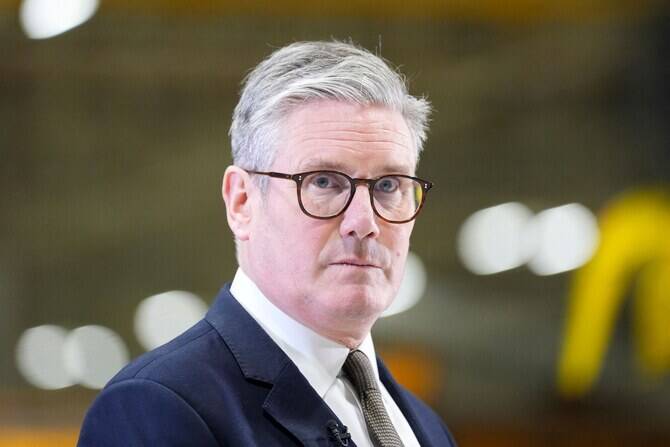
UK Prime Minister Keir Starmer has condemned Israel with his strongest comments yet, as pressure mounts within and outside the government for Britain to formally recognize a Palestinian state. (AFP/File Photo)
Short Url
Updated 25 July 2025
Follow

UK’s Keir Starmer condemns Israel in strongest terms yet as pressure mounts for Palestine recognition

  • ‘Suffering and starvation unfolding in Gaza is unspeakable and indefensible,’ UK leader says
  • Senior figures within and outside govt urge Starmer to follow Macron and recognize Palestinian state

LONDON: UK Prime Minister Keir Starmer has condemned Israel with his strongest comments yet, as pressure mounts within and outside the government for Britain to formally recognize a Palestinian state.

Starmer’s remarks came after French President Emmanuel Macron said his country would recognize a Palestinian state, and as the two leaders, along with Germany’s Friedrich Merz, were set to hold an emergency call on the issue.

“The suffering and starvation unfolding in Gaza is unspeakable and indefensible. While the situation has been grave for some time, it has reached new depths and continues to worsen. We are witnessing a humanitarian catastrophe,” the UK prime minister said.

For the first time with reference to Israel, his statement failed to mention the country’s right to defend itself, or the hostages held by Hamas and other militant groups.

Starmer “appeared to have lost his patience with Benjamin Netanyahu’s Israeli government,” The Independent said, adding that the PM “appeared to be on the cusp of being prepared to recognize a Palestinian state.”

The political movement among major European countries is taking place as Israel faces mounting global anger over its actions in Gaza.

Starvation in the enclave has reportedly surged in recent weeks, with at least 113 hunger-related deaths being recorded, including 82 children, according to Palestinian health officials.

The Israeli military has also killed scores of Palestinians queuing for food at designated aid sites operated by the controversial Gaza Humanitarian Foundation, a US charity backed by Israel that is attempting to supersede Gaza’s existing UN-operated aid system.

Starmer added in his statement: “I will hold an emergency call with E3 partners tomorrow, where we will discuss what we can do urgently to stop the killing and get people the food they (Palestinians) desperately need while pulling together all the steps necessary to build a lasting peace.

“We all agree on the pressing need for Israel to change course and allow the aid that is desperately needed to enter Gaza without delay.”

Starmer has faced significant pressure this week from within his own Labour Party, including Cabinet ministers, as well as from trade unions and academics, to recognize a Palestinian state.

He added: “We are clear that statehood is the inalienable right of the Palestinian people. A ceasefire will put us on a path to the recognition of a Palestinian state and a two-state solution which guarantees peace and security for Palestinians and Israelis.”

Justice Secretary Shabana Mahmood said yesterday that recognition would lead to “multiple benefits” and send a “strong message” to the Netanyahu government.

She is one of several government ministers who have privately urged Starmer to recognize a Palestinian state in recent months.

The issue has also been raised at regular Cabinet meetings.

Mahmood, the most senior Muslim politician in the UK, told The Times that though pushing for a ceasefire in Gaza was “the most urgent thing of all,” Palestinian statehood represented the “best mechanism to get us through a peace process.”

In its manifesto for last year’s general election, the ruling Labour Party pledged to recognize Palestine once in office.

Labour’s Sadiq Khan, the mayor of London, also urged the government to follow France’s lead.

He warned that there could be no two-state solution — a longtime policy target of British governments — if “there is no viable state left to call Palestine.”

Another Labour politician, Emily Thornberrry, chair of the foreign affairs select committee, also urged Starmer to act.

The UK’s actions in relation to the Israel-Palestine conflict have “time and time again … come too little, too late,” she wrote in an opinion piece for The Independent on Friday.

Thornberry highlighted the potential of the major joint Saudi-French conference on the two-state solution, set to begin in New York next week.

After addressing Parliament on a visit to London last week, Macron met Palestinian President Mahmoud Abbas on Thursday, delivering a letter that said he would formally recognize Palestine at the UN General Assembly in September.

The French president was “right” to do so, Thornberry said.

“A unified move by the signatories to the secret Sykes-Picot agreement which carved up the Middle East more than a century ago would demonstrate our sincere commitment to a two-state solution,” she added.

“The natural reaction of the British public to the scenes of starvation and death in Gaza is to call on their politicians to do something. The challenge for politicians is to ensure that what they do makes a real difference.

“The recognition of Palestine as part of a renewed commitment by the UK to work with others to build a peace process would be just that.”


Nobel laureate Machado says US helped her leave Venezuela, vows return

Updated 6 sec ago
Follow

Nobel laureate Machado says US helped her leave Venezuela, vows return

  • Machado emerged on a hotel balcony in Oslo to cheering supporters early Thursday
  • “We did get support from the United States government to get here,” Machado said

OSLO: Nobel Peace laureate Maria Corina Machado said on Thursday that the United States helped her get to Norway from hiding in Venezuela, expressing support for US military action against her country and vowing to return home.
Machado, who vanished in January after challenging the rule of President Nicolas Maduro, emerged on a hotel balcony in Oslo to cheering supporters early Thursday after several days of confusion over her whereabouts.
“We did get support from the United States government to get here,” Machado told a press conference when asked by AFP about whether Washington had helped.
The Wall Street Journal reported that she wore a wig and a disguise on the high-risk journey, leaving her hide-out in a Caracas suburb on Monday for a coastal fishing village, where she took a fishing skiff across the Caribbean Sea to Curacao.
The newspaper said the US military was informed to avoid the boat being targeted by airstrikes. Once on the island, she took a private jet to Oslo early on Wednesday.
Machado thanked those who “risked their lives” to get her to Norway but it was not immediately clear how or when she will return to Venezuela, which has said it would consider her a fugitive if she left.
“Of course, the risk of going back, perhaps it’s higher, but it’s always worthwhile. And I’ll be back in Venezuela, I have no doubt,” she added.
Machado has been hailed for her fight for democracy but also criticized for aligning herself with US President Donald Trump, to whom she has dedicated her Nobel, and for inviting foreign intervention in her country.

- Military build-up -

The United States has launched a military build-up in the Caribbean in recent weeks and deadly strikes on what Washington says are drug-smuggling boats.
“I believe every country has the right to defend themselves,” Machado told reporters Thursday.
“I believe that President Trump’s actions have been decisive to reach the point where we are right now, in which the regime is weaker than ever, because the regime previously thought that they could do anything,” she continued.
Late Wednesday, Trump said the United States had seized a “very large” oil tanker near Venezuela, which Caracas denounced as “blatant theft.”
Maduro maintains that US operations are aimed at toppling his government and seizing Venezuela’s oil reserves.
Machado first appeared on a balcony of the Grand Hotel in the middle of the night, waving and blowing kisses to supporters chanting “libertad” (“freedom“) below.
On the ground, she climbed over metal barriers to get closer to her supporters, many of whom hugged her and presented her with rosaries.
She said she has missed much of her children’s lives while hiding, including graduations and weddings.

- ‘ Political risk’ -

Machado won the Peace Prize for “her struggle to achieve a just and peaceful transition from dictatorship to democracy.”
She has accused Maduro of stealing Venezuela’s July 2024 election, from which she was banned — a claim backed by much of the international community.
She last appeared in public on January 9 in Caracas, where she protested Maduro’s inauguration for his third term.
The decision to leave Venezuela and join the Nobel festivities in Oslo comes at both personal and political risk.
“She risks being arrested if she returns even if the authorities have shown more restraint with her than with many others, because arresting her would have a very strong symbolic value,” said Benedicte Bull, a professor specializing in Latin America at the University of Oslo.
While Machado is the ” undisputed” leader of the opposition, “if she were to stay away in exile for a long time, I think that would change and she would gradually lose political influence,” Bull said.
In her acceptance speech read by one of her daughters Wednesday, Machado denounced kidnappings and torture under Maduro’s tenure, calling them “crimes against humanity” and “state terrorism, deployed to bury the will of the people.”