

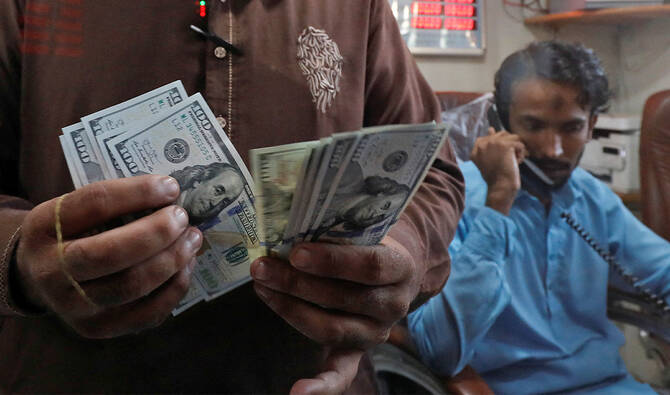

KARACHI: Pakistan’s rupee has strengthened against the US dollar this week after the country’s top intelligence agency launched a crackdown on black market currency traders, the head of a major forex trade body told Arab News.
The Inter-Services Intelligence (ISI), Pakistan’s powerful military-run spy agency, met on July 22 in Islamabad with senior officials from currency exchange companies, amid growing concern over the rupee’s depreciation, which fell to a 22-month low of Rs284.97 against the US dollar earlier this week.
Maj. Gen. Faisal Naseer, a deputy chief of the ISI, chaired the session, according to Malik Bostan, who attended the discission and is the chairman of the Exchange Companies Association of Pakistan (ECAP). The Pakistani army did not respond to Arab News questions regarding the meeting.
“The crackdown is going on and has lifted pressure from the currency market,” Bostan told Arab News, confirming that backed by the ISI, the Federal Investigation Agency (FIA) had begun raiding informal, unregulated money transfer hundi-hawala operators and currency smuggling networks, prompting many to go underground.
“The dollar rate is going to come down significantly.”
The dollar slipped slightly to Rs283 on Friday morning, after gaining nearly Rs10 over recent weeks. On July 22, it surged to Rs284.97, a rate last seen in September 2023, according to Adnan Sami Sheikh, assistant vice president of research at Pakistan-Kuwait Investment Company.
Pakistan operates a multi-tiered currency market, with rates diverging between the official interbank channel, the open market, and an unregulated “grey market” where many traders and informal hawala dealers operate. Burdened by over $58 billion in imports in the last fiscal year, Pakistan faces severe inflationary pressure whenever the dollar strengthens.
The rupee has lost 2 percent of its value since January, despite Pakistan’s current account recording a surplus of $2.1 billion, according to central bank data. Under a $7 billion International Monetary Fund (IMF) program approved in September 2024, Islamabad is obligated to allow a market-driven exchange rate. But volatility persists.
“This crackdown would make a difference, and it has already, as we saw the dollar slide,” said Qazi Owais-ul-Haq, a currency trader at Arif Habib Ltd., a Karachi-based brokerage.
ISI MEETING AND BLACK MARKET DYNAMICS
Bostan said he informed General Naseer that smugglers were once again actively sending foreign currency, particularly dollars, to neighboring Iran and Afghanistan. He cited new tax policies such as the requirement to declare purchases of Rs200,000 or more in cash as driving some customers to the black market.
“Many customers who do not pay taxes hide their identities while buying and hoarding foreign currencies from the black market at a large scale,” Bostan said. “Maj. Gen. Naseer immediately ordered law enforcement agencies to launch a crackdown on currency smugglers and arrest them.”
This is the second major intervention of its kind.
In 2023, the military spearheaded a similar crackdown when illegal currency flows to Afghanistan reached as high as $5 million per day, according to ECAP’s Secretary-General Zafar Sultan Paracha.
At the time, Afghanistan’s central bank was injecting just $17 million weekly into its own markets.
Bostan said recent dollar hoarding had been driven by speculation that the rupee would fall to Rs290. But the crackdown, coupled with exporters selling proceeds, had reversed that trend.
“The dollar fell below Rs287 in the open market because of the agencies’ crackdown and exporters who have started selling their proceeds,” he said.
He also pointed to central bank activity, with the State Bank of Pakistan (SBP) having purchased $9 billion from the interbank market over the past nine months to build reserves, which currently stand at $19.9 billion.
“It has now stopped buying dollars from the interbank, meaning the dollar rate will not rise but is likely to fall significantly,” Bostan said, adding that the rupee could appreciate by Rs10 or more in the coming month.
But others were less optimistic.
“Despite the crackdown in the news, ground reality is very different,” said Sheikh, the Pakistan-Kuwait Investment Company executive. “Money changers in affluent areas of Karachi where dollar demand remains high report no availability of dollars.”
He added that the grey market rate hovered around Rs295–Rs300, nearly 5 percent above the official interbank rate.
“When no dollars are available at money changers, of course people would continue to buy from the grey market and the rate would remain elevated.”
SELECTIVE ENFORCEMENT
ECAP’s Secretary-General Zafar Sultan Paracha had another theory.
He said large banks and a few well-connected exchange firms were manipulating the market by offering daily premiums of Rs1 on forward contracts to exporters.
“The banks and some blue-eyed exchange companies are responsible for the current surge in dollar rate,” Paracha said. “There is no crackdown like what we saw in 2023, but just administrative measures have been taken that has told the banks and other wrongdoers that the regulator (SBP) has woken up.”
“This has changed the sentiment, and we see the dollar rate is coming down daily.”
Separately, on July 21, Army Chief Field Marshal Asim Munir also met leading Pakistani industrialists from the Federation of Pakistan Chambers of Commerce and Industry (FPCCI) and the All Pakistan Textile Mills Association in a show of support for economic stabilization efforts.
FPCCI President Atif Ikram Sheikh said in a July 22 statement that the army chief had “assured the business community of his full support in efforts to revive and strengthen Pakistan’s economy.”


