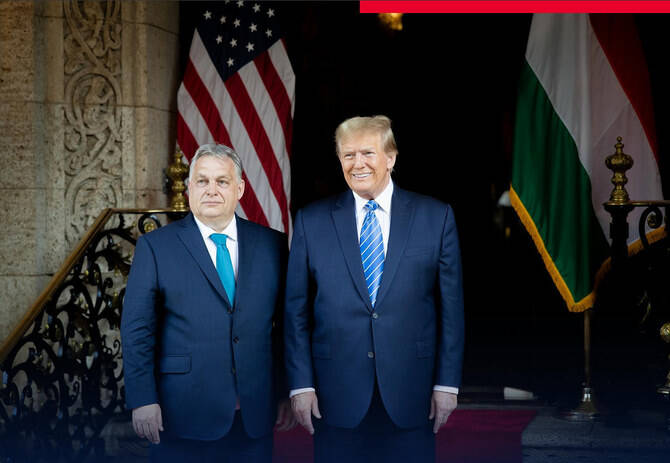

BUDAPEST: Hungary’s populist prime minister has spent years building a close political relationship with US President Donald Trump and aligning himself with the MAGA movement.
But despite Viktor Orban’s success in gaining favor with the culturally conservative and nationalist wing of Trump’s administration, his country is poised to be among those hard hit by Trump’s tariffs against the European Union.
Trump earlier this month announced he would levy tariffs of 30 percent against Mexico and the EU beginning Aug. 1 – a move that could cause massive upheaval between the United States and the 27-member EU, of which Hungary is a member.
As a small, export-oriented economy with major automobile, pharmaceutical and wine industries – some of the main categories of products Europe exports to the US – Hungary will be particularly vulnerable to Trump’s tariffs.
The duties “would put the Hungarian economy in a very, very difficult situation, because then the entire possibility for Hungary to export to America would be essentially eliminated,” Péter Virovacz, chief analyst at ING Hungary, told The Associated Press.
‘Not the best way to make money’
Hungary’s largest trading partners are other EU countries like Germany, Italy and Romania, as well as China, but many Hungarian companies export their goods across the Atlantic. Outgoing trade to the United States represents around 15 percent of all Hungarian exports to countries outside the EU.
One such enterprise, a Budapest-based company specializing in Hungarian wine, said it will likely cease doing business in the US altogether if the 30 percent duty is levied on its products.
“If it’s really going to be 30 percent, then there is no more shipment ... We might just call it a day at the end of the year,” said Gabor Banfalvi, co-owner of Taste Hungary.
Banfalvi’s company has been shipping around 10,000 bottles of premium Hungarian wine per year to the US for about half a decade. With a base in Washington D.C., it exports a range of red and white wines to clients in numerous US states including specialty wine shops and bars.
Until now, “it’s been a thin profit margin, but it’s been fine because we want Hungarian wine to be available” to US consumers, Banfalvi said.
“Then came 2025,” he said.
When Trump began imposing tariffs on EU exports earlier this year, the cost of Taste Hungary’s shipments tripled, Banfalvi said – price hikes he had to build into the sticker price of the wine. The imposition of 30 percent tariffs would make exporting “unsustainable.”
“You just start to think, why are we doing this? Is it really worth it? It’s just not the best way to make money,” he said.
In total, the value of EU-US trade in goods and services in 2024 amounted to 1.7 trillion euros ($2 trillion.)
Doubts that political ties could soften the blow
Hungary’s government, a vocal proponent of Trump’s “patriotic” foreign policy prioritizing national interests, has acknowledged that the tariffs would present a challenge. But, careful not to criticize the Trump administration, it has instead blamed the EU, a frequent target of Orban’s scorn, for failing to reach a comprehensive trade agreement with Washington.
Confident that his right-wing populist policies would help win him favor with Trump’s administration, Orban said in an interview in April that while tariffs “will be a disadvantage,” his government was negotiating “other economic agreements and issues that will offset them.”
But Peter Kreko, director of the Budapest-based Political Capital think tank, expressed doubt that political affinities could play a meaningful role in mitigating damage to Hungary’s economy caused by Trump’s trade policy.
“The unquestionably good bilateral relations simply cannot compensate for the trade conflicts between the EU and the US, and as a consequence, Hungary will suffer the tariffs the same way that the EU will,” Kreko said. “Mutual nationalisms cannot be coordinated in a way that it is going to be a win-win situation.”
Car manufacturing and pharmaceuticals
Virovacz, the economist, pointed out that Hungary is home to numerous automobile factories for major automakers like Audi and Mercedes. The manufacturing of cars and motor vehicle parts represents an “overwhelming majority” of the country’s total exports, he said.
Pharmaceuticals make up an even larger share of Hungarian exports to the United States – an industry on which Trump this month threatened to impose 200 percent tariffs. That “will essentially kill European and thus Hungarian exports to America,” Virovacz said.
“It’s impossible for tariffs to be levied on EU products but not on Hungarian ones,” he said. “A theoretical option is that Trump could somehow compensate Hungary because he’s on good terms with the Hungarian political leadership, but if that only starts happening now, it’s way too late.”
Kreko, the political analyst, said Trump’s administration “gives practically nothing for free. If Hungary ... cannot fulfill the interests of the US, then I think Hungary is not going to receive gifts.”
“Hungary just doesn’t have the cards, to use Trump’s terminology,” he added.