Pakistan to introduce end-to-end digital Hajj system next year — IT minister
Pakistan to introduce end-to-end digital Hajj system next year — IT minister/node/2634256/pakistan
Pakistan to introduce end-to-end digital Hajj system next year — IT minister
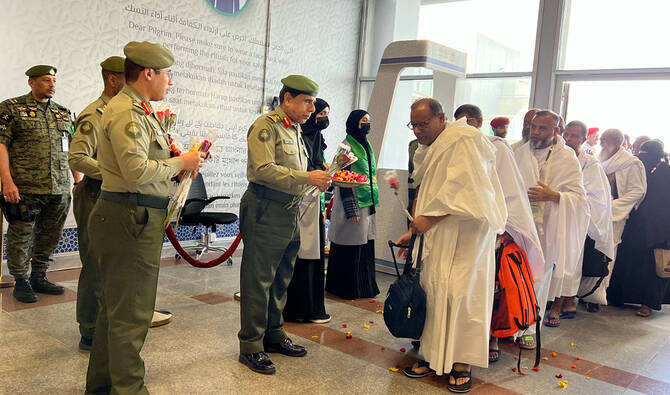
Muslim pilgrims from Bangladesh and Pakistan arrive at King Abdul Aziz International Airport in Jeddah, ahead of the Hajj pilgrimage in Mecca, on June 20, 2023. (AFP/File)
ISLAMABAD: Pakistan will introduce a fully digital, end-to-end Hajj management system next year, Information Technology Minister Shaza Fatima Khawaja said on Tuesday, covering the entire process from application to pilgrims’ return home.
The announcement followed the signing of a memorandum of understanding between the Ministry of Religious Affairs and the Ministry of IT to modernize the country’s Hajj operations.
The move comes as Pakistan pushes to digitize public services and improve administrative efficiency while managing one of the country’s largest annual overseas logistical operations.
“Next year, an end-to-end digital system will be introduced covering the entire Hajj journey from application to return home,” Khawaja said. “A simple and user-friendly online Hajj portal will be established for applicants.”
Religious Affairs Minister Sardar Muhammad Yousaf said the digital transition would improve transparency and operational efficiency.
“The digital system will eliminate unnecessary delays and human errors,” he said.
Under the agreement, authorities will upgrade the existing Pak Hajj mobile application and integrate systems to improve coordination among stakeholders and ensure compliance with Saudi timelines.
Pakistan has already made preparations for this year’s Hajj, with the Ministry of Religious Affairs announcing this week it has completed the first phase of a 10-day technical training program for 870 Khuddam-ul-Hujjaj, government facilitators who assist Pakistani pilgrims in Saudi Arabia.
Officials said the training includes digital navigation tools, emergency response modules and crowd management instruction.
More than 179,000 Pakistanis are expected to perform Hajj this year, requiring coordination across transport, accommodation, health services and regulatory compliance with Saudi authorities. Among these pilgrims, 119,210 will travel under the government scheme and 60,000 through private tour operators, according to ministry data.
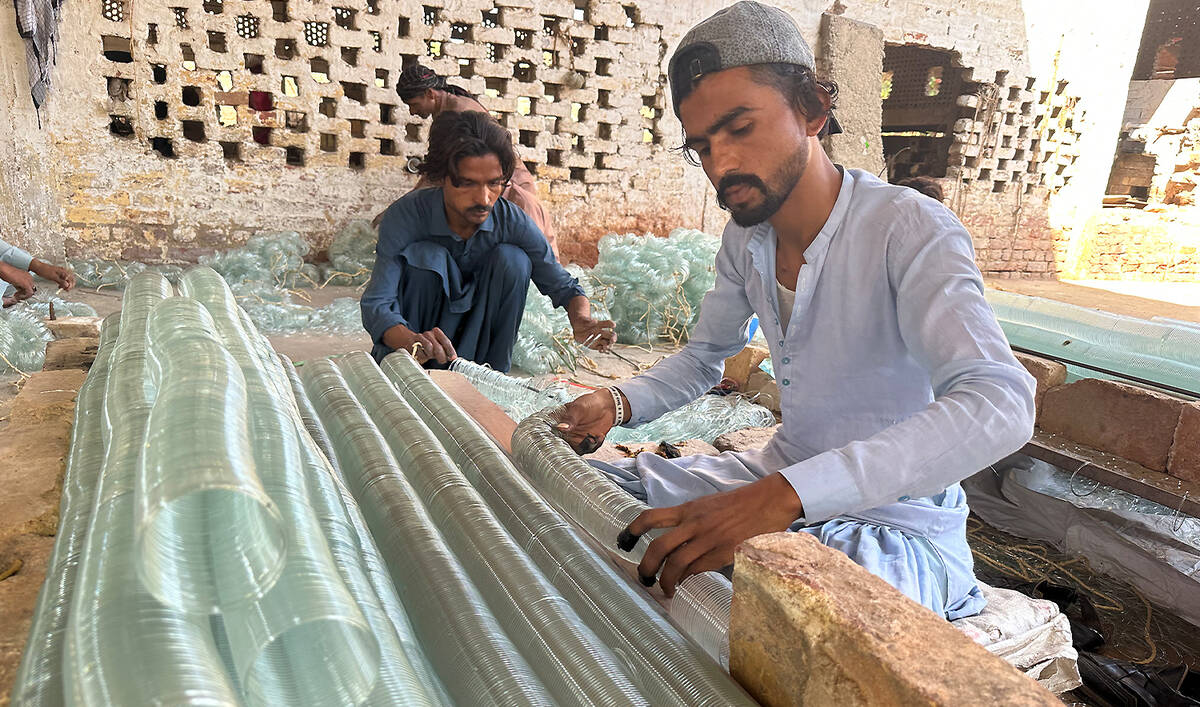
Hyderabad/Karachi: In a cramped room in Hyderabad’s historic Choori Gali, 50-year-old Farmida Khalid carefully joins the two open ends of a glass bangle over the flames of oil lamps, working alongside her children in sweltering heat to complete nearly 3,000 bangles a day.
For generations, glass bangles have been a staple of festive shopping in Pakistan, with women buying brightly colored sets during the final days of Ramadan and ahead of the Eid Al-Fitr festival. Much of that demand is met by workshops in Hyderabad, the country’s largest glass bangle manufacturing hub.
But producers say the industry’s future is increasingly uncertain as soaring gas tariffs and rising taxes push up costs and squeeze both manufacturers and buyers.
Pakistan’s energy prices have risen sharply in recent years as the government withdrew subsidies under a $7 billion International Monetary Fund (IMF) stabilization program. Gas, the primary fuel used in bangle furnaces, has become significantly more expensive, raising production costs across the sector.
“Gas is the most important utility for bangle production, and its cost has become extremely high,” said Muhammad Saleem Khan, president of the Hyderabad Glass Bangle Manufacturers Association (HGBMA).
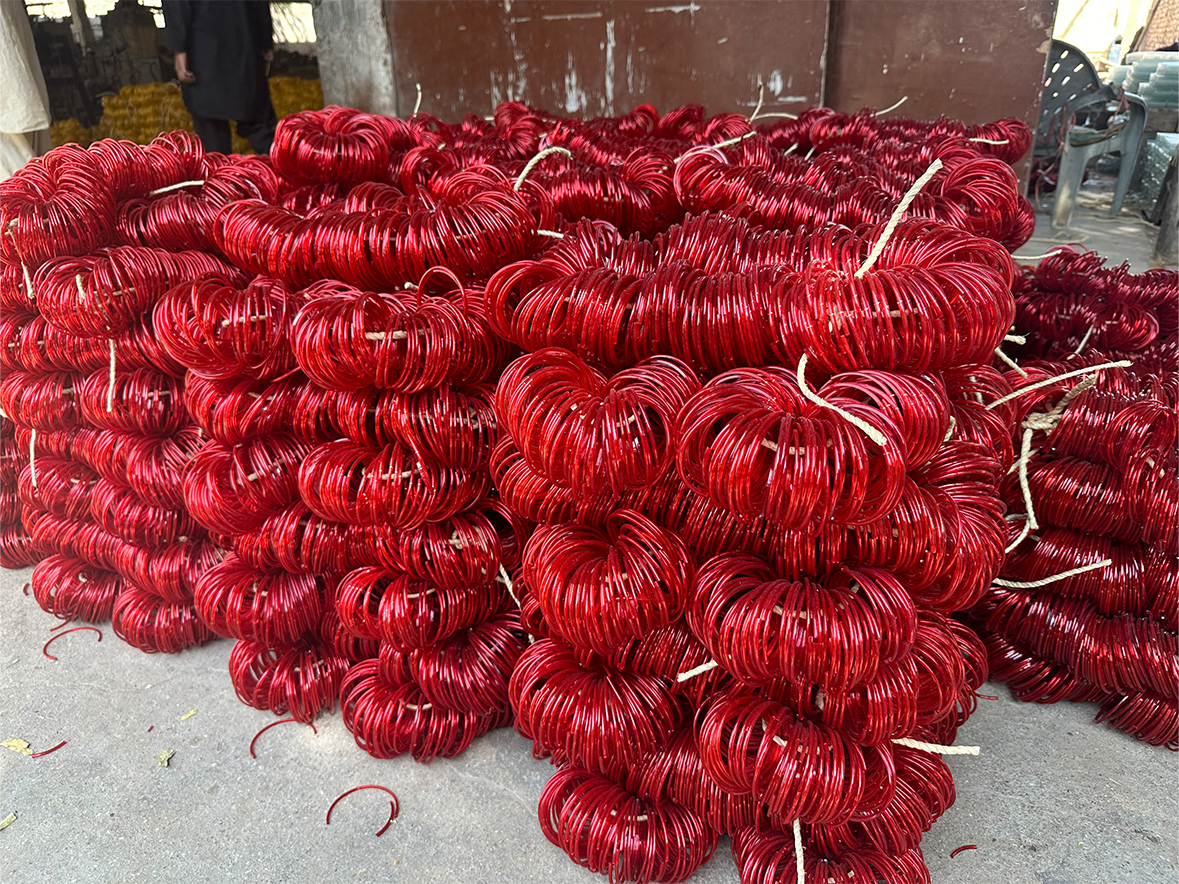
A worker is seen stacking glass bangles at a factory in Hyderabad, Pakistan, on February 21, 2026. (AN photo)
According to Khan, gas prices have surged by 92% in the past two years to Rs2,300 ($8.20) per one million British Thermal Units (MMBTU). He said the industry also pays an 18% general sales tax on manufacturing, plus an additional 4% applied to unregistered wholesalers, effectively a 22% tax burden.
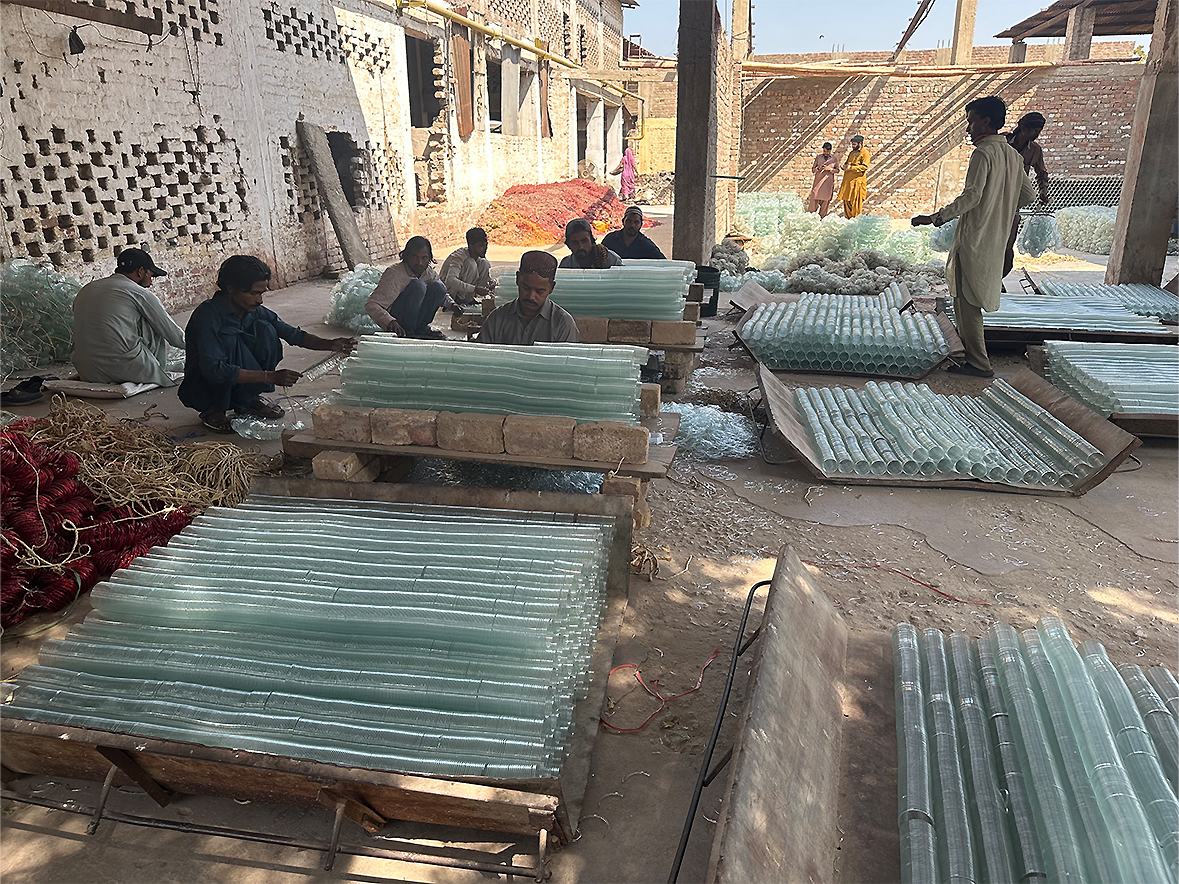
Workers are seen stacking glass bangles at a factory in Hyderabad, Pakistan, on February 21, 2026. (AN photo)
The result, he said, is a dramatic rise in retail prices.
“Gas that once allowed us to produce bangles costing Rs50 now results in products sold at Rs500 in the market,” Khan said. “And higher-end designs can reach Rs1,000 or Rs2,000.”
The HGBMA estimates the Rs10 billion (approximately $36 million) industry employs around 200,000 people in Hyderabad and supplies markets across Pakistan, as well as exports to Afghanistan, Bangladesh, Nepal and the Gulf region.
A worker is seen stacking glass bangles at a factory in Hyderabad, Pakistan, on February 21, 2026. (AN photo)
“SOMEHOW SURVIVING”
Once bustling with roaring furnaces and the constant clink of glass, Choori Gali today has shuttered workshops and reduced production lines. Khan said the industry is operating at about 50% of its capacity and producing roughly 100,000 bunches during peak seasons such as Eid.
Traditionally, the Islamic months of Shaban and Ramadan were peak production periods, with factories running at around 70% capacity. This year, however, manufacturers say output has dropped closer to 30% amid inflationary pressures and disruptions to cross-border trade with Afghanistan, a key export market.
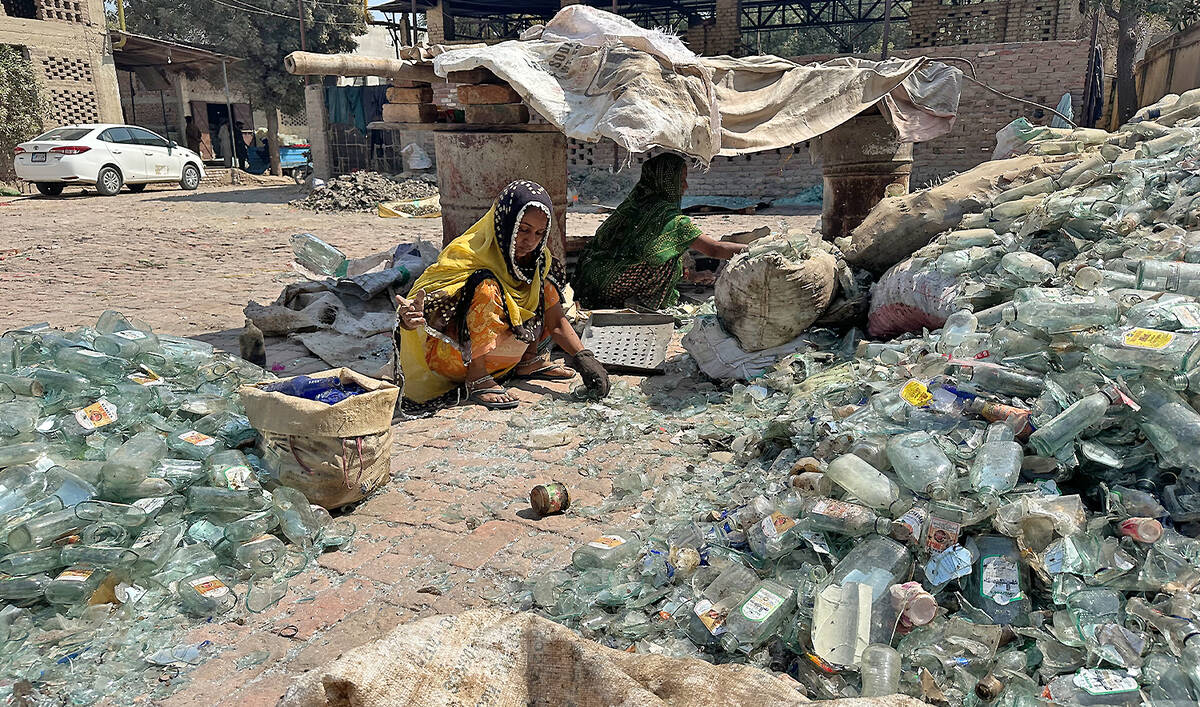
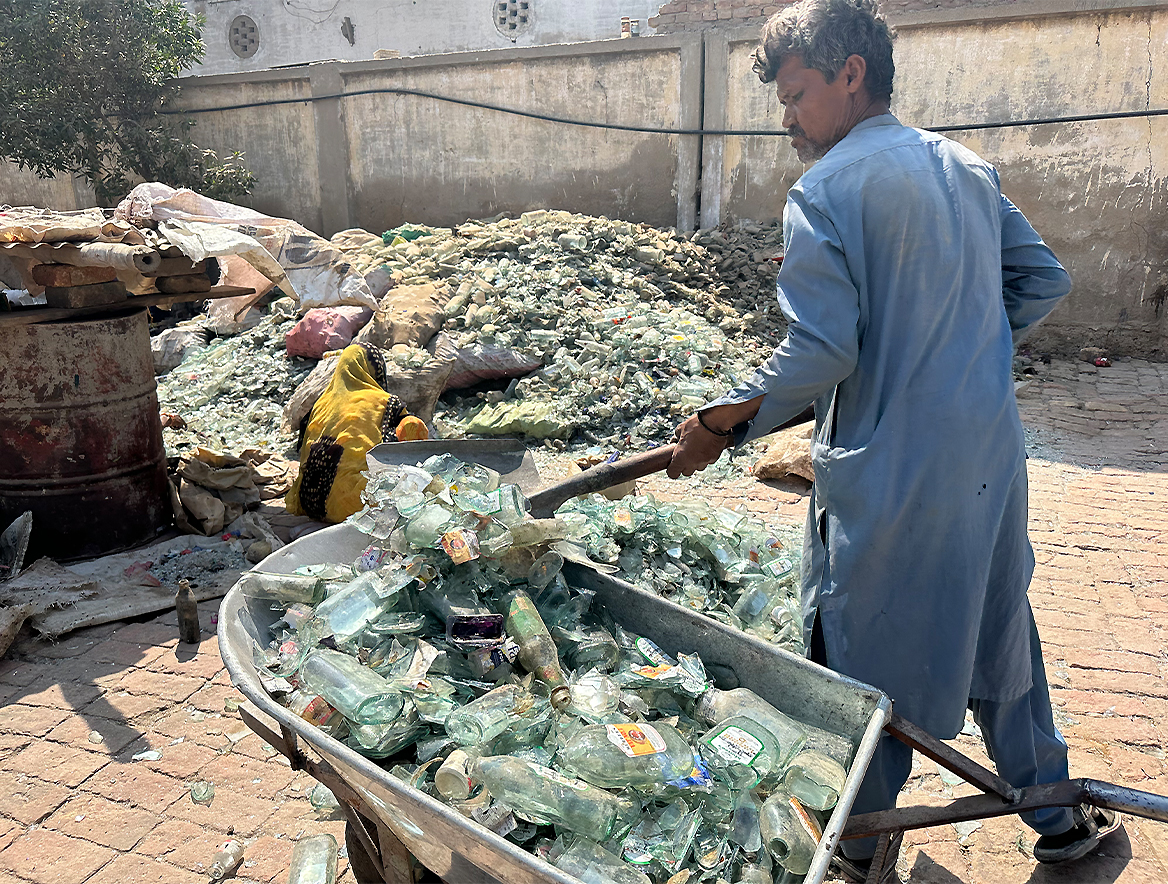
A worker is stashing glass bottles at a factory in Hyderabad, Pakistan, on February 21, 2026. (AN photo)
At the worker level, the slowdown has translated into fewer shifts and lower earnings.
“Work has mostly decreased. In winter, we get less material and less gas,” Khalid said. “In summer, we get more. That is how the work goes [on].”
Islam Din, 30, who works 12-hour shifts at Al Naeem Glass Works, one of the largest manufacturers, produces about 1,500 bangles per shift. He said factory operations are often suspended for weeks at a time.
“Of course, we have problems,” Din said. “But we are somehow surviving. We don’t have any other business.”
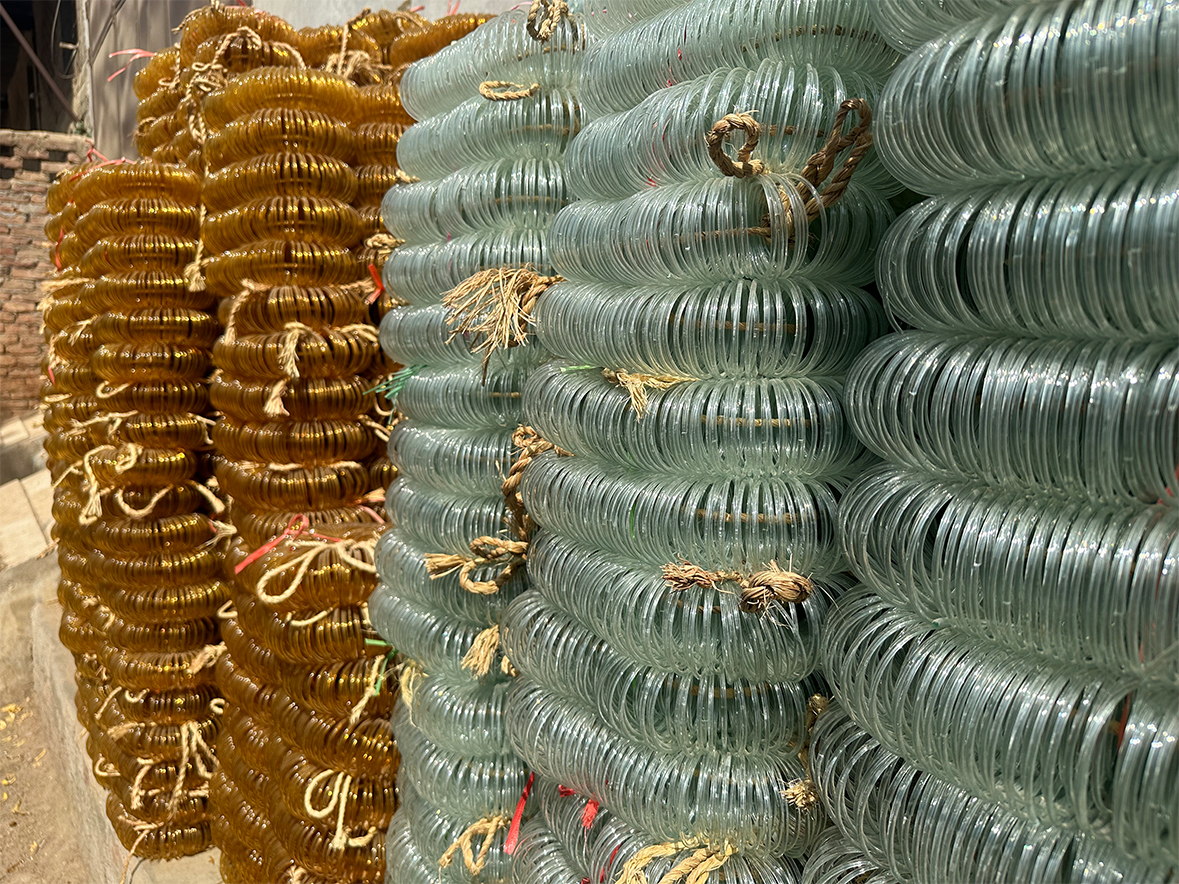
Glass bangles are stacked at a factory in Hyderabad, Pakistan, on February 21, 2026. (AN photo)
Rising prices are also reshaping consumer behavior. Pakistan’s annual inflation rate surged to a record 38 percent in May 2023 before easing to single-digit levels, but household purchasing power remains under strain.
“Cheaper metal bangles have taken over more than 50 percent of the market across Pakistan,” Khan said. “We cannot compete with them because glass bangles are more expensive.”
Wholesaler Muhammad Imran Shaikh said order volumes have shrunk significantly.
“Now, our orders look like 500, 700, 300, 400, 100 boxes,” he said, recalling a time when monthly orders reached 2,000 boxes.
Glass bangles are stacked at a factory in Hyderabad, Pakistan, on February 21, 2026. (AN photo)
Khan urged the government to rationalize gas tariffs by at least 35 percent to Rs1,500 per MMBTU and reduce the overall tax burden.
“If relief is not provided, it [industry] will gradually close down,” he warned.