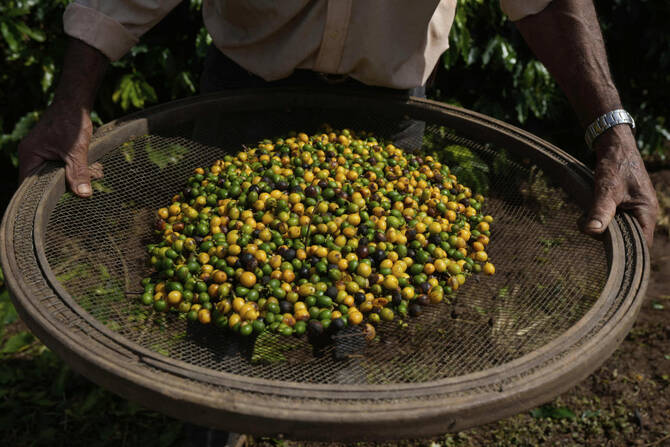
PORCIUNCULA: Brazilian José Natal da Silva often tends to his modest coffee plantation in the interior of Rio de Janeiro state in the middle of the night, sacrificing sleep to fend off pests that could inflict harm on his precious crops.
But anxiety has troubled his shut-eye even more in recent weeks, following President Donald Trump’s announcement earlier this month of a 50 percent tariff on Brazilian imported goods, which experts expect to drive down the price of coffee in Brazil.
Da Silva sighed as he recounted his fears, sitting on the dry earth surrounded by his glossy green arabica coffee shrubs, in the small municipality of Porciuncula.
“We’re sad because we struggle so much. We spend years battling to get somewhere. And suddenly, everything starts falling apart, and we’re going to lose everything,” da Silva said. “How are we going to survive?”
Tariff linked to Bolsonaro trial
Trump’s tariff on Brazil is overtly political. In his public letter detailing the reasons for the hike, the US president called the trial of his ally, former President Jair Bolsonaro, a ” witch hunt.” Bolsonaro is accused of masterminding a coup to overturn his 2022 election loss to left-leaning President Luiz Inácio Lula da Silva.
The tariff has sparked ripples of fear in Brazil, particularly among sectors with deep ties to the American market such as beef, orange juice — and coffee. Minor coffee producers say the import tax will hit their margins and adds to the uncertainty already generated by an increasingly dry and unpredictable climate.
Brazil, the world’s largest coffee producer, exports around 85 percent of its production. The United States is the country’s top coffee buyer and represents around 16 percent of exports, according to Brazil’s coffee exporters council Cecafe.
The president of Cecafe’s deliberative council, Márcio Ferreira, told journalists last week that he thinks the US will continue to import Brazilian coffee, even with the hefty tariff. “It’s obvious that neither the United States nor any other source can give up on Brazil, even if it’s tariffed,” he said.
Tariff could hurt competitiveness of Brazilian coffee in US
But the tariff will likely decrease Brazilian coffee’s competitiveness in the US and naturally reduce demand, said Leandro Gilio, a professor of global agribusiness at Insper business school in Sao Paulo.
“There’s no way we can quickly redirect our coffee production to other markets,” Gilio said. “This principally affects small producers, who have less financial power to make investments or support themselves in a period like this.”
Family farmers produce more than two-thirds of Brazilian coffee. They are a majority in Rio state’s northwestern region, where most of the state’s coffee production lies.
Coffee farming is the primary economic activity in these municipalities. In Porciuncula, which neighbors Brazil’s largest coffee-producing state Minas Gerais, gentle mountains are layered with symmetrical lines of coffee shrubs.
Da Silva, who wore a straw hat for protection from the sun and a crucifix around his neck, owns around 40,000 coffee trees. He started working in the fields when he was 12.
Besides coffee, he grows cassava, squash, bananas, oranges and lemons and has a few chickens that provide fresh eggs. “We have them because of the fear of not being able to eat. We wouldn’t manage if everything were bought, because the profit is very low,” he said.
Last year, drought — made more likely by human-caused climate change — devastated large swathes of da Silva’s production. The reduction in supply pushed coffee prices up, but only after many small-scale farmers had already sold all their crops.
Since peaking in February, prices of arabica have fallen, dropping 33 percent by July, according to the University of Sao Paulo’s Center for Advanced Studies in Applied Economics, which provides renowned commodity price reports.
“When you make an investment, counting on a certain price for coffee, and then when you go to sell it the price is 20-30 percent less than you calculated, it breaks the producers,” said Paulo Vitor Menezes Freitas, 31, who also owns a modest plantation of around 35,000 coffee trees in the nearby municipality of Varre-Sai.
The demands of coffee farming
Life out in the fields is tough, according to Menezes Freitas.
During harvest season, he sometimes gets up at 3 a.m. to turn on a coffee drier, going to bed as late as midnight. The rest of the year is less intense, but still, there are few to no breaks because there’s always work to do, he said.
Menezes Freitas, who is expecting his first child in October, said the tariff’s announcement increased his fears for the future.
“It’s scary. It feels like you’re on shaky ground. If things get worse, what will we do? People will start pulling out their coffee and finding other ways to survive because they won’t have the means to continue,” he said.
In addition to slashing the value of his coffee beans, Menezes Freitas said the tariff will impact machinery and aluminum — goods that producers like him use every day.
“We hope this calms down. Hopefully, they’ll come to their senses and remove that tariff. I think it would be better for both the United States and Brazil,” he said.


![]()

Small Brazilian coffee producers fear for the future after Trump’s 50 percent tariff
Short Url
https://arab.news/j8mjx
Small Brazilian coffee producers fear for the future after Trump’s 50 percent tariff
- Experts warn the tariff will hit small producers hardest, as they lack resources to adapt quickly or find new markets for their crops


Latest updates


© 2026 SAUDI RESEARCH & PUBLISHING COMPANY, All Rights Reserved And subject to Terms of Use Agreement.