

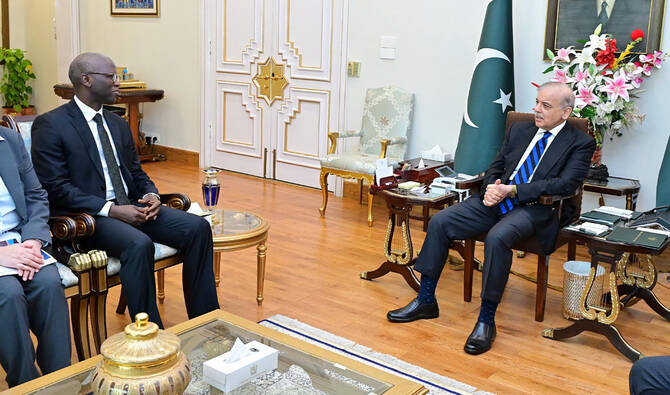

ISLAMABAD: Prime Minister Shehbaz Sharif on Thursday welcomed the World Bank’s position against India’s unilateral suspension of the Indus Waters Treaty (IWT), describing it as “principled support” for Pakistan during a meeting with the Bank’s regional vice president, Ousmane Dione, who is currently visiting the country.
The IWT, brokered by the World Bank and signed in 1960, governs water sharing between India and Pakistan. Earlier this year, New Delhi announced it was placing the treaty “in abeyance” following a militant attack in Indian-administered Kashmir that killed 26 tourists.
Indian authorities blamed the attack on Pakistan, a charge Islamabad denied while calling for a transparent and impartial international investigation.
The incident also triggered a four-day military standoff between the two nuclear-armed neighbors, which ended with a US-brokered ceasefire on May 10.
“The Prime Minister appreciated the World Bank’s principled support for Pakistan’s legitimate position in light of India’s unilateral and illegal actions to undermine a key international agreement like the Indus Waters Treaty,” said a statement issued by the Prime Minister’s Office after Sharif’s meeting with Dione.
“He reaffirmed Pakistan’s commitment to international law, the pursuit of prosperity, and the maintenance of regional peace, and expressed his resolve to address all issues through dialogue,” it added.
The World Bank’s stance aligns with comments made by its president, Ajay Banga, in May, when he clarified that the IWT contains no provision for unilateral suspension or withdrawal, and that any changes to the agreement must be made mutually by both India and Pakistan.
Banga also noted the Bank’s role in the treaty is strictly administrative, to appoint dispute-resolution experts and manage a trust fund when required, adding the institution has no authority to intervene in political decisions by either country.
During their meeting, Sharif and Dione discussed ongoing development cooperation, including the World Bank’s Country Partnership Framework (CPF), a strategic roadmap for investments in energy, education, governance reforms, and climate resilience.
The prime minister also thanked the Bank for its “swift and generous assistance” during Pakistan’s 2022 floods, which killed over 1,700 people, displaced millions and devastated agricultural land and public infrastructure.
Dione, the Bank’s regional vice president for the Middle East, North Africa, Afghanistan and Pakistan (MENAAP), reaffirmed his institution’s commitment to deepening its engagement with Pakistan.
He praised the country’s ongoing macroeconomic stabilization efforts and expressed confidence in the current administration’s reform agenda aimed at restoring investor confidence and promoting inclusive, sustainable growth.


