

One billion Africans being harmed by cooking pollution

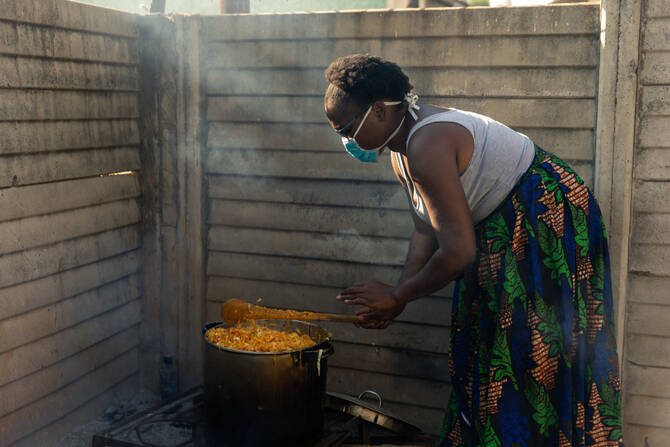
Two billion people across the world still cook on open fires or with rudimentary stoves fed by wood, charcoal, agricultural waste or manure, an International Energy Agency report says. (AFP file photo)
Short Url
Updated 21 July 2025
Follow

One billion Africans being harmed by cooking pollution

  • The IEA estimates that 815,000 premature deaths occur each year in Africa alone due to poor indoor air quality, largely resulting from a lack of access to clean cooking methods

PARIS: One billion Africans have to cook on open fires or with fuel that is hazardous to their health and the environment, the International Energy Agency said Friday.
The problem, which its report says can be easily solved, causes as much greenhouse gas emissions every year as the aviation industry.
Two billion people across the world still cook on open fires or with rudimentary stoves fed by wood, charcoal, agricultural waste or manure, the IEA report found.
"It is one of the greatest injustices of our time, especially in Africa," IEA head Fatih Birol told AFP, where four out of five households rely on open fires and burning wood.
These fuels pollute the air both indoors and outdoors with fine particles that penetrate the lungs and cause multiple respiratory and cardiovascular problems, the report said.
It also adds to the destruction of forests, natural sinks that trap carbon and help fight global warming.
The IEA estimates that 815,000 premature deaths occur each year in Africa alone due to poor indoor air quality, largely resulting from a lack of access to clean cooking methods.
Women and children suffer the most, spending hours each day searching for fuel and keeping the fire going.
This takes time away from paid employment or education, the report said.

A landmark IEA summit on the issue, held in Paris in May last year raised $2.2 billion in public and private sector commitments, as well as political pledges from 12 African governments.
Since then $470 million has been distributed, with concrete results already being seen, Birol insisted, citing a stove factory under construction in Malawi and an affordable stove programme developed in Uganda and Ivory Coast.
The IEA report assesses the progress made a year after the summit and sets out a roadmap for African countries to be able to use clean cooking methods at low cost before 2040.
Since 2010, nearly 1.5 billion people in Asia and Latin America, particularly in Brazil, India, and Indonesia, have got access to modern cooking stoves and fuels.
But the challenge remains immense in sub-Saharan Africa, where the number of people without access to clean cooking methods continues to grow.
"For once and for ever this problem can be solved with an annual investment of $2 billion per year," Birol said.
He stressed that the figure "is about 0.1 percent of global energy investment, which is nothing".
Alternative solutions are well known: electricity from solar panels, renewable gas and especially liquefied petroleum gas (LPG), a fossil fuel, which, while not ideal, is preferable than the loss of carbon sinks due to tree felling, Birol said.
The IEA said this would prevent 4.7 million premature deaths in sub-Saharan Africa by 2040 and reduce the continent's greenhouse gas emissions by 540 million tons per year, as much as the equivalent of the annual emissions of the global aviation sector.


Supporters of Venezuelan opposition leader María Corina Machado march in cities worldwide

Updated 07 December 2025
Follow

Supporters of Venezuelan opposition leader María Corina Machado march in cities worldwide

  • Machado went into hiding and has not been seen in public since January

CARACAS: Supporters of Venezuelan opposition leader María Corina Machado demonstrated Saturday in several cities worldwide to commemorate her Nobel Peace Prize win ahead of the prestigious award ceremony next week.
Dozens of people marched through Madrid, Utrecht, Buenos Aires, Lima and other cities in support of Machado, whose organization wants to use the attention gained by the award to highlight Venezuela’s democratic aspirations. The organization expected demonstrations in more than 80 cities around the world on Saturday.
The crowd in Lima carried portraits of Machado and demanded a “Free Venezuela.” With the country’s yellow, blue and red flag draped over their backs or emblazoned on their caps, demonstrators clutched posters that read, “The Nobel Prize is from Venezuela.”
Venezuelan Verónica Durán, who has lived in Lima for eight years, said Machado’s Nobel Peace Prize is celebrated because “it represents all Venezuelans, the fallen and the political prisoners in their fight to recover democracy.”
The gatherings come at a critical point in the country’s protracted crisis as the administration of US President Donald Trump builds up a massive military deployment in the Caribbean, threatening repeatedly to strike Venezuelan soil. Venezuela’s President Nicolás Maduro is among those who see the operation as an effort to end his hold on power, and the opposition has only added to this perception by reigniting its promise to soon govern the country.
“We are living through times where our composure, our conviction, and our organization are being tested,” Machado said in a video message shared Tuesday on social media. “Times when our country needs even more dedication because now all these years of struggle, the dignity of the Venezuelan people, have been recognized with the Nobel Peace Prize.”
Machado won the award Oct. 10 for her struggle to achieve a democratic transition in the South American nation, winning recognition as a woman “who keeps the flame of democracy burning amid a growing darkness.”
Machado, 58, won the opposition’s primary election and intended to run against Maduro in last year’s presidential election, but the government barred her from running for office. Retired diplomat Edmundo González, who had never run for office before, took her place.
The lead-up to the July 28, 2024, election saw widespread repression, including disqualifications, arrests and human rights violations. It all increased after the country’s National Electoral Council, which is stacked with Maduro loyalists, declared him the winner despite credible evidence to the contrary.
González sought asylum in Spain last year after a Venezuelan court issued a warrant for his arrest.
Meanwhile, Machado went into hiding and has not been seen in public since Jan. 9, when she was briefly detained after joining supporters in what ended up being an underwhelming protest in Caracas, Venezuela’s capital. The following day, Maduro was sworn in for a third six-year term.