Indian capital tightens anti-pollution measures as air quality worsens

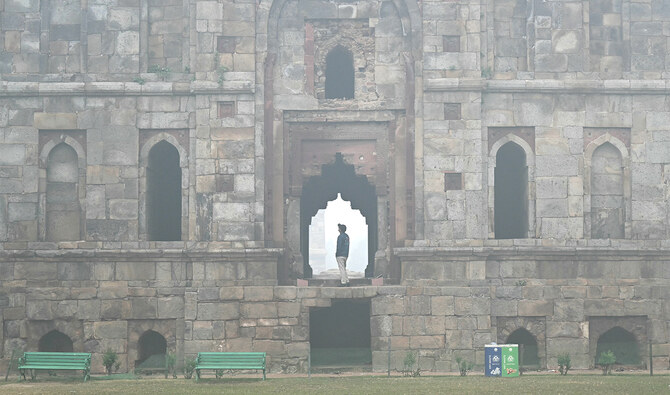
A man visits the Lodhi gardens on a cold smoggy morning in New Delhi on November 18, 2024. (AFP/File)
Short Url
Updated 16 December 2024
Follow

Indian capital tightens anti-pollution measures as air quality worsens

  • India directs schools to move to hybrid mode for some grades, asks government offices to stagger staff timings 
  • Government has also imposed restrictions on vehicles in Delhi and adjoining regions to control air pollution 

NEW DELHI: India directed schools to move to hybrid mode for some grades, asked government offices to stagger timings for staff and imposed restrictions on vehicles in Delhi and adjoining regions as air quality deteriorated in the country’s north on Monday.

Delhi recorded “very poor” air on Monday with an air quality index (AQI) reading of 379 in the 24 hours to midday, the Central Pollution Control Board said.

Pollution was expected to worsen on Tuesday to “severe” levels above an AQI reading of 400, which poses a risk to healthy people and seriously impacts those with existing diseases.

The restrictions were imposed “considering the highly unfavorable meteorological conditions including calm winds,” said the Commission for Air Quality Management (CAQM), which handles air quality in the national capital region.

Its order, among other measures, directed schools to conduct classes in hybrid mode — online and in-person — for students up to Grade 5, and asked the federal government to decide on staggering timings of its office hours.

North India battles intense air pollution every winter as cold air and low temperatures trap vehicular pollutants, construction dust, and smoke from farm fires set off illegally in the adjoining states of Punjab and Haryana.

Delhi recorded its highest pollution during this season last month when AQI readings shot up to 494, prompting the government to close schools and advise offices to allow 50 percent of employees to work from home. 


Philippines says China fired flares toward its patrol plane in the disputed South China Sea

Updated 5 sec ago
Follow

Philippines says China fired flares toward its patrol plane in the disputed South China Sea

  • “The Bureau of Fisheries and Aquatic Resources aircraft recorded video footage of three flares fired from the reef toward the aircraft during its lawful overflight,” said the Philippine coast guard
  • The Philippine patrol plane spotted a Chinese hospital ship, two Chinese coast guard ships and 29 suspected militia ships anchored in the waters off Subi

MANILA: Chinese forces fired three flares from an island toward a Philippine plane undertaking a routine patrol Saturday in the disputed South China Sea, but the incident did not cause any problem and the aircraft proceeded with its surveillance mission, the Philippine coast guard said.
It was not immediately clear how far the flares that Filipino officials said were fired from the Chinese-occupied Subi Reef were from the Cessna Grand Caravan aircraft of the Philippine fisheries bureau.
Chinese officials did not immediately comment on the incident, Beijing has claimed virtually the entire South China Sea, a key global trade route, and has vowed to staunchly defend its sovereignty. Chinese forces has fired flares from its occupied islands and from its aircraft as a warning for foreign planes to move away from what it calls its airspace in the disputed waters.
“The Bureau of Fisheries and Aquatic Resources aircraft recorded video footage of three flares fired from the reef toward the aircraft during its lawful overflight,” said the Philippine coast guard, which carried out Saturday’s surveillance flight with the fisheries agency.
“These flights aim to monitor the marine environment, assess the status of fisheries resources and ensure the safety and welfare of Filipino fishermen in the West Philippine Sea,” the coast guard said, using the Philippine name for the stretch of the South China Sea that Manila claims.
The Philippine patrol plane spotted a Chinese hospital ship, two Chinese coast guard ships and 29 suspected militia ships anchored in the waters off Subi, the Philippine coast guard said.
Subi is one of seven disputed and mostly submerged reefs which China turned more than a decade ago into what are now island bases in the Spratlys, the most hotly disputed region of the South China Sea. The artificial islands are protected by a missile system and three of them have military-grade runways, according to US and Philippine security officials.
Aside from Subi, the Philippine patrol plane flew near six other disputed islands, reefs and atolls, including Sabina, an uninhabited disputed shoal, where it monitored a Chinese navy ship. “This vessel repeatedly issued radio challenges against the Bureau of Fisheries and Aquatic Resources aircraft while it was flying well within Philippine sovereign rights,” the Philippine coast guard said.
“All safe and mission accomplished,” Jay Tarriela of the Philippine coast guard said of Saturday’s surveillance flight.
The United States has no territorial claims in the sea passage but has patrolled the waters for decades and repeatedly warned it’s obligated to defend the Philippines, its oldest treaty ally in Asia, if Filipino forces come under an armed attack, including in the South China Sea.
Vietnam, Malaysia, Brunei and Taiwan have also been involved in the long-seething disputes in the resource-rich waters.