Children most affected by worsening malnutrition in Gaza Strip

1 / 5
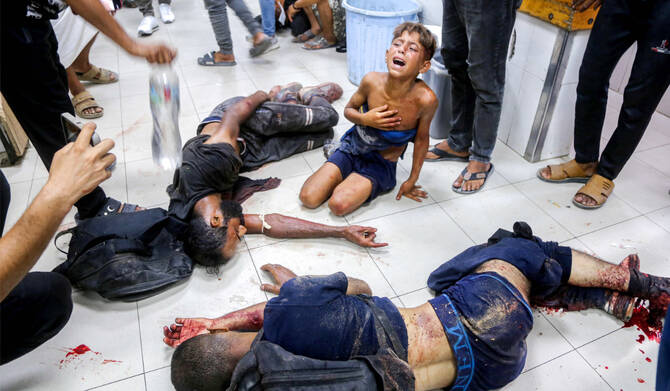
An injured boy reacts as he sits on the ground by other men who were all wounded while previously queueing for aid, at Nasser Medical Complex in Khan Yunis in the southern Gaza Strip on July 20, 2025. (AFP)
2 / 5
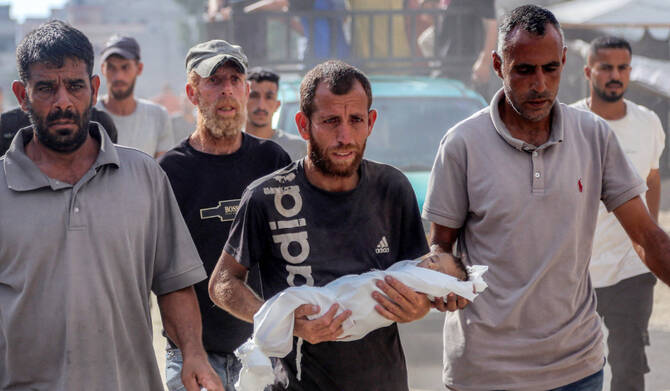
A man carries the body of Yahya Fadi al-Najjar, an infant who died due to malnourishment, during the funeral at Nasser Medical Complex in Khan Yunis in the southern Gaza Strip on July 20, 2025. (AFP)
3 / 5
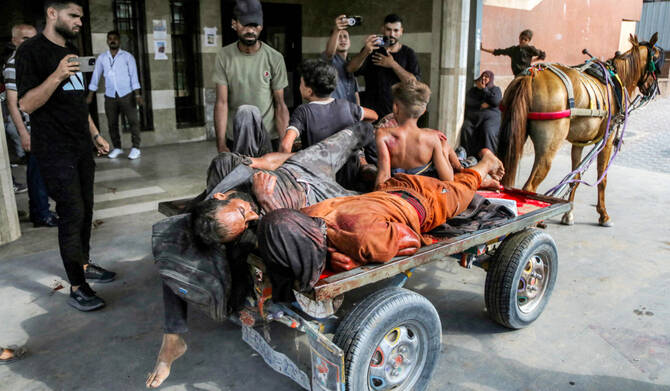
A horse-driven cart carrying injured people and the bodies of dead victims arrives at Nasser Medical Complex in Khan Yunis in the southern Gaza Strip on July 20, 2025. (AFP)
4 / 5
Mourners gather by the body of a young victim killed the previous day by Israeli bombardment during the funeral at Nasser Medical Complex in Khan Yunis in the southern Gaza Strip on July 20, 2025. (AFP)
5 / 5
The mother of Yahya Fadi al-Najjar, an infant who died due to malnourishment, mourns as she holds his body during the funeral at Nasser Medical Complex in Khan Yunis in the southern Gaza Strip on July 20, 2025. (AFP)
Short Url
Updated 21 July 2025
Follow

Children most affected by worsening malnutrition in Gaza Strip

  • The UN’s World Food Programme warned in early July that the price of flour for bread was 3,000 times more expensive than before the war began more than 21 months ago

NUSEIRAT: As malnutrition surges in war-torn Gaza, tens of thousands of children and women require urgent treatment, according to the UN, while aid enters the blockaded Palestinian territory at a trickle.
Gaza’s civil defense agency said it has noted a rising number of infant deaths caused by “severe hunger and malnutrition,” reporting at least three such deaths in the past week.
“These heartbreaking cases were not caused by direct bombing but by starvation, the lack of baby formula and the absence of basic health care,” civil defense spokesman Mahmud Bassal said.

FASTFACT

MSF said that patients at its Gaza clinics do not heal properly from their wounds due to protein deficiency.

Ziad Musleh, a 45-year-old father displaced from Gaza’s north to the central city of Nuseirat, said: “We are dying, our children are dying and we can’t do anything to stop it.”
“Our children cry and scream for food. They go to sleep in pain, in hunger, with empty stomachs. There is absolutely no food.
“And if by chance a small amount appears in the market, the prices are outrageous — no one can afford it.”
At a food distribution site in a UN-school-turned-shelter in Nuseirat on Sunday, children entertained themselves by banging on their plates as they waited for their turn.
Several of them had faces stretched thin by hunger, a journalist reported.
Umm Sameh Abu Zeina, whose cheekbones protruded from her thin face as she waited for food in Nuseirat, said she had lost 35 kg.
“We do not eat enough. I don’t eat, I leave the food I receive for my daughter,” she said, adding that she had a range of health conditions, including high blood pressure and diabetes.
Gazans as well as the UN and aid organizations frequently complain that depleted stocks have sent prices skyrocketing for what little food is available in the markets.

WFP condemns violence at food distribution points

In northern Gaza on Sunday, the Health Ministry, witnesses and a UN official said Israeli forces opened fire toward crowds who tried to get food from a 25-truck convoy that had entered the hard-hit area.
The World Food Program statement, which said the crowd surrounding its convoy “came under fire from Israeli tanks, snipers and other gunfire,” backs up those claims. The statement did not specify a death toll, saying only the incident resulted in the loss of “countless lives.”
“These people were simply trying to access food to feed themselves and their families on the brink of starvation,” it said, adding that the incident occurred despite assurances from Israeli authorities that aid delivery would improve. “Shootings near humanitarian missions, convoys and food distributions must stop immediately.” 


Two dead in UAE, 8 injured in Qatar from waves of Iranian strikes on Gulf neighbors

Updated 8 sec ago
Follow

Two dead in UAE, 8 injured in Qatar from waves of Iranian strikes on Gulf neighbors

  • UAE defense ministry said Iran fired 137 missiles and 209 drones at the territory
  • Qatar intercepted most of the 65 missiles and 12 drones launched by Iran, said officials

ABU DHABI: Explosions rocked cities across the Gulf on Saturday, killing two people in Abu Dhabi, while smoke and flames rose from Dubai landmark The Palm as Iran launched waves of attacks in retaliation for US and Israeli strikes.

The attacks hit airports in Abu Dhabi, Dubai and Kuwait, as well as Gulf military bases and residential areas, raising fears of a wider conflict and rattling a region long seen as a haven of peace and security.

Across the UAE, Iran fired 137 missiles and 209 drones at the territory, the country’s defense ministry said, as projectiles streaked across the skies of every Gulf state but Oman, a mediator in the recent US-Iran talks.

The UAE defense ministry said most of the missiles and drones were intercepted but at Abu Dhabi’s Zayed International Airport officials said at least one person was killed and seven wounded in an “incident.”

Earlier, falling debris killed a Pakistani civilian in Abu Dhabi, the United Arab Emirates’ capital, officials said.

At Dubai International Airport four people were injured according to airport authorities and four others were also hurt at the luxury Palm development.

In Qatar, officials said Iran launched 65 missiles and 12 drones toward the Gulf state, most of which were intercepted, but eight people were injured in the salvos, with one of them in critical condition.

“We are scared of what the future is for us now, and we can’t say how the next few days are going to be,” Maha Manbaz, a nursing student in Doha told AFP.

‘Terrified’

Smoke poured from US bases in Abu Dhabi and Bahrain’s capital Manama, home of the American navy’s Fifth Fleet, witnesses saw.

A drone struck Kuwait’s international airport and a base housing US personnel was targeted. Three Kuwaiti soldiers and 12 other people were wounded, authorities said.

After Iran’s Revolutionary Guards reported missile strikes, US Central Command (CENTCOM) said on X that no American naval vessels were hit, damage to US facilities was minimal, and no US casualties had been reported.

Residential buildings were also targeted in Manama, with officials saying firefighters and civil defense teams had been dispatched to the scene.

“The sound of the first explosion terrified me,” said a 50-year-old retiree living near the US base in Manama’s Juffair area, where residents were quickly evacuated.

The UAE, Saudi Arabia and Qatar warned they reserved the right to respond to the attacks.

The oil-and-gas-rich Arab monarchies, lying just across the Gulf from Iran, are long-term American allies and host a clutch of US military bases.

“The Gulf states are sandwiched between Iran and Israel, and have to bear the worst inclinations of both,” said Bader Al-Saif, an assistant professor at Kuwait University.

“Iran’s attacks on the Gulf are misplaced. They’ll only alienate its neighbors and invite further distancing from Iran,” he added.

Conflict is unusual in the Gulf, which has traded on its reputation for stability to become the Middle East’s commercial and diplomatic hub.

‘Significant damage’

The unprecedented barrage targeted Qatar’s Al Udeid base, the region’s biggest US military base, as well as Riyadh and eastern Saudi Arabia.

The UAE, Qatar and Kuwait all announced that their airspace was closed.

An AFP journalist in Qatar saw one missile destroyed in a puff of white smoke, while another in Dubai saw a volley of Patriot interceptors taking off.

Iran fired missiles at Al Udeid last June after US strikes targeted Iranian nuclear facilities during a brief war with Israel.

The escalation also saw Saudi Crown Prince Mohammed bin Salman and UAE President Mohamed bin Zayed speak for the first time since a public row in late December.

The Saudi de facto ruler called the Emirati president and the pair discussed Iran’s retaliatory strikes on the Gulf and expressed solidarity and sympathy.

In Kuwait, an Iranian missile attack caused “significant damage” to the runway at an air base hosting Italian air force personnel, Italian Foreign Minister Antonio Tajani was quoted by the ANSA news agency as saying.

Late on Saturday, Kuwaiti officials said a drone targeted a naval base there with air defense forces intercepting the projectile, according to a post by the defense ministry on X.

For many residents in the Gulf, which has drawn a cosmopolitan, largely expat population, the reaction was one of shock.

“I heard the explosions, I don’t know what I felt,” a Lebanese woman living in Riyadh told AFP.

“We came to the Gulf because it’s known to be safer than Lebanon. Now I don’t know what to do or how to think really.”