

El Salvador frees jailed Venezuelan migrants in US prisoner deal

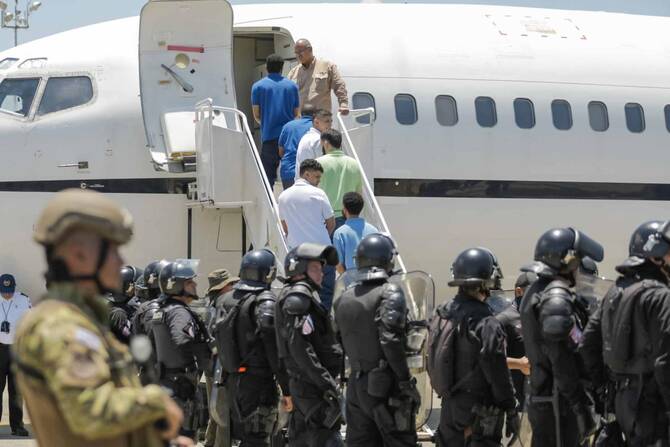
Venezuelan migrants who were jailed in El Salvador board a plane bound for Venezuela at the San Oscar Romero International Airport in San Luis Talpa, El Salvador on July 18, 2025. (El Salvador’s Presidency Press Office/AFP)
Short Url
Updated 19 July 2025
Follow

El Salvador frees jailed Venezuelan migrants in US prisoner deal

  • The 252 men were accused – without evidence – of being gang members and flown to the notorious ‘anti-terror’ jail last March
  • On Friday, after months of legal challenges and political stonewalling, the men arrived at an airport near Caracas

MAIQUETIA, Venezuela: Hundreds of Venezuelans swept up in Donald Trump’s immigration dragnet were abruptly freed from a maximum security Salvadoran jail and sent home as part of a prisoner swap Friday, ending a months-long high-profile ordeal.

The 252 men were accused – without evidence – of being gang members and flown to the notorious CECOT “anti-terror” jail last March.

There, they were shackled, shorn and paraded before cameras – becoming emblematic of Trump’s immigration crackdown and drawing howls of protest.

On Friday, after months of legal challenges and political stonewalling, the men arrived at an airport near Caracas.

The Trump administration said they were released in exchange for 10 Americans or US residents held in Venezuela, and an undefined number of “political prisoners.”

“Today, we have handed over all the Venezuelan nationals detained in our country,” Salvadoran President Nayib Bukele said on social media.

The migrants’ return to Venezuela sparked tearful celebrations from family members who had heard nothing from them in months.

“I don’t have words to explain how I feel!” said Juan Yamarte. “My brother (Mervin) is back home, back in Venezuela.”

Mervin’s mother said she could not contain her happiness. “I arranged a party and I’m making a soup,” she said.

The men had been deported from the United States under rarely used wartime powers and denied court hearings.

Exiled Salvadoran rights group Cristosal believes that just seven of the 252 men had criminal records.

Venezuelan leader Nicolas Maduro thanked Trump for “the decision to rectify this totally irregular situation.”

In the United States, families were also excited to see their loved ones return. One had been imprisoned for nearly a year.

Global Reach, an NGO that works for wrongly detained Americans, said one of the men freed was 37-year-old Lucas Hunter, held since he was “kidnapped” by Venezuelan border guards while vacationing in Colombia in January.

“We cannot wait to see him in person and help him recover from the ordeal,” it quoted his younger sister Sophie Hunter as saying.

Uruguay said one of its citizens, resident in the United States, was among those liberated after nine months in Venezuelan detention.

Another plane arrived at Maiquetia airport earlier Friday from Houston with 244 Venezuelans deported from the United States and seven children who Interior Minister Diosdado Cabello said had been “rescued from the kidnapping to which they were being subjected.”

The children were among 30 who Caracas says remained in the US after their Venezuelan parents were deported.

Clamping down on migrants is a flagship pursuit of Trump’s administration, which has ramped up raids and deportations.

It has agreed with Maduro to send undocumented Venezuelans back home, and flights have been arriving near daily also from Mexico, where many got stuck trying to enter the United States.

Official figures show that since February, more than 8,200 people have been repatriated to Venezuela from the United States and Mexico, including some 1,000 children.

The Venezuelans detained in El Salvador had no right to phone calls or visits, and their relatives unsuccessfully requested proof of life.

Bukele had CECOT built as part of his war on criminal gangs, but he agreed to receive millions of dollars from the United States to house the Venezuelans there.

Amnesty International, Human Rights Watch and other rights groups have denounced the detentions as a violation of human rights.


Trump's 'gold card' program goes live, offering US visas starting at $1 million per person

Updated 4 sec ago
Follow

Trump's 'gold card' program goes live, offering US visas starting at $1 million per person

  • The president said all funds taken in as part of the program will “go to the US”

WASHINGTON  — President Donald Trump announced Wednesday that his long-promised “ gold card ” was officially going on sale, offering legal status and an eventual pathway to U.S. citizenship for individuals paying $1 million and corporations ponying up twice that per foreign-born employee.
A website accepting applications went live as Trump revealed the start of the program while surrounded by business leaders in the White House's Roosevelt Room. It is meant to replace EB-5 visas, which Congress created in 1990 to generate foreign investment and had been available to people who spend about $1 million on a company that employs at least 10 people.
Trump sees the new version as a way for the U.S. to attract and retain top talent, all while generating revenue for federal coffers. He's been promoting the gold card program for months, and once suggested that each card would cost $5 million, though he more recently revised that to the $1 million and $2 million pricing scheme.
The president said all funds taken in as part of the program will “go to the U.S. government” and predicted that billions would flow into an account run by the Treasury Department “where we can do things positive for the country.”
The new program is actually a green card, effectively offering permanent legal residency with the chance for citizenship.
“Basically, it's a green card but much better," Trump said. “Much more powerful, a much stronger path.”
The president made no mention of requirements for job creation for applying corporations or on overall caps on the program, which exist under the current EB-5 program. Instead, he said he'd heard complaints from business leaders who had been unable to recruit outstanding graduates from U.S. universities because they were from other countries and lacked permission to stay.
“You can't hire people from the best colleges because you don't know whether or not you can keep the person,” Trump said.
Trump has built his political career around clamping down on the U.S.-Mexico border and championing hard-line immigration policies. His second administration spent its first 10-plus months launching mass deportation pushes and sweeping immigration crackdowns that have targeted cities including Los Angeles and Charlotte.
But he's also drawn criticism from leading voices of his “Make America Great Again” movement for repeatedly suggesting that skilled immigrants should be allowed into the U.S. — something the gold card program could facilitate.
Commerce Secretary Howard Lutnick said the program will include $15,000 for applicant vetting and that the thorough process used to scrutinize backgrounds would ”make sure these people absolutely qualify to be in America.” Companies will be able to receive multiple cards, but will be limited to one individual per card, he said.
Lutnick also said the current green card holders earn less money than the average American, and that Trump wanted to change that.
"So, same visas, but now just full of the best people,” Lutnick said.
Investors’ visas are common around the world, with dozens of countries offering versions of “golden visas” to wealthy individuals, including the United Kingdom, Spain, Greece, Malta, Australia, Canada and Italy.
Trump said the program means the U.S. is “getting somebody great coming into our country because we think these will be some tremendous people" and singled out top U.S. college graduates from China, India and France as among those who will possibly be receiving gold cards.
“The companies are going to be very happy,” he said.