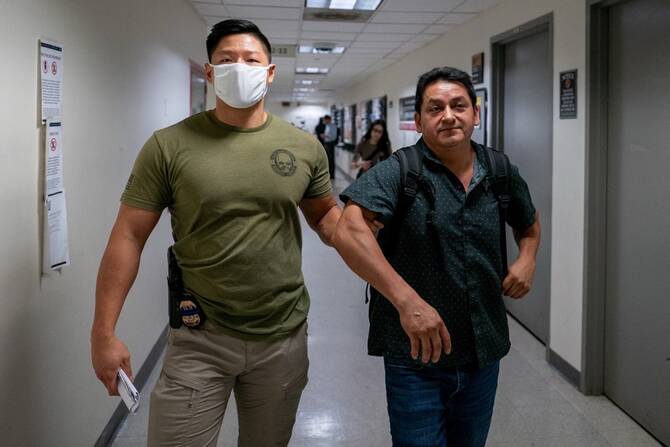
NEW YORK: In gloomy corridors outside a Manhattan courtroom, masked agents target and arrest migrants attending mandatory hearings — part of US President Donald Trump’s escalating immigration crackdown.
Trump, who campaigned on a pledge to deport many migrants, has encouraged authorities to be more aggressive as he seeks to hit his widely-reported target of one million deportations annually.
Since Trump’s return to the White House, Homeland Security agents have adopted the tactic of waiting outside immigration courts nationwide and arresting migrants as they leave at the end of asylum hearings.
Missing an immigration court hearing is a crime in some cases and can itself make migrants liable to be deported, leaving many with little choice but to attend and face arrest.
Armed agents with shields from different federal agencies loitered outside the court hearings in a tower block in central New York, holding paperwork with photographs of migrants to be targeted, an AFP correspondent saw this week.
The agents arrested almost a dozen migrants from different countries in just a few hours on the 12th floor of the Jacob K. Javits Federal Building.
Brad Lander, a city official who was briefly detained last month by ICE agents as he attempted to accompany a migrant targeted for removal, called the hearings “a trap.”
“It has the trappings of a judicial hearing, but it’s just a trap to have made them come in the first place,” he said Wednesday outside the building.
Lander recounted several asylum seekers being arrested by immigration officers including Carlos, a Paraguayan man who Lander said had an application pending for asylum under the Convention Against Torture — as well as a future court date.
“The judge carefully instructed him on how to prepare to bring his case to provide additional information about his interactions with the Paraguayan police and make his case under the global convention against torture for why he is entitled to asylum,” Lander said.
After his hearing, agents “without any identifying information or badges or warrants grabbed Carlos, and then quickly moved him toward the back stairwell,” he said.
Lander, a Democrat, claimed the agents were threatening and that they pushed to the ground Carlos’s sister who had accompanied him to the hearing.
The White House said recently that “the brave men and women of ICE are under siege by deranged Democrats — but undeterred in their mission.”
“Every day, these heroes put their own lives on the line to get the worst of the worst... off our streets and out of our neighborhoods.”
Back at the building in lower Manhattan, Lander said that “anyone who comes down here to observe could see... the rule of law is being eroded.”


‘A trap’ — Asylum seekers arrested after attending US courts
https://arab.news/y6qtm
‘A trap’ — Asylum seekers arrested after attending US courts


Iran war unsettles India’s packaged water makers as bottles, caps get pricey
- Higher polymer prices hurt bottled water industry
- Industry worth $5 billion has big multinational players like Pepsi, Coca-Cola
NEW DELHI: The Iran war is rattling India’s $5 billion packaged water market just ahead of the sweltering summer season.
One of the world’s fastest growing bottled water markets is seeing some manufacturers hike prices for distributors, as supply disruptions linked to the war fuel higher costs in everything from plastic bottles to caps, labels and cardboard boxes.
Though retail prices are yet to feel the heat and bigger companies are absorbing the pain, about 2,000 smaller bottled water makers have increased rates for their resellers by around 1 rupee per bottle, a 5 percent hike, which will rise by a further 10 percent in coming days, according to the Federation of All India Packaged Drinking Water Manufacturers’ Association.
Consumers usually pay less than 20 rupees, or around 20 US cents, for a one-liter bottle.
“There is chaos and within the next 4-5 days, this will start impacting customer prices,” said Apurva Doshi, the federation’s secretary general.
Rising oil prices have increased the cost of polymer, which is made from crude oil and is a key material for the industry’s plastic bottles. The cost of material used in making plastic bottles has risen by 50 percent to 170 rupees per kilogram, while the price of the caps has more than doubled to 0.45 rupees apiece. Even corrugated boxes, labels and adhesive tape are costing much more, industry letters showed.
Clean water is a privilege in the country of 1.4 billion people where researchers say 70 percent of the groundwater is contaminated, leaving people reliant on bottled water. Companies including Bisleri, Coca-Cola’s Kinley, Pepsi’s Aquafina, billionaire Mukesh Ambani’s Reliance and Tata all compete for a share of the $5 billion market. The companies did not respond to Reuters request for comment.
PREMIUM WATER FACES HEAT TOO
Within the broad bottled water market, natural mineral water is a $400 million business in India and a new, fast-growing wellness product for India’s wealthy.
The premium water segment accounted for 8 percent of the bottled water market last year in India, compared to just 1 percent in 2021, Euromonitor says.
Aava, which sells mineral water sourced from the foothills of the Aravalli mountains, has increased prices of its water bottles by 18 percent for resellers, Shiroy Mehta, CEO of the company, told Reuters.
“Most manufacturers are absorbing 40-50 percent of the cost to ensure that they don’t lose clients. It’s a poor situation for the beverage industry ahead of the summer season,” he said.
The mass market, however, is dominated by companies that produce “drinking water” to be sold in 1-liter bottles to customers. Clear Premium Water, a brand of India’s Energy Beverages, said in a notice to its distributors there had been an “unprecedented and continuous surge” in prices of key raw materials used in packaging and production.
“It is no longer possible for us to absorb the escalating costs while maintaining existing product prices,” the notice said.


